
The Complete CO2 Diffusers Guide: How to Choose and
The single unifying system model governing this problem
Your planted aquarium is a CO2 delivery system constrained by a dissolution bottleneck. Plants do not use CO2 bubbles. They use dissolved CO2 in the water column. If gas enters the tank faster than it dissolves and distributes, it escapes before plants can access it.
CO2 diffusers exist to solve one constraint: maximizing gas to water contact time so dissolution rate matches plant demand.
When growth stalls, algae appears, or fish gasp, the issue is rarely “CO2 on or off.” It is almost always the dissolution bottleneck.
Everything in this guide maps back to that model: effective CO2 systems are limited by how efficiently gas dissolves and spreads.
Quick Summary (Beginner)
A CO2 diffuser breaks pressurized CO2 into tiny bubbles so more gas dissolves before reaching the surface.
In most tanks, poor diffusion leads to wasted CO2, unstable pH swings, uneven plant growth, and algae problems.
This explains why simply increasing bubble rate rarely fixes growth issues. If bubbles are large or poorly distributed, the gas escapes.
A good diffuser improves dissolution efficiency. Good placement improves distribution. Stable CO2 levels widen the growth stability envelope.
CO2 success is not about more gas. It is about better dissolution.
What a CO2 Diffuser Actually Does
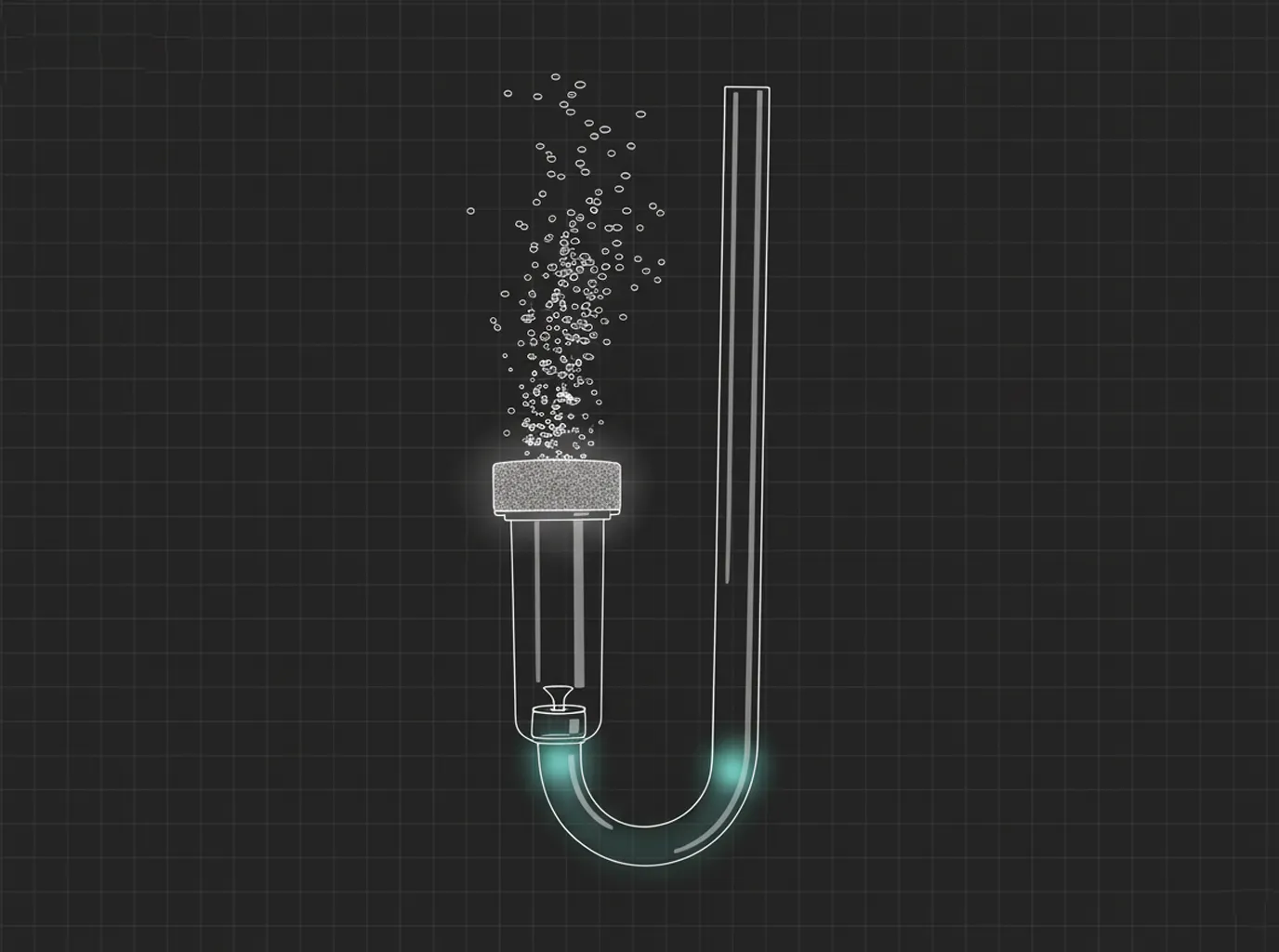
If you look closely at a planted tank running CO2, you will see a stream of microbubbles rising from a ceramic disc or inline reactor. It looks simple.
What you are seeing is an attempt to increase surface area.
Gas dissolves into water at the interface between the two. Smaller bubbles have more total surface area relative to volume. More surface area increases dissolution rate before the bubble reaches the surface.
In practice, large bubbles shoot upward and escape. Fine mist lingers and dissolves.
This is why diffuser quality matters. The bottleneck is not pressure. It is contact efficiency.
Reconnect to the model: diffusion exists to widen the dissolution bottleneck.
Why CO2 Diffusion Fails in Many Tanks
When this starts appearing, plants may pearl weakly or only near the diffuser. Algae may form in dead zones. Bubble counters may show high output but growth remains inconsistent.
In most tanks, failure happens for one of three reasons:
The diffuser produces bubbles that are too large. Flow does not distribute dissolved CO2 evenly. Or the system pushes gas faster than it can dissolve.
All three connect back to the same constraint.
Large Bubble Size
If ceramic pores clog or are low quality, bubbles increase in size. Larger bubbles rise faster and dissolve less.
You will often notice visible streams shooting straight to the surface.
This explains why cleaning diffusers restores performance. The pore structure determines dissolution efficiency.
Poor Circulation
Even if dissolution is efficient at the diffuser, dissolved CO2 must travel through the entire tank.
In practice, tanks with strong localized mist but weak circulation show uneven plant response. Foreground thrives while background struggles.
This is usually where aquarists misdiagnose nutrient deficiency. The issue is uneven CO2 distribution.
Reconnect again: dissolution without distribution does not widen the bottleneck fully.
Excess Injection Without Efficiency
Increasing bubble rate without improving diffusion raises gas concentration near the outlet but wastes the rest.
Almost always, fish stress under these conditions is not caused by total CO2 level alone. It is caused by local concentration spikes.
This explains why aggressive bubble rates can harm livestock without improving plant growth.
Types of CO2 Diffusers and How They Address the Bottleneck
In planted tanks, different diffuser designs attempt to solve the same problem through different mechanical approaches.
In Tank Ceramic Diffusers
These sit inside the aquarium and push gas through a ceramic disc.
If you have ever seen a fine mist cloud spreading from a glass diffuser, you have seen high surface area diffusion.
In most tanks, these work well up to moderate sizes. Their limitation is maintenance. Ceramic pores clog with biofilm and mineral deposits.
This is why periodic bleaching restores microbubble size.
Inline Diffusers
Inline diffusers sit on the filter outflow hose. Gas dissolves before entering the tank.
In practice, inline units create less visible mist but often achieve higher dissolution efficiency because gas mixes under pressure in a closed chamber.
This explains why larger tanks often benefit from inline systems. They integrate dissolution with flow.
Reactors
Reactors trap gas in a chamber and force water to mix with it until dissolved.
If you look closely at reactor driven systems, you may not see bubbles at all. That is the point.
Reactors attempt to eliminate escape entirely by maximizing contact time.
Reconnect again: reactors widen the dissolution bottleneck by preventing premature surface loss.
Atomizers and Spray Bar Integration
Some systems integrate CO2 into spray bars, increasing turbulence and distribution.
In most tanks, distribution improvements can be as impactful as bubble size improvements.
This explains why diffuser placement relative to filter output often matters more than brand.
How To Diagnose CO2 Diffuser Problems
When plant growth feels inconsistent, start by observing bubble behavior before adjusting anything.
Are bubbles fine and mist like, or large and coarse. Do they travel across the tank or rise straight upward.
You will often notice that strong pearling occurs only near the diffuser. That indicates distribution limitation.
Measure pH drop across the photoperiod. In most high tech tanks, a drop of about 1.0 indicates adequate dissolved CO2 relative to KH.
If pH drop is minimal despite high bubble rate, dissolution efficiency is likely poor.
This is usually the point when aquarists realize they have been increasing injection instead of improving diffusion.
Reconnect to the model: measure outcome, not bubble count. Dissolution rate defines usable CO2.
How To Improve CO2 Diffusion
Improving diffusion is rarely about buying more equipment immediately. It is about optimizing dissolution and flow.
Clean the Diffuser
Ceramic pores clog invisibly over time. Soak in diluted bleach, rinse thoroughly, and neutralize before reuse.
In practice, restored pore integrity reduces bubble size dramatically.
Adjust Placement
Position diffusers under filter outflow so microbubbles circulate throughout the tank before reaching the surface.
You will often notice improved plant response across all zones when flow integration improves.
Optimize Flow Pattern
Dead spots trap low CO2 water.
Ensure circulation carries dissolved CO2 behind hardscape and into corners.
This is why flow and diffusion are inseparable in high tech tanks.
Match Injection to Demand
High light drives high CO2 demand. Low light systems require less.
Almost always, instability comes from mismatch between light intensity and CO2 stability.
Reconnect once more: dissolution must match plant uptake. Excess without efficiency narrows stability margin.
Prevention Strategy
CO2 systems perform best when maintenance and monitoring are consistent.
In most tanks, stable injection timing matters more than peak injection volume. Use a solenoid and timer to begin CO2 before lights on.
Monitor pH drop rather than chasing bubble count.
Clean diffusion components regularly. Check tubing and check valves for leaks.
This is what prevents silent efficiency loss. Diffusers degrade gradually, not suddenly.
Stable dissolution widens plant growth stability and reduces algae pressure.
System Interactions
CO2 diffusion interacts with nearly every subsystem in a planted tank.
Light
Higher light increases carbon demand. Insufficient diffusion under high light leads to carbon limitation and algae opportunity.
Nutrients
Plants require carbon as the backbone of growth. Without adequate dissolved CO2, even perfect fertilization fails.
Filtration and Flow
Filter turnover determines distribution efficiency.
In most tanks, strong turnover enhances CO2 spread. Weak flow creates local bottlenecks.
Substrate
Dense plantings can restrict circulation near substrate level. CO2 must reach root zones and carpeting plants.
Stability
CO2 fluctuations destabilize pH and stress fish.
Stable diffusion ensures gradual pH shifts rather than abrupt spikes.
Reconnect again: diffusion quality determines stability ceiling in high tech planted tanks.
Advanced: Mechanism and Gas Exchange
CO2 dissolves according to Henry’s Law. Higher pressure and greater surface area increase dissolution.
Once dissolved, CO2 forms carbonic acid and equilibrates with bicarbonate based on KH.
Gas exchange at the surface also removes CO2. High agitation increases loss. Low agitation retains gas but reduces oxygen.
In practice, balance is required. Too much surface agitation wastes CO2. Too little risks oxygen limitation.
This is why dissolution must be efficient before adjusting surface movement.
Advanced: System Stability Analysis
Think of CO2 systems in three layers.
Layer 1: Efficient dissolution through microbubble size or reactor contact time.
Layer 2: Effective distribution via flow pattern.
Layer 3: Stable injection timing relative to light cycle.
If one layer fails, plants suffer even if others are strong.
In most tanks, algae outbreaks trace back to inconsistent carbon availability rather than nutrient excess.
This explains why stable CO2 often resolves multiple visible issues simultaneously.
CO2 diffusion is not an accessory. It is a throughput limiter in high demand planted systems.
Common Myths
More bubbles does not equal more dissolved CO2.
Visible mist is not required if dissolution is efficient through reactors.
Expensive diffusers do not outperform proper placement and maintenance.
Fish gasping does not always mean too much CO2. It can mean poor oxygen balance.
FAQ
Why are my bubbles large and noisy? Ceramic pores may be clogged or low quality.
Why do plants pearl only near the diffuser? Distribution is uneven.
Can I overshoot CO2 with a good diffuser? Yes. Efficiency increases dissolved concentration quickly.
How often should I clean a diffuser? Many tanks benefit from monthly cleaning, but observation is key.
Do inline diffusers waste less CO2? Often yes, because dissolution occurs under pressure before release.
Related Guides
CO2 and pH Stability Explained
How To Lower pH Safely
RO Water for Planted Tanks
High Light vs Low Light Systems
Why Ammonia Spikes in Planted Tanks
Clean URL suggestion: /freshwater/co2/co2-diffusers-guide