
Algae in Planted Tanks: The Complete Beginner's Guide
Quick Summary (Beginner)
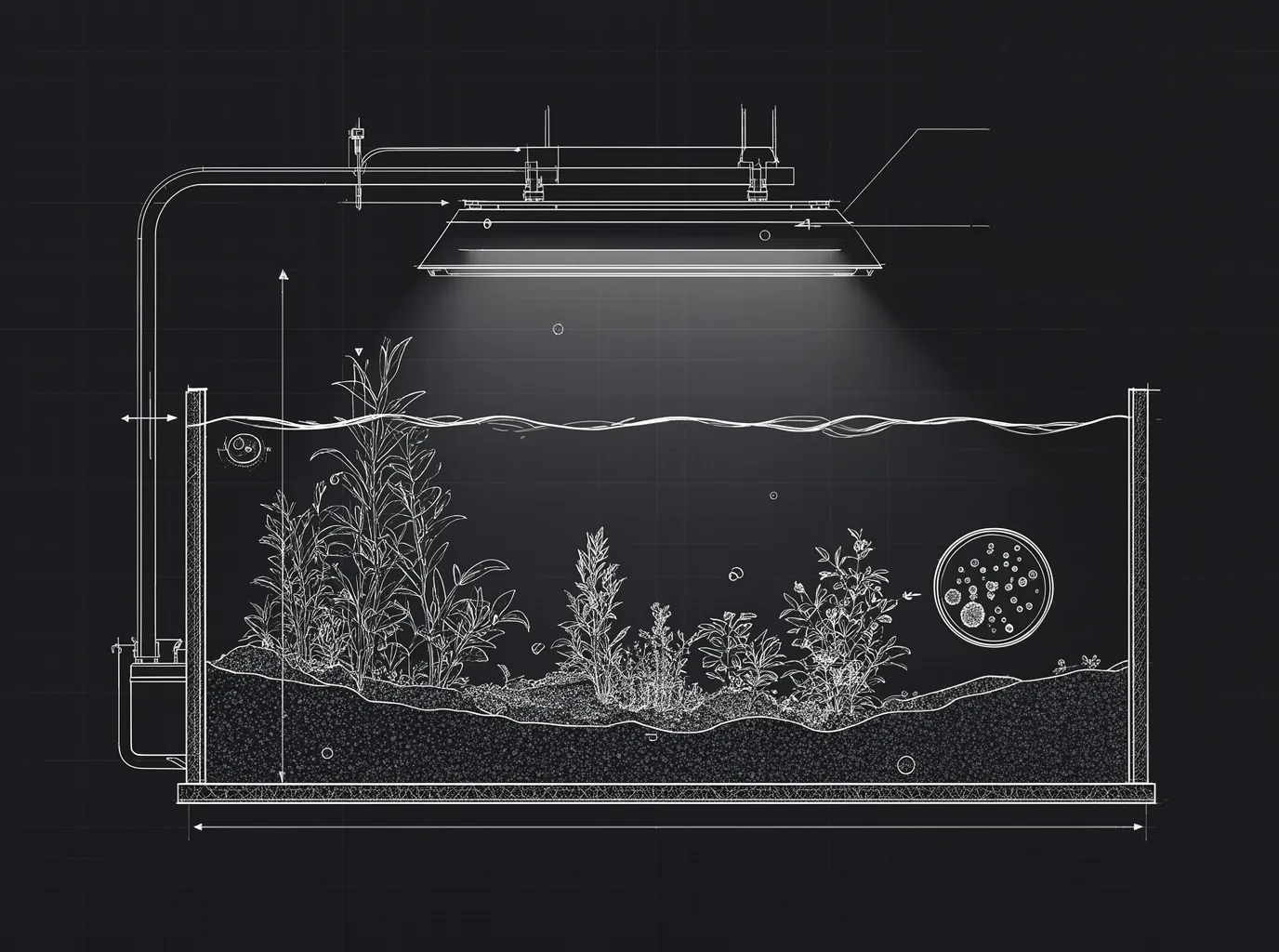
Algae appears in every planted tank, especially during the first few months of setup. This is completely normal and doesn't mean you've failed. In most tanks, algae grows when plants cannot utilize available resources (light, nutrients, CO₂) efficiently, creating an opportunity for algae establishment.
The condition signals system imbalance rather than standalone problem. Unlike treating diseases, you cannot cure algae without addressing underlying environmental conditions. This is usually the point when beginners panic and consider tearing down their tank, but patience combined with systematic adjustment resolves most algae issues within 6 to 12 weeks.
Algae thrives when resources exceed plant consumption capacity. You'll often notice algae appearing after specific changes (new lighting, adjusted fertilization, CO₂ fluctuations) or during tank maturation before plants fully establish. Small amounts of algae actually indicate healthy living ecosystem providing food for microfauna and contributing to nutrient cycling.
Immediate actions to take:
- Reduce lighting duration to 6 to 7 hours daily using timer (from typical 8 to 10 hours)
- Maintain 30 to 50 percent weekly water changes removing organics and resetting nutrients
- Improve circulation eliminating dead zones where algae establishes
- Manually remove visible algae during water changes (scrape glass, trim affected leaves)
- Avoid dramatic changes to multiple parameters simultaneously (choose one adjustment, observe 2 weeks)
When not to panic:
- Light green dusting on glass appearing within weeks of setup (normal new tank process)
- Small amounts on older lower leaves while new growth stays clean (natural leaf aging)
- Brief algae spike after major changes like rescaping or new equipment (temporary instability)
- Minor algae presence during first 2 to 3 months (very normal maturation phase)
When to take action:
- Algae spreading rapidly covering multiple plant leaves weekly
- Plants showing poor health (yellowing, melting, stunted growth)
- Specific persistent algae types like black beard algae or staghorn indicating system issues
- Algae returning repeatedly after manual removal (root cause unaddressed)
What Is Algae?
When you look into any natural pond, stream, or aquarium, you'll see algae in some form. These simple photosynthetic organisms exist in virtually every aquatic environment on Earth.
Algae differ fundamentally from aquatic plants despite both performing photosynthesis. Algae lack true roots, stems, or leaves, absorbing nutrients directly across cell membranes. They grow opportunistically wherever conditions permit photosynthesis and reproduction without requiring complex vascular systems or specialized tissues.
In planted tanks, algae compete directly with your plants for identical resources.
Shared resource competition:
Light provides energy for photosynthesis in both plants and algae. CO₂ serves as primary carbon source for tissue building. Nutrients including nitrogen, phosphorus, and micronutrients fuel growth and metabolism. Physical space on surfaces (glass, leaves, hardscape) offers attachment sites and light access.
When plants grow healthily and actively, they consume these resources efficiently leaving minimal excess. Algae struggle establishing under these conditions facing overwhelming competition. However, when resources remain available while plants cannot utilize them, algae thrive filling the ecological niche.
This reveals the fundamental principle driving planted tank algae dynamics. Algae appear when excess resources exist relative to plant consumption capacity. The solution focuses on optimizing plant growth rather than eliminating algae food sources.
Why Algae Happens
Most beginners encounter contradictory algae advice creating confusion about actual causes. Once you understand the system dynamics, prevention becomes straightforward.
The Balance Principle
In planted tanks, algae appearance indicates environmental imbalance rather than isolated problems.
Common simplified advice treats algae as single-cause issues. Too much light causes algae. Excess nutrients cause algae. Insufficient CO₂ causes algae. These statements contain partial truth but miss crucial context.
The reality involves dynamic balance between three primary factors: light intensity and duration, CO₂ availability and consistency, and nutrient levels and ratios. When these factors align with plant capacity for utilization, plants dominate. When misalignment occurs, algae opportunity emerges.
Common imbalance scenarios:
Several specific combinations create algae-favorable conditions in planted tanks.
High light combined with low CO₂ limits plant photosynthesis despite abundant light energy. Plants cannot process available light without adequate carbon source. Unused light energy and resulting stress create algae opportunity.
High light with inadequate nutrients starves plants preventing growth despite energy availability. Nutrient-limited plants cannot build new tissue even with light and CO₂. Algae requiring lower nutrient concentrations establishes successfully.
High nutrients combined with low light and no CO₂ leaves nutrients unused in water column. Plants grow slowly under light limitation unable to consume available nutrients. Algae utilizing these excess nutrients proliferate.
Inconsistent conditions stress plants repeatedly preventing stable competitive growth. Daily parameter fluctuations (variable CO₂, irregular fertilization, changing photoperiod) weaken plant defenses. Algae exploit these vulnerability windows.
This is why you cannot eliminate algae through single parameter adjustment. The pattern reveals whenever plants cannot use available resources effectively, algae establish. Your goal involves creating conditions where plants consume resources so efficiently that algae cannot compete.
Common Algae Types and What They Reveal
When specific algae types appear in your tank, they signal particular imbalances revealing diagnostic information. Learning identification helps target corrections.
Green Dust Algae (GDA)
Most aquarists first encounter green dust algae as fine film coating glass surfaces.
Visual identification: Appears as uniform dusty green layer on glass resembling light green powder. Easily wiped away leaving clear glass underneath. Reappears within days during active growth phase.
System signal: Often indicates new tank settling with fluctuating nutrient levels or inconsistent CO₂. Also appears after major parameter changes while system rebalances. Generally resolves naturally as stability develops.
Practical response: Wipe glass during regular water changes maintaining visibility. Typically self-resolves within 4 to 8 weeks as tank matures. Not major concern unless persistent beyond 3 months.
Green Spot Algae (GSA)
In planted tanks, green spot algae creates distinctive hard circular spots requiring mechanical removal.
Visual identification: Small hard circular green spots firmly attached to glass and plant leaves. Requires razor blade or credit card edge for removal from glass. Spots range 1 to 3 millimeters diameter.
System signal: Usually indicates low phosphate levels (under 1 ppm) or inconsistent CO₂. Can also appear under very high light intensity exceeding plant processing capacity.
Practical response: Check phosphate levels aiming for 1 to 2 ppm. Ensure consistent CO₂ delivery if injecting. Scrape spots from glass using razor blade. Remove heavily spotted leaves allowing plant to produce fresh growth.
Hair Algae and Thread Algae
Most beginners struggle with hair algae due to rapid growth and widespread distribution.
Visual identification: Long thin green strands growing on plants, hardscape, and substrate. Individual strands reach 2 to 10 centimeters. Easily removed by twisting onto toothbrush or tweezers. May form floating mats if abundant.
System signal: Often indicates excess organics from overfeeding or poor circulation. Inconsistent CO₂ and inadequate flow create favorable conditions. Common in new tanks during first 8 weeks.
Practical response: Manual removal twisting algae onto toothbrush during water changes. Improve circulation ensuring flow reaches all tank areas. Stabilize CO₂ if injecting. Increase water change frequency temporarily (2 times weekly) exporting organics. Consider adding Amano shrimp consuming hair algae effectively.
Black Beard Algae (BBA)
In most tanks, black beard algae signals specific CO₂ and circulation deficiencies requiring targeted correction.
Visual identification: Dark brown to black fuzzy tufts appearing on leaf edges, slow-growing plants, hardscape, and equipment. Firmly adhered requiring aggressive removal. Individual tufts range 2 to 10 millimeters. Turns reddish when treated with hydrogen peroxide confirming identity (red algae despite dark color).
System signal: Strongly correlated with low or unstable CO₂ relative to light intensity. Also indicates poor flow in affected areas creating localized CO₂ deficiency. Appears in tanks with inadequate CO₂ distribution despite adequate average levels.
Practical response: Address CO₂ consistency using timer maintaining stable 25 to 30 ppm throughout photoperiod. Improve circulation aiming filter output toward BBA-prone areas. Spot treat existing BBA with Excel (glutaraldehyde) or hydrogen peroxide application. Remove heavily affected leaves as plants produce fresh growth. Prevention requires maintaining stable CO₂ and adequate flow permanently.
Blue-Green Algae (Cyanobacteria)
Despite the name, blue-green algae represents bacteria rather than true algae requiring different approach.
Visual identification: Slimy blue-green to brownish film covering substrate and plants. Peels off in sheets when disturbed. Produces distinctive unpleasant smell. Can trap air bubbles underneath creating bubbling appearance.
System signal: Indicates poor circulation, low oxygen levels, excess organics, or very low nitrate levels (under 5 ppm). Thrives in stagnant low-nutrient conditions where true plants and algae struggle.
Practical response: Manually remove sheets during water changes using siphon. Improve circulation dramatically adding powerhead if needed. Ensure adequate nitrate levels maintaining 10 to 20 ppm. Increase surface agitation improving oxygen. Can treat with erythromycin antibiotic as last resort though system correction preferred.
Brown Algae (Diatoms)
New tank owners frequently encounter brown diatoms during initial weeks after setup.
Visual identification: Brown dusty coating appearing on all surfaces including glass, substrate, plants, and decorations. Easily wiped away though returns quickly during bloom phase. Feels slightly gritty when rubbed due to silica cell walls.
System signal: Very common in new tanks feeding on silicates leaching from fresh substrate and tap water. Indicates new tank maturation rather than imbalance. Usually self-resolves within 4 to 8 weeks as silicate depletes.
Practical response: Patience proves most effective strategy. Diatoms typically disappear naturally after 4 to 8 weeks. Can wipe from glass during water changes maintaining visibility. Adding otocinclus catfish or nerite snails accelerates removal. Not concern unless persisting beyond 12 weeks suggesting ongoing silicate input.
How to Diagnose Your Specific Algae Issue
When algae appears in your tank, systematic diagnosis reveals underlying causes enabling targeted correction. Once you identify patterns, adjustment becomes clear.
Step 1: Identify Algae Type
Examine algae closely under good lighting noting color, texture, location, and growth pattern.
Use descriptions from previous section matching characteristics. Take photos comparing to reference images if needed. Consider multiple algae types may coexist indicating several imbalances. Record when algae first appeared and growth progression.
Step 2: Review Current Parameters
Check all relevant system parameters documenting actual values versus targets.
Lighting assessment: Measure photoperiod duration (hours daily). Estimate intensity based on fixture specifications and mounting height. Note any recent lighting changes (new fixture, raised or lowered position, altered schedule).
CO₂ evaluation (if injecting): Check drop checker color at photoperiod start, middle, and end. Confirm bubble rate consistency. Verify timer functioning correctly. Note cylinder pressure indicating remaining gas supply.
Nutrient testing: Test nitrate targeting 5 to 20 ppm for planted tanks. Test phosphate targeting 1 to 2 ppm. Consider comprehensive test if plants show deficiency symptoms. Record water change frequency and volume.
Step 3: Assess Plant Health
Healthy plants represent your primary algae defense requiring evaluation before algae-specific interventions.
Observe growth rate noting new leaf production frequency (healthy plants produce new leaves weekly). Examine leaf color looking for bright healthy green versus pale or yellowing. Check new growth for normal size and vigor versus stunted development. Watch for pearling (oxygen bubbles on leaves) during peak photoperiod indicating strong photosynthesis.
If plants struggle with poor growth, yellowing, or stunted development, they cannot compete against algae effectively. Address plant health issues before expecting algae improvement.
Step 4: Look for Patterns and Triggers
In practice, algae appearance correlates with specific events or conditions revealing causation.
Consider recent tank changes made within 2 to 4 weeks before algae appeared. New lighting, changed fertilizer schedule, CO₂ adjustment, rescaping, or missed maintenance often precede outbreaks. Note whether algae distributes uniformly or concentrates in specific areas (dead zones, high-light zones, low-flow areas). Observe correlation with particular locations or plant types.
Step 5: Determine Likely Imbalance
Use tank age and symptoms narrowing diagnosis to probable causes.
New tanks (0 to 8 weeks old): Likely settling microbiology, inconsistent parameters, and incomplete cycling. Diatoms and green dust algae most common. Solution requires stability and patience allowing natural maturation.
Algae on glass only: Minor imbalance with plants generally healthy. Solution involves slight light reduction or photoperiod decrease maintaining routine otherwise.
Algae on slow-growing plant leaves: Older leaves outcompeted while new growth stays clean. Natural aging process especially on Anubias and Java fern. Solution requires trimming affected leaves and maintaining overall plant health.
Sudden algae explosion: Recent parameter change likely caused outbreak. Solution involves reverting change and stabilizing system. Consider what changed 1 to 3 weeks before outbreak.
Persistent BBA or staghorn: Low or unstable CO₂ relative to light intensity. Solution requires improving CO₂ consistency or reducing light intensity creating better balance.
Cyanobacteria appearance: Poor flow, low oxygen, or insufficient nitrates. Solution involves increasing circulation, surface agitation, and nitrate levels.
How to Fix Algae
When algae establishes in your tank, systematic phased approach produces reliable results. Once you implement changes, patience allows system rebalancing.
Phase 1: Stabilize (Weeks 1 to 2)
Early intervention focuses on immediate stabilization preventing worsening conditions.
Reduce light duration to 6 to 7 hours daily: Use timer ensuring perfect consistency. Keep intensity moderate without adjustment initially. Shorter photoperiod reduces total available energy while maintaining sufficient light for plant survival. This single change often provides dramatic algae reduction within 2 weeks.
Establish consistent maintenance routine: Perform water changes same day weekly maintaining predictability. Dose fertilizer on identical schedule (after water change or split evenly across week). Maintain CO₂ levels consistent if injecting (same bubble rate and timing daily).
Improve water circulation throughout tank: Adjust filter output eliminating visible dead zones. Aim flow at algae-prone areas. Ensure gentle plant movement in all areas indicating adequate circulation. Add supplemental powerhead if existing filter inadequate.
Manual algae removal during maintenance: Remove visible algae by hand during water changes preventing spore release. Scrape glass clean using algae scraper or credit card edge. Trim heavily affected leaves rather than attempting cleaning (plants produce fresh growth quickly). Siphon out removed algae immediately preventing reattachment.
Perform 30 to 50 percent water changes weekly: Large water changes remove excess organics accumulating in water column. Reset nutrient levels preventing excessive buildup. Export free-floating algae spores reducing recolonization. Provide fresh minerals supporting plant health.
Phase 2: Optimize (Weeks 3 to 6)
After initial stabilization, fine-tune parameters optimizing plant growth while maintaining algae suppression.
Ensure adequate nutrient availability: Target nitrate 10 to 20 ppm supporting active plant growth. Maintain phosphate 1 to 2 ppm preventing deficiency-related algae. Dose comprehensive all-in-one fertilizer consistently (not randomly or when remembered). Test parameters verifying levels match targets.
Verify effective CO₂ delivery (if injecting): Aim for 25 to 30 ppm throughout entire photoperiod. Drop checker should display light green color consistently. Activate CO₂ 1 to 2 hours before lights ensuring full saturation at photoperiod start. Monitor bubble rate consistency checking daily for changes indicating issues.
Monitor plant growth as primary indicator: Healthy plants represent foundation of algae control. New leaf production weekly indicates adequate conditions. Bright green coloration confirms sufficient nutrients and light. If plants struggle despite parameter adjustment, diagnose plant issues before expecting algae resolution.
Gradually increase light duration if plants healthy: Add 30 minutes weekly observing response. Stop increasing at 7 to 8 hours for most planted tanks (high-tech systems) or 6 to 7 hours (low-tech systems). Only increase if plants display vigorous healthy growth without algae worsening. Reduce immediately if algae returns.
Phase 3: Maintain Long-Term (Ongoing)
After system stabilizes with reduced algae, consistent maintenance prevents recurrence.
Prioritize consistency above all else: Maintain same weekly schedule without skipping or irregular timing. Avoid frequent parameter adjustments causing instability. Keep fertilizer dosing and water changes identical week to week. Only change one parameter at a time observing 2 to 3 weeks before additional adjustments.
Simplify routines for sustainability: Complex regimens fail due to inconsistent execution. Simple repeatable routines succeed through reliable application. Choose straightforward fertilizer schedule (once weekly after water change works well). Avoid constantly adjusting dosing chasing perfect numbers.
Accept minor algae as normal: Small amounts indicate healthy living ecosystem. Minor glass dusting or occasional leaf spots normal and manageable. Perfection neither achievable nor necessary. Focus on overall balance rather than zero algae.
Prevention Strategy
Once your tank stabilizes with minimal algae, following core principles maintains long-term balance. In practice, prevention requires less effort than repeated treatment.
Match Light to Plant and CO₂ Capacity
Light intensity must align with plant requirements and available CO₂ preventing excess energy.
Low-tech tanks without CO₂ injection require low to moderate light intensity (20 to 40 PAR). Photoperiod should stay 6 to 7 hours daily. Lower light reduces CO₂ demand matching atmospheric levels naturally dissolved at surface.
High-tech tanks with consistent CO₂ injection tolerate moderate to high light (40 to 80 PAR). Photoperiod extends to 7 to 8 hours daily. Higher light utilization requires proportional CO₂ and nutrient availability.
Start conservative with lower intensity and shorter duration. Increase gradually only if plant growth inadequate. Easier preventing algae through conservative lighting than correcting outbreaks from excessive light.
Dose Nutrients Consistently
Regular predictable fertilization supports steady plant growth preventing deficiency-induced vulnerability.
Use comprehensive all-in-one fertilizer containing both macro and micronutrients. Dose after water changes (entire weekly amount) or split across week (divided into daily doses). Never skip weeks or randomly increase doses attempting to "catch up." Inconsistency creates fluctuations stressing plants.
Avoid excessive nitrogen or phosphorus attempting to boost growth. Excess nutrients unused by plants remain available for algae. Follow manufacturer recommendations initially adjusting only if testing reveals deficiencies.
Maintain CO₂ Consistency (If Using)
In most tanks with CO₂ injection, consistency matters more than absolute levels for algae prevention.
Use timer synchronized with lighting ensuring identical daily schedule. Activate CO₂ 1 to 2 hours before photoperiod start allowing full saturation. Maintain stable bubble rate counting periodically confirming consistency. Monitor drop checker placement ensuring representative reading (moderate flow area, mid-water depth).
Check for leaks monthly using soapy water on connections. Replace cylinder before complete depletion preventing pressure drop and delivery inconsistency. Clean diffuser monthly maintaining fine bubble production for efficient dissolution.
Establish Reliable Routine
Consistency in maintenance creates stability preventing algae-triggering fluctuations.
Perform water changes same day weekly (choose day you reliably have time). Clean glass before water changes removing accumulated algae preventing spore release. Trim plants regularly removing old declining leaves before heavy algae colonization. Remove debris during water changes preventing organic accumulation.
Mark calendar or set phone reminder ensuring consistent schedule. Skipped maintenance accumulates creating instability. Regular attention prevents problems better than intensive intervention correcting neglect.
Stock Cleanup Crew Appropriately
Algae-eating organisms supplement manual removal without replacing good practices.
Nerite snails consume most algae types including green dust, diatoms, and green spot. Stock 1 per 10 gallons. They cannot reproduce in freshwater preventing overpopulation.
Amano shrimp excel at hair algae and detritus removal. Stock 1 per 5 to 10 gallons. Require hiding places and peaceful tankmates. Cannot survive cycling phase (add after tank establishes).
Otocinclus catfish specialize in diatoms and soft algae. Stock groups of 4 to 6. Require established tanks with biofilm and algae food. Sensitive to poor water quality requiring stable parameters.
These organisms help manage minor growth but cannot overcome system imbalances. They represent supplemental tools rather than solutions.
Prioritize Plant Health Above All
Healthy fast-growing plants provide best long-term algae prevention available.
Choose plant species appropriate for your lighting and CO₂ setup. Low-light plants for low-tech tanks, moderate to high-light plants for CO₂-injected systems. Provide adequate light intensity for selected species without excess. Fertilize consistently supporting growth without deficiency symptoms. Maintain stable conditions avoiding frequent dramatic changes. Plant densely creating competition for resources (aim for 70 percent substrate coverage minimum).
System Interactions
In planted tanks, algae control depends on understanding how all system components interact rather than manipulating isolated variables. Understanding these relationships enables effective prevention.
Light
Light intensity and duration determine total energy available for both plant and algae photosynthesis.
Higher light (over 50 PAR) increases plant photosynthesis rate demanding proportional CO₂ and nutrients. If CO₂ or nutrients cannot match demand, plants become stressed while algae utilizing lower resource levels thrive. Lower light (20 to 40 PAR) reduces plant energy and subsequent CO₂ and nutrient requirements. Plants grow slower but system tolerates lower CO₂ and simpler fertilization.
Duration multiplies intensity effects. Eight hours at 40 PAR provides 320 PAR-hours daily. Same intensity for 6 hours provides only 240 PAR-hours (25 percent reduction). This is why photoperiod adjustment proves powerful algae control tool. Reduce total energy without eliminating light completely.
CO₂
CO₂ availability affects plant growth capacity and competitive ability against algae.
Adequate stable CO₂ (25 to 30 ppm in injected tanks, 3 to 5 ppm in low-tech from atmosphere) allows plants utilizing available light and nutrients efficiently. Insufficient CO₂ limits photosynthesis despite adequate light creating unused energy and nutrients. Fluctuating CO₂ stresses plants daily while algae adapt more readily to changing conditions.
This is why CO₂ consistency matters more than absolute level. Stable 20 ppm supports better plant growth than fluctuating 30 ppm. Plants adapt to steady conditions while variation prevents full acclimation.
Interestingly, low-tech tanks without CO₂ injection often show less algae than poorly managed high-tech tanks. Low light matches low atmospheric CO₂ creating balance. High light with unstable CO₂ creates severe imbalance favoring algae.
Nutrients
Nutrient availability affects plant health and algae opportunity differently than commonly assumed.
Adequate nutrients (nitrate 10 to 20 ppm, phosphate 1 to 2 ppm, comprehensive micros) support healthy plant growth and strong algae resistance. Insufficient nutrients limit plant growth despite adequate light and CO₂. Deficient plants grow slowly with poor defenses allowing algae establishment.
Excess nutrients alone don't cause algae if plants grow vigorously consuming them. However, unused nutrients provide opportunity for algae when plant growth limited by other factors (low light, insufficient CO₂). This explains why nutrient reduction strategy fails. Limiting nutrients weakens plants without improving their competitive position.
Substrate
Substrate quality affects plant nutrition and system stability particularly during initial months.
Nutrient-rich substrates (aquasoil, dirted) provide root nutrition supporting plant growth independent of water column fertilization. They release organics initially (first 4 to 8 weeks) potentially fueling algae during this transition period. After settling, they support excellent plant growth suppressing algae.
Inert substrates (sand, gravel) provide minimal nutrition requiring water column or root tab supplementation. They avoid initial organic release but demand active fertilization maintaining plant health. Work well for rhizome plants (Anubias, Java fern) absorbing nutrients from water rather than substrate.
Filtration
Filtration affects algae through circulation, organic removal, and system stability maintenance.
Adequate flow (5 to 10 times tank volume per hour) distributes CO₂ and nutrients evenly preventing dead zones. Mechanical filtration removes particulate organics and some free-floating algae spores. Biological filtration processes ammonia and nitrite while establishing beneficial bacteria competing with algae for resources.
Filter maintenance directly impacts performance. Clogged media reduces flow creating dead zones and poor CO₂ distribution. Monthly cleaning maintains design flow rate preventing gradual circulation degradation enabling algae establishment.
Stability
System stability determines algae resistance beyond matching specific parameter targets.
Stable mature tanks resist algae despite minor parameter fluctuations or occasional maintenance lapses. Established plant communities, mature bacterial populations, and consistent conditions create resistance against opportunistic algae. Unstable tanks with frequent changes, irregular maintenance, or equipment issues show high algae vulnerability despite temporarily matching target parameters.
This is why patience matters for new tanks. Biological maturation requires 8 to 12 weeks regardless of parameter matching. Rush creates instability while patience allows natural equilibrium development.
Advanced: Mechanism & Biology
In planted tanks, understanding algae and plant competition at cellular level reveals why certain strategies succeed while others fail.
Why Algae Initially Outcompete Plants
Algae possess several advantages in new or unstable tank environments.
Reproduction rate greatly favors algae in fluctuating conditions. Algae reproduce through cell division completing cycles in hours under favorable conditions. Single algae cell becomes millions within days. Plants grow through complex differentiation requiring days to weeks producing new leaves. They cannot respond rapidly to temporary resource availability.
Simpler structure reduces resource requirements. Algae lack vascular systems, complex tissues, or specialized organs. They absorb nutrients directly across cell membranes without transport infrastructure. This simplicity allows faster response to available resources. Plants must develop roots, stems, and leaves before effective resource utilization.
Lower resource threshold enables establishment in marginal conditions. Algae photosynthesize at lower light levels and minimal nutrient concentrations. Plants require higher minimums for sustained growth. Initial colonization occurs while plants still establishing.
Opportunistic growth pattern exploits instability. Algae reproduce explosively when temporary resource abundance occurs. Plants respond slowly unable to capitalize on brief favorable periods. Each fluctuation favors algae over slower-responding plants.
Why Plants Eventually Win in Stable Systems
Once plants establish in consistent conditions, they gain competitive advantages suppressing algae.
Allelopathy provides chemical warfare capability. Some plants release compounds inhibiting algae growth and reproduction. Established plant communities create chemical environment hostile to algae establishment. This develops over weeks as plants mature.
Resource monopolization physically excludes algae. Dense plant growth shades surfaces preventing algae light access. Extensive root systems dominate substrate nutrients. Water column nutrients depleted by vigorous plant growth leave minimal excess for algae.
Stable nutrient cycling favors plant roots over algae. Mature substrate develops bacterial communities supporting plant nutrient uptake. Biofilm on roots assists nutrient absorption while inhibiting algae attachment. These relationships require time establishing explaining new tank vulnerability.
The Microbial Community Role
Mature tanks develop complex bacterial communities affecting algae beyond simple nutrient competition.
Beneficial bacteria colonize all surfaces creating biofilm. This biofilm physically prevents algae spore attachment to substrates, hardscape, and plant surfaces. Surface colonization race strongly favors first colonizers (bacteria over algae in healthy systems).
Bacterial communities break down organic compounds that would otherwise fuel algae heterotrophic growth. Some bacteria produce compounds directly inhibiting algae reproduction. Others compete so effectively for dissolved nutrients that algae face starvation despite apparent nutrient presence.
This is why patience matters fundamentally. Bacterial community maturation requires 8 to 16 weeks regardless of nutrient dosing or parameter matching. Artificial acceleration proves difficult. Natural succession proceeds at biological pace requiring time.
Advanced: System Stability Analysis
Examining why some tanks resist algae while others struggle persistently reveals stability principles beyond parameter matching.
New Tank Maturation Timeline
Most aquarists notice predictable algae patterns during tank establishment reflecting biological succession.
Weeks 0 to 3 show bacterial colonization with parameters fluctuating daily. Ammonia and nitrite appear then gradually decline as nitrogen cycle establishes. Diatoms commonly appear feeding on silicates from new substrate. Plants focus on root development with minimal visible growth. This represents normal establishment phase requiring patience.
Weeks 4 to 8 display settling into balance with potential algae spikes. Cycling completes with stable zero ammonia and nitrite. Nutrient levels stabilize from substrate leaching. Green algae varieties (dust, spot, hair) may appear as system finds equilibrium. Plants begin active growth producing new leaves regularly.
Weeks 8 to 16 show mature system establishing with declining algae. Plant growth accelerates with developing root systems. Bacterial communities mature occupying surfaces and preventing algae attachment. Algae presence decreases noticeably if proper parameters maintained. System develops resilience tolerating minor fluctuations.
Month 4 onwards represents stable ecosystem with minimal algae under good practices. Plants dominate resource consumption. Biofilm and bacterial communities establish comprehensively. System resists algae even with occasional maintenance lapse or parameter deviation. This stability represents goal requiring time rather than forcing.
The CO₂ Consistency Factor
CO₂ relationship to algae proves more nuanced than simple correlation.
Low CO₂ doesn't directly cause algae despite common belief. However, insufficient CO₂ limits plant photosynthesis preventing efficient light and nutrient utilization. Plants cannot use available resources leaving them accessible for algae consumption. Additionally, stressed plants release organic compounds algae can utilize heterotrophically.
Inconsistent CO₂ proves worse than steady low levels. Plants adapt to stable conditions even if suboptimal. Daily fluctuations prevent adaptation forcing continuous stress response. Each stress period weakens competitive ability. Algae exploit vulnerability windows. This explains why low-tech tanks without CO₂ often show less algae than poorly managed high-tech systems.
Black beard algae specifically correlates with CO₂ instability in moderate to high light. It appears in areas with poor CO₂ circulation, tanks where CO₂ depletes mid-photoperiod, and systems with fluctuating bubble rates. The solution requires consistency over absolute level.
Distribution Patterns Reveal Causes
In practice, where algae appears reveals causation as much as which type appears.
Uniform distribution across all surfaces suggests tank-wide imbalance (excessive light, general nutrient issues, complete CO₂ absence). Algae in low-flow areas (behind hardscape, tank corners) indicates circulation deficiency creating dead zones. Algae in high-light zones only suggests light intensity excessive for current CO₂ and nutrient capacity.
Algae on slow-growing plants (Anubias, Java fern) while fast-growers remain clean indicates these plants cannot compete effectively. Not necessarily system imbalance but species limitation. Sudden widespread algae after specific change (new light, fertilizer adjustment, CO₂ modification) clearly correlates change to outbreak guiding correction.
Common Myths About Algae
Myth 1: "Reduce light to eliminate algae"
Reality: Light reduction slows everything including plant growth. While temporarily effective, it treats symptom rather than cause. Better approach optimizes light relative to CO₂ and nutrients creating balance. Healthy plants under appropriate light suppress algae more effectively than dim lighting suppressing both plants and algae.
Myth 2: "Add more plants to outcompete algae"
Reality: Only works if conditions support plant growth. Adding plants to unbalanced system creates unhealthy plants plus algae. Plants require adequate light, nutrients, and stability before competing effectively. Fix system first, then add plants as conditions improve.
Myth 3: "Algae eaters will fix algae problem"
Reality: Cleanup crew manages minor growth without addressing root causes. They represent maintenance tools rather than solutions. Even large cleanup crew cannot overcome system imbalance. Snails, shrimp, and fish supplement good practices without replacing them.
Myth 4: "UV sterilizers or chemical treatments cure algae"
Reality: These kill free-floating algae spores without fixing environmental imbalance. Algae return when treatment stops because favorable conditions persist. Additionally, attached algae (most problematic types) remain unaffected by UV sterilization. Chemical treatments risk harming plants and beneficial bacteria.
Myth 5: "Mature tanks don't get algae"
Reality: Mature tanks show less algae and greater resistance. However, major changes (new lighting, missed maintenance, equipment failure, significant rescaping) still trigger algae spikes. Maturity provides buffer against minor fluctuations but not immunity against significant disturbances.
Myth 6: "Starve algae by limiting nutrients"
Reality: Algae survive at much lower nutrient levels than plants. Nutrient limitation weakens plants more than algae creating worse competitive position. Imbalanced nutrient ratios can trigger specific algae types. Better approach maintains adequate nutrients while optimizing plant utilization through proper light and CO₂.
FAQ
Q: How long until algae disappears after adjustments?
A: Visible improvement typically occurs within 2 to 4 weeks after proper parameter adjustments. Complete resolution of persistent algae requires 6 to 12 weeks as system stabilizes biologically. New tanks show significant improvement around month 3 to 4 as maturation completes. Patience proves essential as biological processes cannot be rushed.
Q: Should I perform blackout treating algae?
A: Blackouts (covering tank 3 to 5 days) reduce algae temporarily while stressing plants. Only recommended for severe cyanobacteria outbreaks unresponsive to circulation and nutrient correction. Not primary strategy for typical algae. Address system imbalance rather than attempting brute force elimination.
Q: Can I use chemicals like glutaraldehyde or hydrogen peroxide?
A: These products work for spot treating persistent algae like black beard algae. Use as supplemental tools rather than primary solutions. Address system imbalance simultaneously or algae returns after treatment. Follow dosing carefully as overdose harms plants and beneficial bacteria. Excel (glutaraldehyde) and 3 percent hydrogen peroxide both work when applied correctly.
Q: Why does my tank have algae but my friend's doesn't?
A: Every system proves unique with different lighting, substrate, plant species, CO₂, maintenance routine, and tap water composition affecting algae susceptibility. Additionally, tank age matters as mature systems resist algae better than new setups. Focus on optimizing your specific system rather than copying others. What works in one tank may not directly translate.
Q: Is some algae actually beneficial?
A: Yes, minor algae growth indicates healthy living ecosystem. It provides food for microfauna, contributes to nutrient cycling, and creates biofilm supporting overall system health. Goal involves balanced algae presence not detracting from aesthetics or plant health. Zero algae neither achievable nor necessary for success.
Q: My plants covered in algae. Should I remove them?
A: If leaves heavily covered, they cannot photosynthesize effectively. Trim worst-affected leaves allowing plant to focus energy on new growth. Leave healthy foliage supporting continued photosynthesis. Plants recover quickly once system imbalance corrects. Removing entire plants unnecessary unless completely overwhelmed.
Q: Do water changes help with algae?
A: Yes, water changes help indirectly through multiple mechanisms. They remove excess organics reducing algae food sources. Reset nutrient levels preventing excessive accumulation. Export free-floating algae spores reducing recolonization. Maintain stability through consistent mineral replenishment. Regular 30 to 50 percent weekly water changes represent one of best preventive measures available.
Q: I'm doing everything right but still have algae. Why?
A: Several possibilities explain persistent algae despite apparent correct practices. Parameters may look good on paper but fluctuate day-to-day (need continuous monitoring not snapshots). Distribution problems exist (CO₂ or flow inadequate in specific zones despite overall adequacy). Light intensity exceeds current plant mass capacity (reduce intensity or increase plant density). System hasn't matured yet (patience required for biological establishment). Tap water introduces phosphates or silicates (test source water). Revisit all variables systematically rather than assuming correctness.
Q: Can I prevent algae completely in new tank?
A: No, new tanks experience algae during maturation regardless of setup quality. Biological succession proceeds naturally as bacteria colonize, plants establish, and parameters stabilize. Expect diatoms and green algae during first 8 weeks. This represents normal process not failure. Proper setup minimizes severity and duration but cannot eliminate occurrence entirely.
Q: Does algae harm my fish?
A: Most algae types prove harmless to fish directly. They produce oxygen during day through photosynthesis (beneficial). However, heavy algae coverage blocks plant growth reducing overall oxygen production long-term. Decomposing algae consumes oxygen potentially causing issues in severely algae-covered tanks. Cyanobacteria can produce toxins in extreme cases. Generally, algae represents aesthetic and plant health issue rather than fish health concern.
Related Guides
- Complete Planted Tank Guide: Start here if you're new to planted tanks
- Algae Control Guide: Advanced strategies and detailed algae species information
- Aquarium Lighting Guide: Understanding PAR, spectrum, and photoperiod
- CO₂ in Planted Tanks: Setting up and managing CO₂ injection
- Water Parameters Guide: Testing and maintaining optimal water chemistry
- Black Beard Algae Guide: Detailed BBA identification and treatment
- Green Spot Algae Guide: GSA causes and removal strategies
Key takeaway: Algae represents system feedback indicating imbalance rather than standalone problem requiring elimination. It appears when plants cannot utilize available resources (light, CO₂, nutrients) efficiently creating opportunity for algae establishment. Control algae through optimizing plant growth conditions (appropriate lighting 6 to 7 hours daily, consistent CO₂ if injecting, adequate nutrients 10 to 20 ppm nitrate and 1 to 2 ppm phosphate, good circulation, regular 30 to 50 percent weekly water changes) rather than attempting resource elimination. Accept minor algae as normal healthy ecosystem indicator while maintaining balance preventing problematic overgrowth. Patience during first 8 to 12 weeks allows natural tank maturation where plants dominate and algae becomes background presence.