
CO₂ Guide for Planted Aquariums
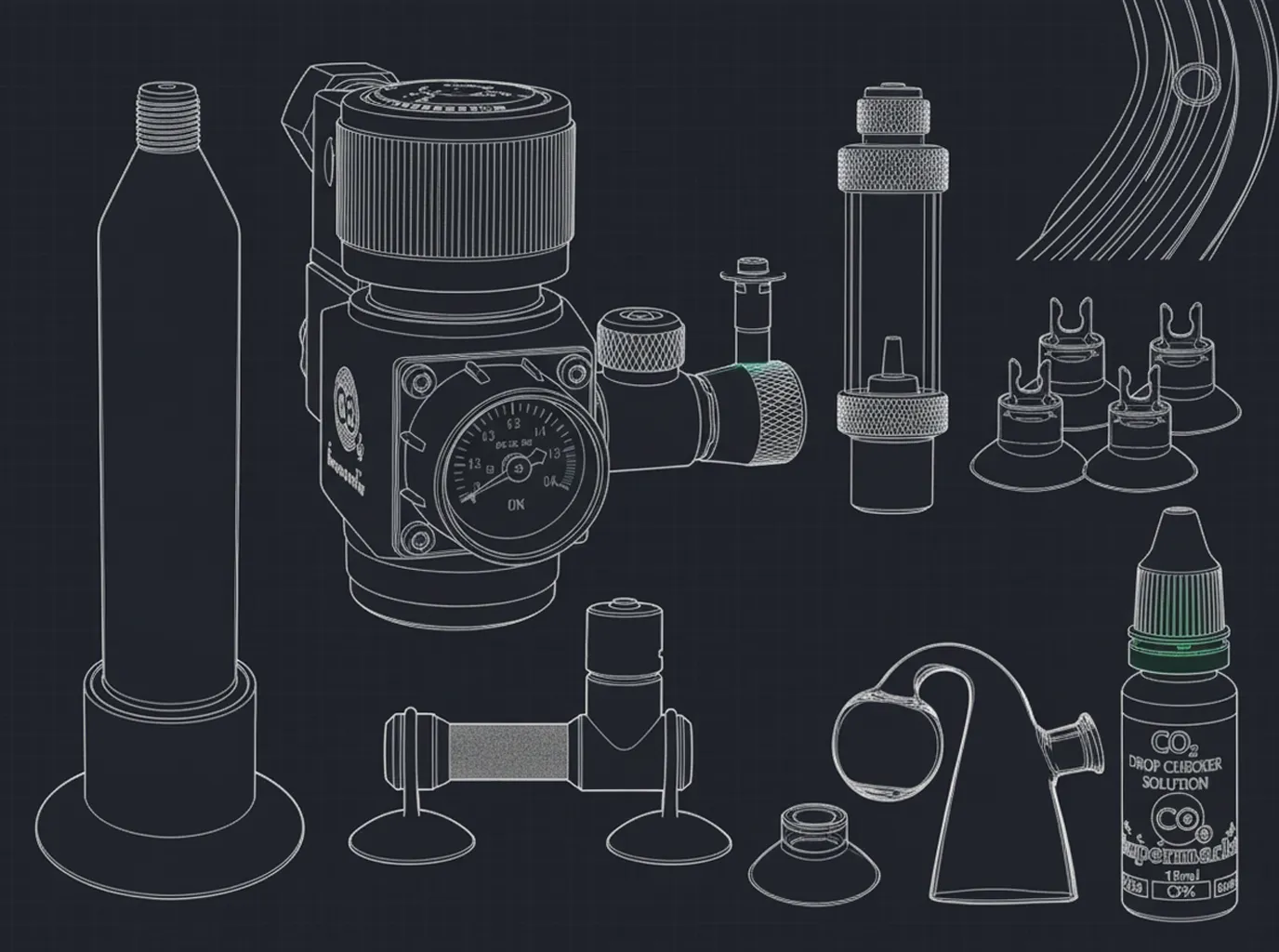
CO₂ injection transforms planted aquariums, enabling faster growth, vibrant colors, and access to demanding plant species. This comprehensive guide covers everything from equipment selection to advanced optimization techniques.
What you'll learn:
- How CO₂ works in planted tanks (chemistry and plant biology)
- Complete equipment selection (cylinders, regulators, diffusers)
- Installation and setup process (step-by-step)
- Tuning and optimization (achieving 20-30 ppm safely)
- Drop checker usage and interpretation
- Troubleshooting common problems
- Safety considerations
- Cost analysis and ongoing maintenance
- Advanced techniques (inline diffusion, reactors, automation)
Prerequisites: This guide assumes you understand basic planted tank concepts. If you're deciding whether to use CO₂, read Do I Need CO₂? first.
How CO₂ Works in Planted Tanks
The Role of CO₂ in Photosynthesis
Plants use CO₂ as their primary carbon source for growth:
Light + CO₂ + H₂O + Nutrients → Sugars + O₂
Carbon makes up 40-50% of a plant's dry weight. It's the most important raw material for growth, more than any other nutrient.
Natural CO₂ Levels
Without injection, aquariums contain 2-5 ppm CO₂ from:
- Fish respiration
- Bacterial decomposition
- Atmospheric exchange at surface
This is sufficient for low-light setups where plants photosynthesize slowly.
Why Inject CO₂?
With moderate to high lighting (50+ PAR), plants photosynthesize rapidly and demand more CO₂ than naturally available.
Without supplemental CO₂ in high light:
- Plants become CO₂-limited (photosynthesis bottlenecked)
- Can't use available light and nutrients efficiently
- Stressed plants → algae opportunity
With CO₂ injection (20-30 ppm):
- Plants photosynthesize at full capacity
- Faster growth, healthier appearance
- Better coloration (reds, pinks develop)
- All plant species accessible
- Plants outcompete algae
How CO₂ Dissolves in Water
When CO₂ gas dissolves, it forms carbonic acid:
CO₂ + H₂O ⇌ H₂CO₃ (carbonic acid)
This equilibrium reaction:
- Lowers pH (more H⁺ ions)
- Is reversible (when CO₂ stops, pH rises)
- Is buffered by KH (carbonate hardness)
Daily pH swing with CO₂:
- Lights on, CO₂ on: pH 6.8
- Lights off, CO₂ off: pH 7.3
This 0.5-1.0 pH swing is normal and safe for fish/plants.
Complete CO₂ System Components
1. CO₂ Cylinder (Tank)
Function: Stores compressed CO₂ gas
Types:
Disposable cartridges:
- Small (20g - 95g)
- Convenient but expensive long-term
- Suitable for nano tanks only
- Not recommended for standard setups
Refillable cylinders:
- 2.5 lb, 5 lb, 10 lb, 20 lb sizes
- Aluminum or steel
- Refillable at welding supply shops, beverage suppliers
- Cost-effective long-term
Size recommendations:
- Nano tanks (5-10 gal): 2.5 lb
- Small tanks (10-20 gal): 2.5-5 lb
- Medium tanks (20-55 gal): 5 lb
- Large tanks (55-120 gal): 10 lb
- Very large (120+ gal): 20 lb
Lifespan (5 lb cylinder on 40 gal tank): 3-6 months typically
Cost: $50-150 depending on size (new), $15-25 per refill
2. CO₂ Regulator
Function: Reduces high pressure (800+ psi in cylinder) to working pressure (10-30 psi)
Essential features:
Dual-stage regulation:
- Two pressure reduction stages
- Prevents "end-of-tank dump" (pressure spike when cylinder nearly empty)
- More stable bubble rate
- Worth the investment
Solenoid valve:
- Electromagnetic valve
- Controls CO₂ on/off via timer
- Essential for daily automation
- Turns on 1-2 hours before lights, off when lights turn off
Needle valve:
- Fine adjustment of CO₂ flow
- Controls bubble rate precisely
- Must be high quality (smooth, precise control)
Pressure gauges:
- High-pressure gauge (cylinder pressure, 0-3000 psi)
- Low-pressure gauge (working pressure, 0-100 psi)
- Monitor cylinder level and output pressure
Optional features:
- Check valve (prevents water backflow)
- Built-in bubble counter
- Multiple outputs (for multiple tanks)
Cost: $80-300
- Budget: $80-120 (single-stage, may have end-of-tank dump risk)
- Mid-range: $120-180 (dual-stage, reliable)
- Premium: $180-300+ (dual-stage, refined needle valve, extra features)
Recommended brands:
- CO2Art Pro-SE (excellent mid-range)
- GLA GRO (premium)
- Fzone (budget)
- AQUATEK (mid-range)
3. Bubble Counter
Function: Visualizes CO₂ flow rate (bubbles per second)
Types:
- Integrated (built into regulator or diffuser)
- External (inline between regulator and diffuser)
Usage: Fill halfway with water. Count bubbles passing through.
Typical rates:
- Small tanks: 1-2 bps (bubbles per second)
- Medium tanks: 2-4 bps
- Large tanks: 4-6+ bps
Cost: $5-15 if separate
4. Diffuser
Function: Dissolves CO₂ gas into water
Types:
Ceramic disc diffuser:
- Creates fine bubbles through porous ceramic
- Most common type
- Place in area with good flow
- Needs weekly cleaning (algae clogs pores)
- Cost: $15-40
Glass spiral diffuser:
- CO₂ travels through spiral path, dissolving
- Aesthetic, less efficient than ceramic
- Larger bubbles
- Cost: $20-40
In-tank atomizer:
- Creates ultra-fine mist
- High dissolution efficiency
- Requires adequate flow to distribute mist
- Cost: $30-60
Inline diffuser (advanced):
- Installed on filter output line (external to tank)
- No equipment visible in tank
- Very efficient dissolution
- Best aesthetics
- Cost: $30-80
Reactor (advanced):
- CO₂ enters chamber with turbulent flow
- Nearly 100% dissolution
- Most efficient method
- Large, external equipment
- Cost: $60-150+
For beginners: Start with ceramic disc diffuser (reliable, affordable)
5. CO₂-Safe Tubing
Function: Connects components without leaking
Standard airline tubing: NOT suitable (CO₂ permeates through)
CO₂-safe tubing:
- Vinyl or silicone designed for CO₂
- Doesn't allow gas escape
- 4mm or 6mm diameter typically
Cost: $0.50-1.00 per foot
6. Drop Checker
Function: Visual indicator of CO₂ concentration in water
How it works:
- Contains 4 dKH reference solution + pH indicator
- Solution color indicates CO₂ level:
- Blue = Low CO₂ (<15 ppm)
- Green = Optimal (20-30 ppm)
- Yellow = High CO₂ (>40 ppm, risky for fish)
Important: Drop checker lags 2-3 hours behind actual CO₂ levels (time for gas to diffuse into solution)
Cost: $8-20
Essential: Yes, for safety and accuracy
7. Timer
Function: Automates CO₂ on/off schedule
Requirements:
- Must handle solenoid power draw
- Digital preferred (multiple on/off cycles possible)
Schedule:
- CO₂ on: 1-2 hours before lights
- CO₂ off: When lights turn off (or 1 hour before)
Cost: $10-25
Complete Setup Process
Pre-Installation Checklist
Before purchasing equipment, confirm:
- Tank is established (plants growing, parameters stable)
- Lighting is moderate to high (CO₂ won't help in very low light)
- You're ready for increased maintenance (faster growth = more trimming)
- Budget: $200-400 for complete system
Step 1: Equipment Assembly
Safety first: Work in well-ventilated area.
-
Attach regulator to cylinder:
- Remove cylinder cap and plastic seal
- Check regulator washer (should be intact)
- Thread regulator onto cylinder valve by hand (CGA-320 fitting for CO₂)
- Tighten with wrench (snug, don't overtighten)
-
Connect tubing to regulator:
- Cut CO₂-safe tubing to required length
- Push firmly onto regulator barb
- Optionally secure with hose clamp
-
Add bubble counter (if external):
- Insert inline in tubing
- Fill halfway with water
- Ensure it's positioned upright
-
Connect diffuser:
- Attach other end of tubing to diffuser inlet
- Place diffuser in tank (low position, area with good flow)
-
Install check valve:
- Insert inline between bubble counter and diffuser
- Arrow should point toward diffuser (prevents backflow)
-
Install drop checker:
- Fill with 4 dKH solution + pH indicator drops (comes with kit)
- Place in tank, away from diffuser (measures ambient CO₂, not localized)
Step 2: Leak Testing
Critical step: CO₂ leaks waste gas and money.
- Open cylinder valve slowly (counterclockwise)
- Check high-pressure gauge (should read 800-1000 psi when full)
- Set working pressure (adjust low-pressure gauge to 10-20 psi using adjustment screw)
- Close needle valve completely
- Spray soapy water on all connections
- Regulator-to-cylinder joint
- Tubing connections
- Bubble counter connections
- Watch for bubbles (indicate leak)
- If leaking: Tighten connection or replace washer/tubing
No leaks = ready for use
Step 3: Initial CO₂ Flow Setup
- Plug regulator solenoid into timer (set to off for now)
- Open cylinder valve fully
- Open needle valve slowly (counterclockwise, 1/4 turn at a time)
- Count bubbles in bubble counter
- Start conservatively: 1 bubble per second for small tanks, 2-3 for medium/large
- Activate solenoid manually (bypass timer or set timer to on)
- Observe diffuser: Should produce steady stream of fine bubbles
Step 4: Automated Scheduling
-
Set timer schedule:
- On: 2 hours before lights turn on
- Off: When lights turn off
-
Why this timing?
- CO₂ needs time to saturate water before photoperiod
- Plants use CO₂ during day only
- Running overnight risks low oxygen (fish safety concern)
Step 5: Monitoring and Tuning (Week 1)
Day 1-2:
- Drop checker will be blue (low CO₂)
- This is expected (takes 12-24 hours to saturate)
Day 2-3:
- Drop checker should turn green
- If still blue: Increase bubble rate slightly
- If yellow: Decrease bubble rate
Watch fish behavior:
- Normal behavior = safe CO₂ levels
- Gasping at surface = too much CO₂ (reduce immediately, increase aeration)
- Lethargic = possibly too much CO₂
Week 1 goal: Achieve light green drop checker consistently during photoperiod
Tuning CO₂ Levels
Target: 20-30 ppm
This range provides optimal plant growth without fish risk.
Using Drop Checker
Color interpretation:
- Blue: <15 ppm — increase bubble rate
- Light green: 20-30 ppm — optimal
- Dark green: 30-40 ppm — acceptable but monitor fish
- Yellow: >40 ppm — dangerous, reduce immediately
Remember 2-3 hour lag: Drop checker shows past CO₂ levels, not current.
Using pH + KH to Calculate CO₂
Formula: CO₂ (ppm) ≈ 3 × KH × 10^(7-pH)
Example:
- KH = 4 dKH
- pH = 6.7 (during photoperiod with CO₂)
- CO₂ ≈ 3 × 4 × 10^(7-6.7) ≈ 24 ppm
Limitation: Other acids (tannins, organic acids) affect pH, making this estimate imperfect. Drop checker is more reliable.
Adjusting Bubble Rate
Small increases: 1/4 turn of needle valve at a time
Wait 24-48 hours between adjustments (allow system to stabilize)
Typical bubble rates by tank size:
- 10 gal: 1-2 bps
- 20 gal: 1.5-2.5 bps
- 40 gal: 2-3 bps
- 55 gal: 3-4 bps
- 75 gal: 4-5 bps
These are starting points. Actual needs vary by:
- Light intensity (higher light = more CO₂ needed)
- Plant density (more plants = more CO₂ consumed)
- Flow rate (better circulation = more efficient dissolution)
- Diffuser efficiency
Signs of Insufficient CO₂
Plant symptoms:
- Slow growth despite good lighting
- Poor coloration (reds staying green)
- Small, deformed new leaves
- Stunted growth
Algae indicators:
- Black beard algae (BBA) appearance
- Staghorn algae
- Plants healthy but algae persistent
Solution: Increase bubble rate gradually
Signs of Excess CO₂
Fish behavior:
- Gasping at surface
- Congregating near filter output (seeking oxygenated water)
- Lethargic, inactive
- Rapid breathing
Drop checker:
- Yellow color
Solution:
- Reduce bubble rate immediately
- Increase surface agitation temporarily
- Add air stone for emergency oxygenation
CO₂ Distribution and Efficiency
Placement Strategy
Diffuser positioning:
- Low in tank (CO₂ bubbles rise, distributing as they travel)
- Near filter intake (intake pulls CO₂-rich water, distributes via output)
- Good flow area (circulation distributes dissolved CO₂)
Avoid:
- Directly under filter output (blows bubbles to surface = waste)
- Dead zones (CO₂ doesn't distribute)
- High in tank (bubbles escape before dissolving)
Maximizing Efficiency
1. Reduce surface agitation:
- Use spray bar or lily pipes (gentle outflow)
- Point output horizontally, not upward
- Don't eliminate circulation (still need flow)
2. Improve circulation:
- Position spray bar to push water across tank
- Ensure no dead zones
- Gentle, even flow is ideal
3. Clean diffuser regularly:
- Ceramic discs clog with algae/biofilm
- Soak in bleach solution weekly (1:10 bleach:water, 30 minutes)
- Rinse thoroughly, air dry
- Maintains fine bubble production
4. Consider diffuser upgrade:
- Inline diffuser or reactor if using canister filter
- Nearly 100% dissolution efficiency
- No visible equipment in tank
Inline Diffusion (Advanced)
Setup:
- Install inline diffuser on canister filter output line
- CO₂ mixes with outflow before entering tank
- Completely dissolved by the time water returns
Benefits:
- Maximum efficiency
- No bubbles visible in tank
- Better aesthetics
- More even distribution
Drawbacks:
- Requires canister filter
- Slightly reduces filter flow
- More complex installation
Cost: $30-80 for inline diffuser
Safety Considerations
Fish Safety
CO₂ at 20-30 ppm is safe for fish if dissolved oxygen is adequate.
Risks:
- High CO₂ (>40 ppm) reduces oxygen availability in fish blood
- Low oxygen + high CO₂ = dangerous combination
- Running CO₂ overnight when plants consume oxygen = risk
Safety protocols:
- Never run CO₂ overnight
- Monitor fish behavior daily
- Use drop checker
- Maintain surface agitation (gentle)
- Consider air stone overnight (in high-tech tanks with heavy stock)
pH Swings
Daily pH swing of 0.5-1.0 is safe:
- Fish and plants tolerate this range
- Natural in CO₂-injected tanks
- Don't try to eliminate it
Dangerous pH swings:
-
1.5 units (very low KH + high CO₂)
- If KH is very low (0-1 dKH), be cautious with CO₂ (pH changes rapidly)
Solution for low KH:
- Add KH buffer (baking soda, commercial buffer)
- Target 3-5 dKH for stability
Equipment Safety
Cylinder safety:
- Secure cylinder (won't tip over)
- Store in cool area (not direct sunlight)
- Don't drop or damage cylinder
- Follow refilling guidelines from supplier
Electrical safety:
- Keep regulator dry (solenoid is electrical)
- Use GFCI outlet
- Don't submerge solenoid
Leak hazards:
- High CO₂ concentration in room can be hazardous
- Work in ventilated area
- Fix leaks immediately
Troubleshooting Common Problems
Problem: Drop Checker Stays Blue (Low CO₂)
Causes:
- Bubble rate too low
- Leak in system
- Diffuser clogged (large bubbles = poor dissolution)
- Poor circulation (CO₂ not distributing)
Solutions:
- Increase bubble rate
- Check for leaks (soapy water test)
- Clean or replace diffuser
- Improve water circulation
Problem: Drop Checker Turns Yellow (High CO₂)
Causes:
- Bubble rate too high
- Cylinder pressure surging (end-of-tank dump on single-stage regulator)
- Very low KH (pH drops easily)
Solutions:
- Reduce bubble rate
- Replace cylinder if nearly empty
- If using single-stage regulator, upgrade to dual-stage
- Increase KH slightly if very low
Problem: Inconsistent Bubble Rate
Causes:
- Poor quality needle valve
- Temperature fluctuations (affects pressure)
- Regulator issue
Solutions:
- Upgrade regulator (better needle valve)
- Stabilize room temperature
- Check regulator working pressure (should be consistent)
Problem: Bubbles Too Large (Poor Dissolution)
Causes:
- Diffuser clogged or worn out
- Wrong diffuser type for tank size
Solutions:
- Clean diffuser (bleach soak)
- Replace diffuser if ceramic is worn
- Upgrade to atomizer or inline diffuser
Problem: CO₂ Runs Out Quickly
Causes:
- Leak in system
- Bubble rate too high
- Cylinder too small for tank size
Solutions:
- Leak test entire system
- Reduce bubble rate (may be overdosing)
- Upgrade to larger cylinder
Problem: Fish Gasping Despite Green Drop Checker
Causes:
- Low dissolved oxygen (separate issue from CO₂)
- Poor circulation
- High temperature (reduces oxygen solubility)
- Overstocked tank
Solutions:
- Increase surface agitation
- Add air stone overnight
- Lower temperature if high (>78°F)
- Reduce bioload if overstocked
- Verify drop checker is green, not yellow
Problem: Plants Not Growing Despite CO₂
Causes:
- Insufficient light (CO₂ alone doesn't drive growth)
- Nutrient deficiency
- CO₂ not distributing to all areas
- Plants not suited to conditions
Solutions:
- Verify lighting is adequate (50+ PAR for high-tech)
- Check nitrate (10-20 ppm) and phosphate (1-2 ppm)
- Improve circulation
- Ensure plant species match setup
Cost Analysis
Initial Investment
Budget setup ($200-250):
- 5 lb cylinder: $80
- Single-stage regulator: $80
- Ceramic diffuser: $15
- Bubble counter: $10
- Drop checker: $10
- CO₂ tubing (10 ft): $10
- Check valve: $5
- Timer: $15
Mid-range setup ($300-400):
- 5 lb cylinder: $80
- Dual-stage regulator: $150
- Atomizer diffuser: $35
- Bubble counter: $10
- Drop checker: $15
- CO₂ tubing: $10
- Check valve: $5
- Timer: $20
Premium setup ($500-700):
- 10 lb cylinder: $120
- Premium dual-stage regulator: $250
- Inline diffuser or reactor: $80
- Built-in bubble counter: included
- Drop checker: $20
- CO₂ tubing: $15
- Check valve: $5
- Timer: $25
Ongoing Costs
CO₂ refills:
- 5 lb refill: $15-25
- Frequency: Every 3-6 months (typical)
- Annual cost: $40-80
Diffuser replacement:
- Ceramic disc: Replace every 1-2 years ($15-30)
Drop checker solution:
- Refill: $5-10 per year
Total annual operating cost: $50-100
Cost per day: $0.15-0.30
Advanced Techniques
CO₂ Reactors
What they are: External chambers where CO₂ is forced to dissolve before returning to tank
Benefits:
- Nearly 100% CO₂ dissolution
- Most efficient method
- Minimal waste
Drawbacks:
- Expensive ($100-200+)
- Takes up space
- Reduces filter flow slightly
- Complex installation
When to use: Very large tanks, high-tech setups where efficiency matters
Automated pH Controllers
What they are: Devices that monitor pH and control CO₂ injection automatically
How it works:
- pH probe in tank
- Controller turns solenoid on/off based on pH target
- Maintains exact CO₂ level
Benefits:
- Consistent CO₂ (no manual tuning)
- Adapts to changes (water changes, fluctuations)
- Set-and-forget
Drawbacks:
- Expensive ($150-300+)
- pH probes require calibration and replacement
- More complexity
- Can malfunction (overdose or underdose)
For most hobbyists: Not necessary. Manual tuning works well once dialed in.
Pressurized Yeast CO₂ (Hybrid)
What it is: Fermentation-based CO₂ generation with pressure regulation
Benefits:
- Cheaper than pressurized CO₂
- More consistent than simple DIY
Drawbacks:
- Still less consistent than pressurized
- Requires maintenance (sugar/yeast replacement)
- Not recommended for long-term
Verdict: Pressurized CO₂ is worth the investment. Skip DIY/hybrid methods for serious setups.
Maintenance Schedule
Daily
- Visual check of bubble rate (should be consistent)
- Observe fish behavior
Time: 30 seconds
Weekly
- Check drop checker color
- Clean diffuser if algae visible (quick wipe)
Time: 2 minutes
Bi-Weekly
- Deep clean diffuser (bleach soak)
Time: 10 minutes (mostly passive soaking)
Monthly
- Verify working pressure (should be stable)
- Check for leaks (if bubble rate changed)
Time: 5 minutes
Every 3-6 Months
- Refill cylinder
- Replace diffuser if worn
Time: 30-60 minutes (cylinder refill trip)
Transition Strategy: Adding CO₂ to Existing Tank
Don't rush. Adding CO₂ changes system balance. Expect 2-4 week adjustment period.
Week 0: Preparation
- Install all equipment
- Begin CO₂ at low rate (1 bps)
- Monitor drop checker (should reach light green)
Week 1-2: Establishment
- Observe plant response (faster growth should begin)
- Watch for algae (imbalance can cause temporary spike)
- Keep up with maintenance
- Don't change lighting or fertilization yet
Week 3-4: Optimization
- Increase light intensity if desired (gradually)
- Increase fertilization to match faster growth
- Fine-tune CO₂ levels
Ongoing: New Normal
- Faster growth = more trimming
- Higher nutrient consumption = more fertilizer
- More maintenance time overall
- Better results (vibrant plants, no algae if balanced)
FAQ
How long does a CO₂ cylinder last?
Typical: 3-6 months for 5 lb cylinder on 40-gallon tank
Factors:
- Tank size (larger = more CO₂)
- Bubble rate (higher rate = faster depletion)
- Leaks (dramatically reduce lifespan)
Monitor: High-pressure gauge shows cylinder pressure. When it drops below 200 psi, refill soon.
Can I use paintball CO₂ tanks?
Yes, but not ideal:
- Small (20 oz typical = ~0.6 lb CO₂)
- Need adapter for aquarium regulators
- Expensive per refill relative to capacity
- Only practical for nano tanks
Better: Use standard beverage/welding CO₂ cylinders
Do I need to turn off CO₂ during water changes?
Optional. Minimal CO₂ waste during 30-minute water change. Most leave it running.
Turn off if:
- Water level drops below diffuser (wastes gas)
- Doing very large water change (75%+)
What if I go on vacation?
Short trips (1-2 weeks):
- Leave CO₂ running normally
- Lights on timer as usual
- Have someone check tank mid-trip if possible
Long trips (3+ weeks):
- Turn off CO₂ (safety)
- Reduce lighting to 6 hours
- Expect some plant adaptation when you return
Is CO₂ dangerous for shrimp?
Shrimp are more sensitive to CO₂ than fish.
Safe approach:
- Target 20-25 ppm (lower end)
- Monitor shrimp behavior closely
- Provide high oxygen (surface agitation, air stone overnight)
Many high-tech shrimp tanks use CO₂ successfully with careful monitoring.
Can I use DIY CO₂ instead?
DIY CO₂ (yeast/sugar fermentation):
- Inconsistent output (fluctuates as yeast ages)
- Requires refilling every 1-2 weeks
- Can't be precisely controlled
- pH swings can be large
- No solenoid (runs 24/7)
Verdict: Not recommended for high-tech setups. Pressurized CO₂ is more reliable and cost-effective long-term.
Related Guides
Foundation:
Related Systems:
Specific CO₂ Topics:
Final Thoughts
CO₂ injection is the single most impactful upgrade for planted aquariums. It transforms growth rates, enables demanding species, and creates conditions where plants dominate algae naturally.
Key success factors:
- Buy quality equipment — Dual-stage regulator prevents frustration
- Start conservatively — Low bubble rate, increase gradually
- Monitor fish daily — Safety first, always
- Be patient — Takes 2-4 weeks to dial in perfect levels
- Maintain consistency — Once tuned, don't constantly adjust
- Match lighting — CO₂ only helps if light is adequate
Investment: $200-400 upfront, $50-100 annually
Return: Transforms your planted tank from slow-growing to thriving ecosystem
Worth it? If you want faster growth, vibrant colors, or demanding plants — absolutely.
If you're happy with low-tech simplicity, CO₂ isn't necessary. But if you're ready to level up your planted tank, CO₂ injection is the path forward.