
Complete Planted Aquarium Guide: Setup to Mastery
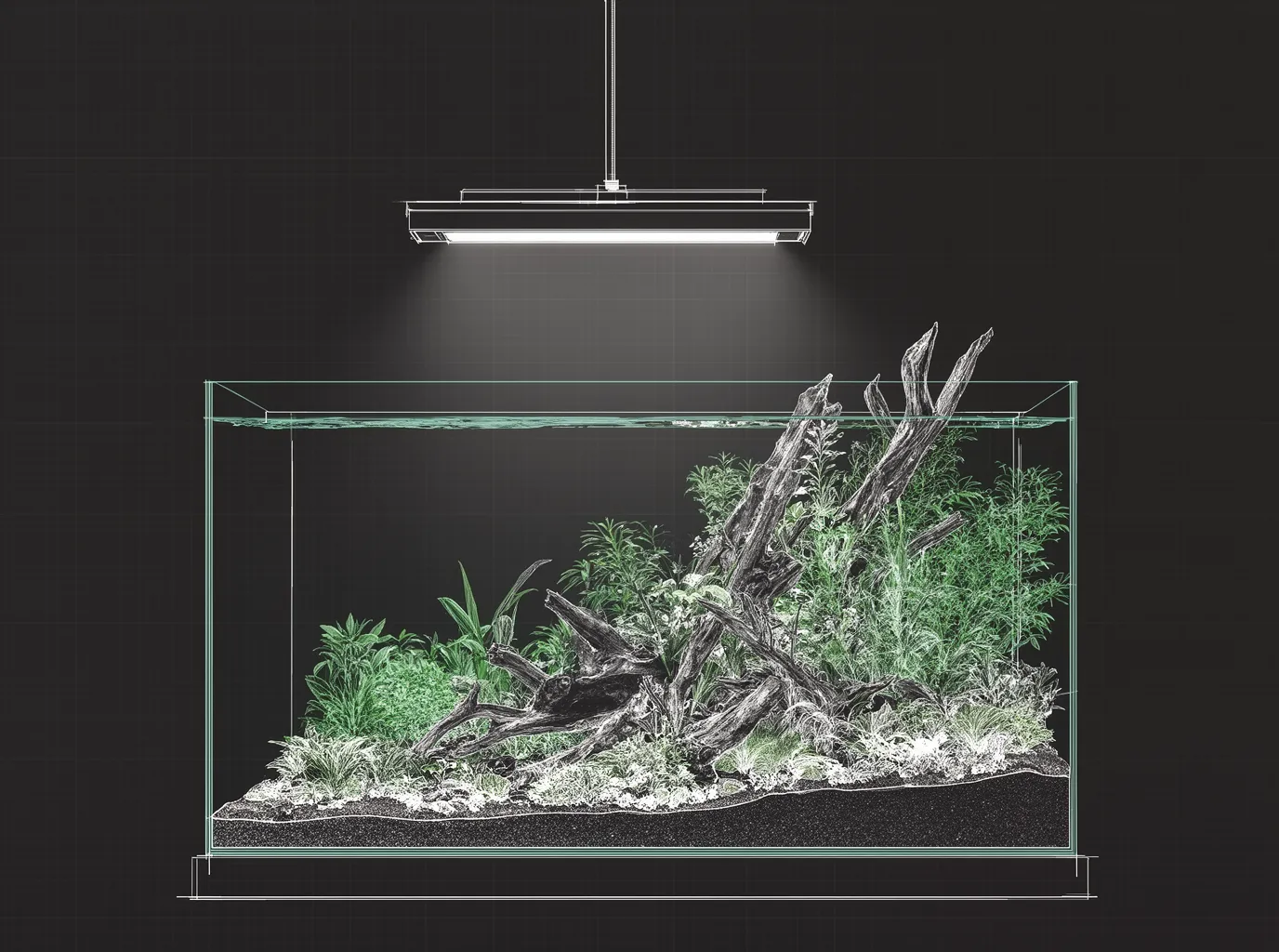
This is the definitive planted aquarium guide. Whether you're planning your first planted tank or optimizing an established system, this guide covers everything: setup strategies, system balance, maintenance protocols, troubleshooting, and advanced techniques.
What you'll learn:
- Low-tech vs high-tech system design principles
- The planted tank stability model (how systems mature over time)
- Component selection and integration (light, CO₂, substrate, filtration)
- Fertilization strategies (from minimalist to EI dosing)
- Maintenance schedules and routines
- Troubleshooting common issues
- Advanced techniques (aquascaping, DSM, plant health optimization)
Understanding Planted Tank Systems
The Core Principle: Balance
Every planted tank is a system where components must work in harmony:
Light + CO₂ + Nutrients = Plant Growth
When these three are balanced, plants thrive and outcompete algae. When imbalanced, problems arise.
The hierarchy:
- Light — The accelerator. Determines photosynthesis rate and system tempo.
- CO₂ — The limiter. Must match light intensity for efficient photosynthesis.
- Nutrients — The fuel. Must be available in proportion to growth rate.
Critical insight: You can't fix imbalance by adjusting just one variable. The system must be viewed holistically.
Low-Tech vs High-Tech: System Philosophy
These aren't just equipment differences — they're fundamentally different approaches to planted tanks.
Low-Tech System Philosophy
Design goals:
- Stability through simplicity
- Slow, steady growth
- Minimal intervention required
- Low cost, low maintenance
- Forgiving of mistakes
Core components:
- Low to moderate lighting (20-40 PAR)
- No CO₂ injection (natural levels: 2-5 ppm)
- Simple fertilization (root tabs or light liquid dosing)
- Basic substrate (gravel/sand or budget aquasoil)
- Standard filtration
- Easy plants only
Why it works:
Low light = slow photosynthesis = low CO₂ demand. Natural CO₂ (2-5 ppm) is sufficient. Plants grow slowly but steadily. Nutrient demand is low. System naturally balances.
Ideal for:
- Beginners learning fundamentals
- Low-maintenance hobbyists
- Stable, long-term displays
- Limited budgets
- Smaller time commitments (1 hour/week)
Limitations:
- Can't grow red plants or demanding species
- Carpeting very difficult
- Slow growth (patience required)
- Limited aquascaping options
Cost to start: $100-300
High-Tech System Philosophy
Design goals:
- Maximum plant growth and variety
- Vibrant coloration (reds, pinks)
- Fast establishment and development
- All plant species accessible
- Competition-level aquascaping
Core components:
- Moderate to high lighting (50-80+ PAR)
- CO₂ injection (20-30 ppm)
- Regular fertilization (daily or weekly dosing)
- Nutrient-rich substrate (quality aquasoil)
- Good filtration with controlled flow
- Any plant species possible
Why it's needed:
High light = fast photosynthesis = high CO₂ demand. Natural CO₂ insufficient — must inject. Plants grow rapidly, consuming nutrients quickly. Must fertilize consistently.
Ideal for:
- Experienced aquarists
- Aquascaping enthusiasts
- Those wanting carpets/red plants
- Active hobbyists who enjoy management
- Higher time commitment (2-3 hours/week)
Challenges:
- Requires attention to detail
- More expensive (equipment, consumables)
- Less forgiving (imbalance → rapid algae)
- Higher maintenance demands
Cost to start: $400-800+
The Mid-Tech Approach
Philosophy: Moderate light + CO₂, provides flexibility.
Components:
- Moderate lighting (40-60 PAR)
- CO₂ injection (15-25 ppm)
- Moderate fertilization
- Budget to mid-range substrate
Benefits:
- More plant variety than low-tech
- Less demanding than high-tech
- Balanced approach
- Good for intermediates
This is often the sweet spot for hobbyists who want more than low-tech but don't want full high-tech commitment.
The Planted Tank Stability Model
Understanding how tanks mature helps manage expectations and troubleshoot issues.
Phase 1: Initial Setup (Week 0-2)
What's happening:
- Tank is cycling (beneficial bacteria colonizing)
- Plants are adapting to new water parameters
- Parameters fluctuating
- Potential initial algae appearance (diatoms common)
Common issues:
- Cloudy water (bacterial bloom — normal)
- Diatom algae (brown dust on everything)
- Plant melting (adaptation)
- Ammonia/nitrite present (cycling)
What to do:
- Don't panic
- Avoid adding fish yet (unless doing fish-in cycle with very light stock)
- Water changes 2-3x per week
- Let plants adapt (don't remove melting plants yet)
- Test ammonia/nitrite/nitrate every 2-3 days
With aquasoil: Expect ammonia leeching for 2-4 weeks. Must fully cycle before adding fish.
Phase 2: Early Maturation (Week 2-8)
What's happening:
- Nitrogen cycle establishing (ammonia/nitrite → nitrate conversion)
- Plants beginning active growth
- Algae often appears (green dust, hair algae, sometimes BBA)
- System still unstable
Common issues:
- Algae spikes (especially week 3-6)
- Parameter swings
- Some plant species not thriving yet
- Substrate may release organics (cloudy water after disturbance)
What to do:
- Maintain consistent routine (lighting schedule, fertilization, water changes)
- Manual algae removal
- Don't drastically change setup (resist urge to "fix" everything)
- Patience — algae typically peaks then declines naturally
- Continue testing parameters weekly
This is the "ugly phase." Nearly all new planted tanks experience algae during weeks 3-8. This is normal. Stay the course.
Phase 3: Stabilization (Week 8-16)
What's happening:
- Nitrogen cycle fully established (ammonia/nitrite at 0 ppm consistently)
- Plant growth accelerating
- Algae declining naturally as plants outcompete
- Beneficial bacteria fully colonized
- System finding balance
What to expect:
- Noticeably healthier plants
- Reduced algae (though some may persist)
- More consistent parameters
- Trimming becoming necessary
What to do:
- Establish maintenance routine (water changes, trimming, fertilization)
- Begin trusting the system (less testing needed)
- Fine-tune lighting/fertilization if needed
- Start planning plant growth management
Phase 4: Maturity (Month 4+)
What's happening:
- Stable, balanced ecosystem
- Plants growing vigorously
- Minimal algae (with good practices)
- Microbiome fully developed
- System highly stable
What to expect:
- Consistent, predictable growth
- Easier to maintain than earlier phases
- Algae only appears when something changes
- Plants recover quickly from trimming or stress
What to do:
- Maintain routine
- Enjoy the results
- Plan rescapes or plant rearrangements if desired
- Refine aesthetics (aquascaping techniques)
Key insight: Maturity takes 3-6 months. You can't rush it. Systems that "just work" have gone through all phases naturally.
Component Selection and Integration
Lighting Strategy
Goal: Match intensity to your CO₂ and plant selection.
Low-tech setups:
- 20-40 PAR at substrate
- Basic LED fixtures ($30-80)
- 6-8 hour photoperiod
- Examples: Nicrew ClassicLED, Hygger, Aqueon Optibright
High-tech setups:
- 50-80+ PAR at substrate
- Quality planted tank LEDs ($100-300)
- 7-8 hour photoperiod (never more than 9 hours)
- Examples: Chihiros WRGB II, ONF Flat One+, Fluval Plant 3.0, Twinstar
Adjustment strategy:
- Start lower intensity, increase gradually if plants struggle
- If algae appears, reduce duration before reducing intensity
- Use dimming if available (better than on/off binary)
CO₂ Strategy
Low-tech: Skip CO₂. Use low to moderate lighting only.
High-tech CO₂ setup components:
- CO₂ cylinder (5-10 lb)
- Dual-stage regulator with solenoid
- Bubble counter
- Diffuser (ceramic, glass spiral, or inline)
- Drop checker (4dKH solution)
- Check valve
- CO₂-safe tubing
Target: 20-30 ppm during photoperiod
Timing:
- Turn on CO₂ 1-2 hours before lights
- Turn off CO₂ 1 hour before lights off (or when lights turn off)
- Never run CO₂ overnight (fish safety)
Distribution:
- Position diffuser where water flow will distribute CO₂
- Use spray bar or lily pipes for even circulation
- Avoid pointing filter output at surface (degasses CO₂)
See: Complete CO₂ Guide
Substrate Strategy
Inert substrate (gravel/sand):
- Long-lasting, stable
- Requires root tabs for root feeders
- Good for low-tech or budget setups
- Vacuum regularly
Nutrient-rich substrate (aquasoil):
- Rich in nutrients, supports faster growth
- Softens water, lowers pH (beneficial for most plants)
- Breaks down over 2-4 years
- Ideal for high-tech setups
- Don't vacuum aggressively
Depth: 2-3 inches minimum. More in back (3-4") for sloped aquascapes.
See: Substrate Guide
Filtration Strategy
Goals:
- Biological filtration (nitrogen cycle)
- Mechanical filtration (debris removal)
- Gentle circulation (3-5x turnover per hour)
- Minimal surface agitation (in high-tech CO₂ setups)
Low-tech: HOB or canister, moderate flow acceptable
High-tech: Canister with spray bar or lily pipes preferred (controlled flow, minimal CO₂ loss)
See: Filter Guide
Fertilization Strategy
Three main approaches:
1. Minimalist (Low-Tech)
Philosophy: Add only what plants need, rely on fish waste and substrate for some nutrition.
Method:
- Root tabs near heavy root feeders (every 3-4 months)
- Light all-in-one liquid fertilizer weekly (half dose)
Best for: Low-tech tanks, light planting, budget-conscious
2. Moderate (All-In-One Dosing)
Philosophy: Provide complete nutrition via all-in-one fertilizer.
Method:
- Dose all-in-one fertilizer 2-3x per week or after water change
- Examples: NilocG Thrive, APT Complete, Aquarium Co-Op Easy Green
- Follow bottle instructions or dose to maintain 10-20 ppm NO₃, 1-2 ppm PO₄
Best for: Most hobbyists, high-tech setups, any tank with moderate to heavy planting
3. EI (Estimative Index) Dosing
Philosophy: Provide excess nutrients so plants are never limited. Weekly 50% water change resets levels.
Method:
- Dose macros (KNO₃, KH₂PO₄, K₂SO₄) 3x per week
- Dose micros (trace elements) 3x per week
- 50% water change weekly
- Target: 20-30 ppm NO₃, 3-5 ppm PO₄ weekly addition
Best for: High-tech tanks, heavy planting, experienced aquarists who want maximum growth
Setup Process (Step-by-Step)
Planning Phase
1. Define goals:
- Low-tech or high-tech?
- Plant species desired?
- Fish compatibility?
- Budget and time commitment?
2. Component selection:
- Tank size
- Light intensity appropriate to goals
- CO₂ system (if high-tech)
- Substrate type
- Filter
- Hardscape materials (driftwood, rocks)
3. Plant selection:
- Choose plants suited to light/CO₂plan
- Mix growth types (stems, crypts, epiphytes, foreground, background)
- Calculate quantities (50-70% initial coverage ideal)
Setup Day
Order of operations:
- Place tank on stand (check level)
- Add hardscape (driftwood, rocks) — dry
- Add substrate (2-3 inches, slope higher in back)
- Fill tank partially (1-2 inches of water)
- Plant plants (while water shallow — easier to work)
- Fill tank completely (use plate method to minimize disturbance)
- Install equipment (filter, heater, CO₂ if using)
- Start filter (immediately — beneficial bacteria need flow)
- Add dechlorinator
- Begin cycling (fishless or planted cycle)
Expect cloudy water for 12-24 hours (especially with aquasoil). This is normal.
First Week
- Run lights 4-6 hours daily only (short photoperiod reduces initial algae)
- Water change 50% midweek (removes organics)
- Test ammonia/nitrite/nitrate every 2 days
- Begin light fertilization (half dose)
- Be patient — plants adapting, bacterial colonies establishing
Weeks 2-4
- Gradually increase light to 6-7 hours
- Continue water changes 2x weekly (30-50%)
- Test parameters 2x weekly
- Watch for ammonia/nitrite spike (cycling)
- Begin CO₂ injection if using (start low, increase gradually)
- Manual removal of any algae appearing
Weeks 4-8
- Increase light to 7-8 hours (full photoperiod)
- Reduce water change frequency to weekly (30-50%)
- Full fertilization dosing
- When ammonia/nitrite hit 0 ppm consistently, tank is cycled (safe for full fish stock)
- Algae may peak during this phase (stay consistent, don't panic)
Month 3+
- System stabilizing
- Establish long-term maintenance routine
- Test parameters bi-weekly or monthly
- Enjoy maturing ecosystem
Maintenance Protocols
Daily Tasks (High-Tech)
- Visually inspect tank (plant health, algae, equipment function)
- Check CO₂ bubble rate (should be consistent)
- Dose fertilizer (if using daily dosing regimen)
- Remove any dead leaves or debris (turkey baster)
Time: 2-5 minutes
Weekly Tasks
For all setups:
- Water change (30-50%)
- Clean glass (algae scraper)
- Dose fertilizer (if weekly dosing)
- Visual inspection for algae or plant issues
- Check filter flow (reduced flow = clogged media)
Additional for high-tech:
- Test CO₂ levels via drop checker
- Check equipment (bubble rate, solenoid function)
- Remove excess floating plant growth if present
Time: 30-60 minutes
Bi-Weekly Tasks
- Trim plants as needed
- Remove dying leaves
- Thin out overgrown areas
- Replant stem tops (if propagating)
Time: 15-30 minutes
Monthly Tasks
- Rinse filter media (in old tank water, never tap water)
- Check intake for clogs
- Clean glass thoroughly (including edges)
- Evaluate plant growth and adjust layout if desired
- Test parameters (ammonia, nitrite, nitrate, pH if concerned)
Time: 30-45 minutes
Every 3-4 Months
- Replace root tabs (if using inert substrate)
- Deep clean hardscape if algae buildup significant
- Check and lubricate canister filter O-rings
- Evaluate fertilization regimen (adjust if plant deficiencies appear)
Time: 45-60 minutes
Annually
- Consider aquascape refresh (replanting, new hardscape arrangement)
- Replace CO₂ cylinder or refill
- Evaluate aquasoil condition (if 2+ years old, may need replacement)
- Deep clean equipment
Time: varies (can be several hours for rescape)
System Troubleshooting
Problem: Algae Outbreak
Causes:
- Imbalanced light/CO₂/nutrients
- Inconsistent maintenance
- Excess organics
- System still maturing (weeks 3-8)
Diagnosis:
- Which algae type? (green dust, hair, BBA, staghorn, cyano)
- When did it appear? (after change? new tank?)
- Is tank parameters stable?
Solutions:
- Reduce light duration to 6 hours temporarily
- Increase water change frequency (2x per week, 50%)
- Manual removal
- Address specific imbalance (see Algae Control Guide)
- Be patient if new tank (algae peaks then declines naturally)
See: Algae Control Guide
Problem: Plants Not Growing
Causes:
- Insufficient light
- Lack of nutrients
- Incorrect CO₂ (if high-light setup)
- Wrong plant species for setup
Diagnosis:
- Are plants showing deficiency symptoms? (yellow leaves, holes, stunted)
- Is lighting adequate for plant species?
- If high-light: is CO₂ reaching 20-30 ppm?
Solutions:
- Test nitrate (should be 10-20 ppm) and phosphate (1-2 ppm)
- Increase fertilization if nutrients low
- Increase light intensity if very slow growth (but check CO₂ first if high-light)
- Verify CO₂ levels with drop checker
Problem: Plants Melting
Causes:
- Adaptation to new parameters (common after purchase)
- Incorrect planting (Anubias/ferns buried in substrate)
- Drastic parameter change
- Crypt melt (normal for crypts)
Diagnosis:
- When did melting start? (immediately after planting = adaptation)
- Which plants? (crypts melt often, new stems often lose emersed leaves)
- Are rhizomes buried? (Anubias, ferns must be attached, not planted)
Solutions:
- If adaptation: wait 2-4 weeks, new growth will appear
- If crypt melt: leave roots in place, new leaves will grow
- If rhizome buried: remove plant, attach to hardscape
- If parameter shock: stabilize parameters, be patient
Problem: Cloudy Water
Causes:
- Bacterial bloom (new tank)
- Substrate disturbance
- Overfeeding
- Dirty filter
Solutions:
- Bacterial bloom: wait 3-7 days, it clears naturally
- Increase filtration and water changes temporarily
- Check filter media (rinse if clogged)
- Reduce feeding
Problem: Inconsistent CO₂ Levels
Causes:
- Regulator not holding pressure
- Bubble rate changing throughout day
- Leaks in system
- Cylinder running low (end-of-tank dump)
Solutions:
- Check all connections for leaks (soapy water test)
- Verify solenoid functioning (should click on/off with timer)
- Check bubble rate multiple times per day (should be stable)
- Replace cylinder if low (pressure drops rapidly when nearly empty)
Advanced Techniques
Aquascaping Principles
Rule of thirds:
- Divide tank into 3x3 grid
- Place focal points at grid intersections
- Avoid centered composition (looks static)
Depth and layering:
- Higher substrate in back, lower in front
- Layer plants: foreground (2-6"), midground (6-12"), background (12-24")
- Creates illusion of depth
Hardscape first:
- Place rocks and driftwood before adding substrate
- Use odd numbers (3, 5 rocks more dynamic than 2, 4)
- Create triangular compositions (more natural than symmetrical)
Golden ratio:
- Roughly 1:1.6 ratio in composition
- Applies to hardscape height, plant groupings
- Creates naturally pleasing proportions
Negative space:
- Don't fill every inch
- Open areas create breathing room
- Sand or substrate patches can be beautiful
Contrast:
- Fine-leafed plants next to broad-leafed
- Light green next to dark green
- Tall plants next to short
- Textural variety
Dry Start Method (DSM)
What it is: Starting plants emersed (above water) for 4-8 weeks, then flooding.
Benefits:
- Carpeting plants establish faster
- No algae during establishment
- Plants root deeply before flooding
Process:
- Setup tank with substrate and hardscape (no water except moist substrate)
- Plant carpet species (HC Cuba, Monte Carlo, etc.)
- Mist daily to keep substrate moist (never dry out)
- Cover tank with plastic wrap (high humidity)
- Provide light (6-8 hours daily)
- Wait 4-8 weeks (plants grow emersed)
- Flood tank slowly
- Expect some melt during transition (normal)
Best for: Carpeting plants in high-tech setups
Dutch Style Aquascaping
Characteristics:
- Dense planting (90%+ coverage)
- Heavy use of stem plants
- Layered terraces
- Contrasting colors and textures
- No hardscape (or minimal)
- Very high maintenance
Requires: High-tech setup, frequent trimming, expert-level plant knowledge
Iwagumi Aquascaping (Japanese Stone Garden Style)
Characteristics:
- Minimalist stone arrangement
- Typically 3-5 rocks (odd numbers)
- Low-growing plants (often carpets)
- Open space
- Simplicity and harmony
Requires: Quality hardscape, carpeting plants, high-tech setup typically
Nature Aquarium (Takashi Amano Style)
Characteristics:
- Natural, asymmetric compositions
- Use of driftwood and stones together
- Emphasis on negative space
- Balanced but not symmetrical
- Mix of plant types
Philosophy: Recreate natural underwater landscapes. Most popular and versatile style.
Plant Health Optimization
Reading Plant Signals
Healthy plants:
- Vibrant color (bright green, red, or species-appropriate color)
- Pearling (oxygen bubbles) under strong light
- Active growth (new leaves regularly)
- Compact growth (short internodes in stems)
- No holes or significant damage
Nitrogen deficiency (NO₃):
- Older leaves yellowing (chlorosis)
- Stunted growth
- Solution: Increase nitrate to 10-20 ppm
Phosphate deficiency (PO₄):
- Dark green leaves, stunted growth
- Older leaves darkening then dying
- Solution: Increase phosphate to 1-2 ppm
Potassium deficiency (K):
- Pinholes in leaves
- Yellow spots between leaf veins
- Leaf edges browning
- Solution: Dose potassium sulfate or use all-in-one fertilizer
Iron deficiency (Fe):
- New leaves yellowing (chlorosis) while veins stay green
- Solution: Dose iron chelate or iron-rich fertilizer
Magnesium deficiency (Mg):
- Interveinal chlorosis (yellowing between veins)
- Older leaves affected first
- Solution: Increase GH or dose magnesium sulfate
CO₂ deficiency (high-light setups):
- Stunted growth despite nutrients
- Leaves small and deformed
- Plants "struggling" despite good fertilization
- Solution: Increase CO₂ to 20-30 ppm
Trimming Techniques
Stem plants:
- Cut 2-4 inches from substrate
- Remove lower leaves from cutting
- Replant tops (roots quickly)
- Discard old bottoms (or keep if still healthy)
Result: Bushier, denser growth
Carpeting plants:
- Trim tops with wave scissors
- Keep height even
- Don't trim too short (damages growth points)
- Vacuum debris immediately
Anubias, crypts, swords:
- Remove individual dying leaves at base
- Don't trim healthy leaves (slow growth, each leaf matters)
Floating plants:
- Net out excess weekly
- Keep 50-70% surface coverage max
- Too much blocks light to lower plants
Long-Term System Management
Year 1 Strategy
Goals:
- Achieve stable system
- Learn your tank's behavior
- Establish consistent routine
- Build confidence
Focus:
- Consistency over perfection
- Observe cause and effect
- Don't constantly change variables
Years 2-3 Strategy
Options:
- Refine existing aquascape (better plant placement, denser growth)
- Major rescape (new hardscape, layout, plant selection)
- Transition from low-tech to high-tech (add CO₂, upgrade lighting)
- Focus on rare or challenging plant species
Long-Term Considerations
Substrate lifespan:
- Inert: indefinite
- Aquasoil: 2-4 years before depletion
Equipment replacement:
- Filters: 5-10+ years
- Lights (LED): 5-10 years (gradual PAR reduction)
- CO₂ regulators: 5-10+ years with care
- Heaters: 2-5 years (safety concern, replace proactively)
System evolution:
- Plants will grow in, mature appearance takes 6-12 months
- Some plants will dominate, others may thin out
- Hardscape may shift slightly or need repositioning
- Substrate may compact or erode (especially at front glass)
Rescape frequency:
- Low-maintenance aquarists: every 2-5+ years
- Active hobbyists: every 6-18 months
- Competition aquascapers: every 3-6 months
Integration with Fish
Fish Selection for Planted Tanks
Best community fish for planted tanks:
- Tetras (Neon, Cardinal, Rummy Nose, etc.)
- Rasboras (Chili, Harlequin, etc.)
- Corydoras catfish (sand substrate preferred)
- Otocinclus catfish (algae eaters)
- Dwarf shrimp (Neocaridina, Caridina)
- Small plecos (Bristlenose, Clown)
Avoid:
- Large cichlids (dig up plants, aggressive)
- Goldfish (uproot plants, high waste load)
- Silver dollars (plant-eaters)
- Large plecos (bulldoze hardscape)
Stocking level:
- Conservative: 1 inch of fish per 2 gallons
- Heavily planted tanks can support slightly higher stocking (plants process waste)
Nutrient Cycling with Fish
Fish waste provides:
- Ammonia (converted to nitrate via nitrogen cycle)
- Phosphate (from food breakdown)
- Some trace elements
In heavily planted tanks, fish waste can provide significant nutrients. Some planted tanks require minimal fertilization if well-stocked and heavily planted.
Balance: Fish + plants create a symbiotic system. Fish provide nutrients, plants clean water.
FAQ
How long does it take for a planted tank to look "finished"?
Fast-growing stems can fill in within 2-3 months. Slow-growers (Anubias, crypts) take 6-12 months to reach mature appearance. Competition aquascapes are often photographed at "peak" (3-4 months after planting) before plants overgrow.
Can I skip the cycling period with plants?
Plants absorb ammonia, which can significantly speed cycling. Heavily planted tanks can be safe for fish within 1-2 weeks (planted cycle). But it's still recommended to test parameters and ensure ammonia/nitrite are 0 ppm before adding full stock.
Do I need to remove activated carbon from my filter?
Yes, for long-term use. Carbon removes trace elements plants need. Use carbon only temporarily (after medication, to remove tannins). Remove after 2-4 weeks.
How do I transition from low-tech to high-tech?
- Add CO₂ system, start with low bubble rate (20 ppm)
- Increase lighting gradually over 2-3 weeks if desired
- Increase fertilization to match faster growth
- Expect 2-4 week adjustment period (possible algae spike)
- Monitor closely, adjust as needed
Can I have a planted tank in direct sunlight?
Not recommended. Sunlight is uncontrollable (varies by season, weather, time of day). Nearly always causes excessive algae. Use artificial lighting only.
How often should I rescape?
Personal preference. Some aquascapers enjoy frequent rescapes (every 6 months). Others maintain stable layouts for years. There's no "required" rescape frequency — do what brings you joy.
Related Guides
Beginner Resources:
- Planted Tank Guide (Beginner)
- Easy Plants for Beginners
- Do I Need CO₂?
- How Much Light Do I Need?
- Water Parameters Explained
Advanced Topic Guides:
- Algae Control Guide
- CO₂ in Planted Tanks
- Aquarium Lighting Guide
- Substrate Guide
- Water Parameters Guide
- Filter Guide
Final Thoughts: The Journey
Planted aquariums are living systems that mature over time. Early challenges (algae, plant adaptation, parameter fluctuations) are part of the process, not indicators of failure.
Key principles for success:
- Start appropriately — Match ambition to experience. Low-tech for beginners, high-tech when ready.
- Think in systems — Everything connects. Address imbalances holistically.
- Be consistent — Routines beat sporadic perfection.
- Be patient — Systems need 3-6 months to mature. You can't rush biological processes.
- Observe and adapt — Learn your tank's unique behavior. No two systems are identical.
- Enjoy the process — This is a hobby. Frustration is temporary, but the satisfaction of a thriving ecosystem is lasting.
The planted aquarium hobby rewards patience, observation, and consistency. Whether you're growing simple Anubias in a low-tech tank or creating competition-level aquascapes, the fundamentals remain the same: balance light, CO₂, and nutrients, maintain stability, and let time work its magic.
Welcome to the world of planted aquariums. The journey is as rewarding as the destination.