
Aquarium Substrate Guide for Planted Tanks
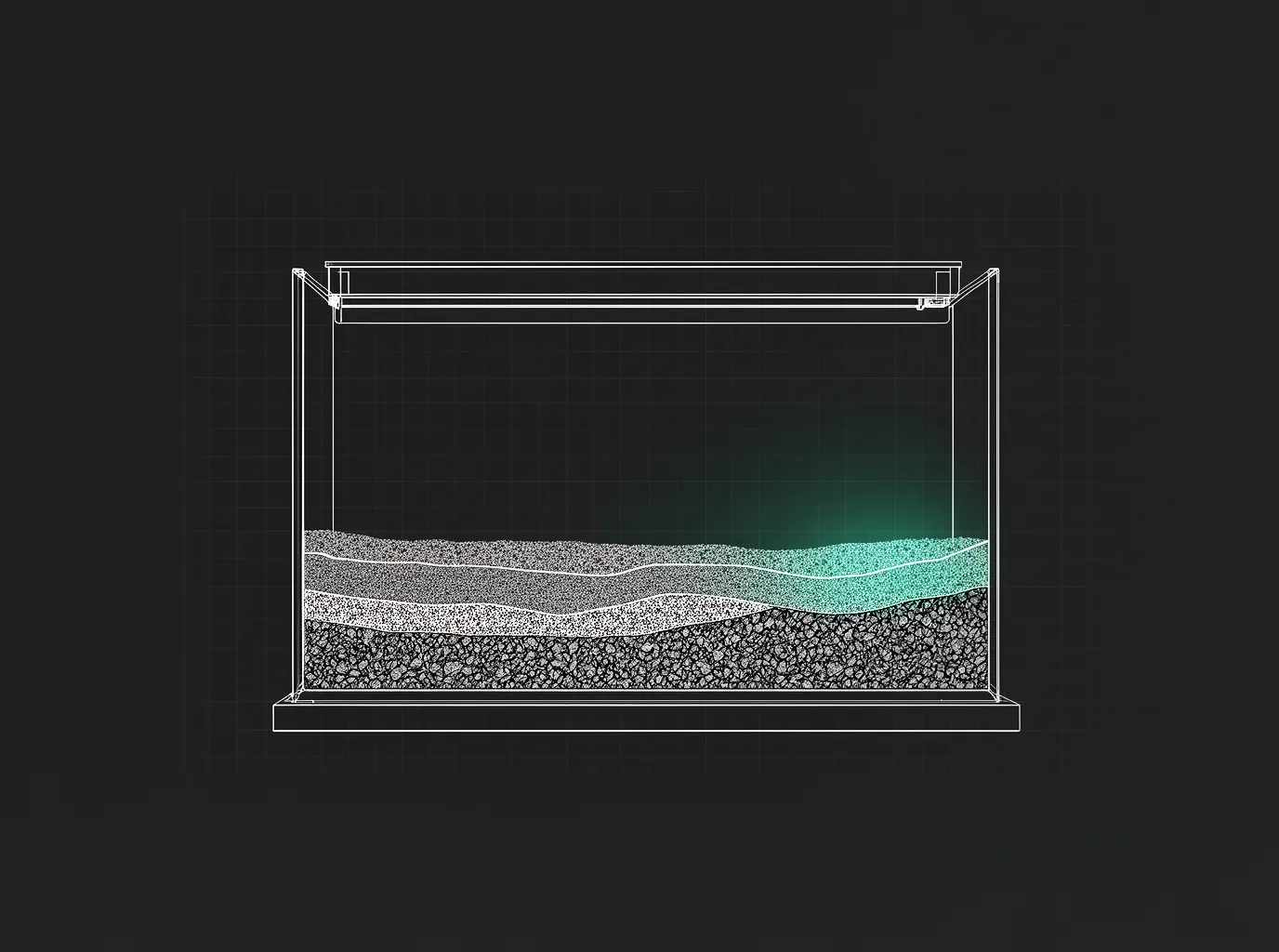
Substrate is the foundation—literally—of your planted aquarium. It affects plant nutrition, water chemistry, aesthetics, and long-term maintenance. This comprehensive guide covers everything from substrate science to advanced techniques.
What you'll learn:
- Substrate functions and plant nutrition mechanisms
- Complete breakdown of substrate types (inert, nutrient-rich, specialty)
- Selection criteria by plant types and setup goals
- Depth requirements and calculations
- Installation methods (standard, capped, layered)
- Water parameter impacts (pH, GH, KH effects)
- Long-term substrate management and lifespan
- Root tab supplementation strategies
- Troubleshooting substrate problems
- Advanced techniques (dirted tanks, mineralized soil, custom mixes)
Prerequisites: This guide assumes basic planted tank knowledge. For beginner-level substrate information, see Best Substrate for Beginners.
Understanding Substrate Functions
1. Plant Anchoring (Universal Function)
All substrates provide:
- Physical support for rooted plants
- Stable base preventing uprooting by fish or flow
- Medium for root penetration and establishment
Minimum requirement: Any substrate with adequate depth (2+ inches)
2. Root Nutrition (Variable by Substrate Type)
Root-feeding plants absorb significant nutrients through roots:
- Amazon Swords
- Cryptocoryne species
- Vallisneria
- Echinodorus species
- Carpeting plants (some)
Column-feeding plants absorb primarily from water:
- Most stem plants
- Floating plants
- Epiphytes (Anubias, Java Fern - don't root in substrate)
Nutrient-rich substrates benefit root feeders significantly.
3. Biological Filtration Support
Substrate surface area hosts beneficial bacteria:
- Aerobic bacteria in top 1-2 inches (oxygen present)
- Processes ammonia/nitrite in nitrogen cycle
- Larger grain = more surface area per volume
- Sand = less surface area but still functional
All substrates contribute to biological filtration.
4. Water Chemistry Buffering
Some substrates actively modify water parameters:
- Aquasoils: Lower pH, soften water (reduce GH/KH)
- Crushed coral/limestone: Raise pH and GH (not recommended for planted tanks)
- Inert substrates: No effect on parameters
Choose based on desired water chemistry.
5. Aesthetic Foundation
Substrate color affects entire tank appearance:
- Dark (black, dark brown): Plants "pop," debris less visible
- Light (beige, white): Shows debris, plants appear washed out
- Contrast with hardscape and background
Dark substrates universally recommended for planted tanks.
Complete Substrate Types Breakdown
Inert Substrates (No Nutrient Content)
Chemically stable materials that don't alter water chemistry or provide root nutrition.
Gravel (2-5mm)
Composition: Natural rock (quartz, granite) or manufactured ceramic
Characteristics:
- Rounded or angular pieces
- Various colors (prefer dark)
- Porous surface area
- Good water flow through gaps
Pros:
- Very affordable ($10-20 per 20 lbs)
- Lasts indefinitely
- Easy to vacuum
- Stable (won't compact)
- Predictable (no parameter changes)
Cons:
- No nutrient content (requires root tabs or water column fertilization)
- Light colors show debris
- Can trap detritus in gaps
Best for:
- Budget-conscious setups
- Tanks with primarily stem plants or column feeders
- Long-term stability preference
- Low-tech approaches
Specific products:
- Standard aquarium gravel (avoid painted types)
- Seachem Flourite (clay-based, some initial nutrients)
- Carib Sea Eco-Complete (marketed as planted substrate, mostly inert)
Sand (0.5-2mm)
Composition: Silica, quartz, or other minerals ground to fine particles
Characteristics:
- Very fine grain size
- Natural appearance
- Smooth texture
- Dense packing
Pros:
- Affordable ($10-20 per 20 lbs)
- Natural aesthetic
- Excellent for bottom-dwelling fish (Corydoras love sand)
- Roots penetrate easily
- Clean appearance
Cons:
- No nutrient content (requires root tabs)
- Can compact over time (reduces oxygen to roots)
- Harder to vacuum (disturbs easily)
- Very fine sand can get sucked into filters
Best for:
- Natural aquascapes
- Tanks with Corydoras or sand-sifting species
- Capping layer for dirted tanks
- Biotope setups
Specific products:
- Pool filter sand (very affordable, popular)
- Black diamond blasting sand ($8-10 per 50 lbs)
- Carib Sea Super Naturals
- Play sand (requires thorough rinsing)
Grain size matters: 1-2mm is ideal. <0.5mm compacts severely. >2mm isn't really sand anymore.
Nutrient-Rich Substrates (Active Soil)
Specially formulated substrates containing nutrients, typically made from baked clay or volcanic soil.
Aquasoil / Planted Tank Soil
Composition: Baked clay granules infused with nutrients (nitrogen, phosphorus, iron, trace elements)
Characteristics:
- Small, uniform granules (3-5mm)
- Dark brown or black color
- Lightweight initially
- High CEC (cation exchange capacity)
Pros:
- Rich in nutrients for 12-24 months
- Lowers pH (0.5-1.0 units typically)
- Softens water (lowers GH/KH)
- Beneficial for most plants (soft, acidic water)
- Faster plant establishment
- Excellent for root-feeding plants
- Professional appearance
Cons:
- Expensive ($30-50 per 9L bag, need 2-3 bags for typical tank)
- Breaks down over time (2-4 years, becomes muddy)
- Leaches ammonia initially (must cycle 3-4 weeks before fish)
- Cannot vacuum aggressively (breaks granules)
- Cloudy water during setup (normal, settles in 12-24 hours)
- Limited lifespan (nutrients deplete, structure degrades)
Best for:
- High-tech planted tanks
- Root-heavy plant selections (swords, crypts, carpets)
- Aquascapers prioritizing aesthetics
- Soft water species (discus, dwarf cichlids, tetras from blackwater)
- Those willing to invest in substrate
Specific products (quality spectrum):
Premium ($45-60 per 9L):
- ADA Amazonia (gold standard, richest nutrients)
- UNS Controsoil (excellent quality, similar to ADA)
Mid-range ($30-40 per bag):
- Tropica Aquarium Soil
- Fluval Stratum (volcanic soil, lighter weight)
- Dennerle Scaper's Soil
Budget ($20-30 per bag):
- AquaSolum
- Mr. Aqua Aquarium Soil
- UP Aqua Sand
Quality differences:
- Nutrient content (premium lasts longer)
- Granule stability (premium breaks down slower)
- Ammonia leaching (premium leaches less)
- Consistency (premium has uniform grain size)
Aquasoil Lifecycle
Months 0-6 (Peak):
- Maximum nutrient content
- Plants establish rapidly
- Minimal supplementation needed
- Water may be slightly tinted (tannins)
Months 6-18 (Productive):
- Still nutrient-rich
- Plants thriving
- Begin supplementing with root tabs if root feeders present
- Granules stable
Months 18-36 (Declining):
- Nutrients significantly depleted
- Root tabs essential for root feeders
- Granules beginning to break down
- Performance still acceptable with supplementation
Year 3+ (Exhausted):
- Minimal nutrient content
- Granules breaking down into mud
- Heavy root tab supplementation required
- Consider replacement during next rescape
Specialty Substrates
Laterite
What it is: Red clay rich in iron, mixed with or layered under gravel
Historical context: Popular in the 1990s-2000s before modern aquasoils
Current status: Largely obsolete
Why it's outdated:
- Only provides iron (incomplete nutrition)
- Modern root tabs more convenient
- Aquasoils provide complete nutrition
- Messy to work with
Skip laterite. Use modern alternatives.
Fluorite (Seachem)
What it is: Porous clay gravel, stable long-term
Characteristics:
- Clay-based, porous structure
- 3-5mm grain size
- Reddish-brown or black
- High CEC (holds nutrients)
- Doesn't break down
Nutrient content: Minimal initially, but holds nutrients from water column or root tabs
Pros:
- Lasts indefinitely (doesn't degrade like aquasoil)
- High CEC (good nutrient retention)
- Can be vacuumed
- Stable
Cons:
- Dusty during setup (requires heavy rinsing)
- Less nutrient-rich than aquasoils initially
- Heavier than aquasoil
Best for: Intermediate approach between inert gravel and aquasoil
Aquatic Plant Substrate (APS - CaribSea)
Similar to Flourite: Clay-based, high CEC, minimal nutrients initially
Requires supplementation with root tabs for root feeders
Baked Clay Balls / Grow Stones
What they are: Large porous clay balls
Use: Substrate underlayer (drainage, prevent compaction)
Not a primary substrate — too large for rooting plants
Substrate Selection Decision Framework
By Plant Type
Primarily stem plants (column feeders):
- Basic gravel or sand works fine
- Water column fertilization sufficient
- Save money on substrate
Heavy root feeders (swords, crypts, Vallisneria):
- Aquasoil or root tabs with inert substrate
- Root nutrition essential
Mixed planting:
- Aquasoil simplest
- Or inert substrate + strategic root tab placement
Carpeting plants:
- Aquasoil strongly recommended
- Provides root zone nutrition where carpets establish
By Budget
Tight budget (<$50 substrate):
- Black diamond blasting sand or dark gravel
- Root tabs where needed ($10-15)
- Total: $20-30
Moderate budget ($50-100):
- Mid-range aquasoil (Fluval Stratum)
- Or Flourite/APS with root tabs
- Total: $50-80
Premium budget ($100-200+):
- ADA Amazonia or UNS Controsoil
- Complete coverage (2-3 bags)
- Total: $100-150
By Maintenance Preference
Low maintenance:
- Inert substrate (lasts forever)
- Root tabs every 3-4 months
- Never needs replacement
Moderate maintenance:
- Aquasoil (2-4 year lifespan)
- Minimal fertilization first year
- Supplement year 2+
- Replace during rescape
High-tech intensive:
- Premium aquasoil
- Maximum plant growth
- Rescape every 12-24 months anyway
By Water Chemistry Goals
Want soft, acidic water (pH 6.0-6.8, low GH/KH):
- Aquasoil (naturally lowers pH and hardens)
- Perfect for blackwater species
Want stable neutral water (pH 7.0-7.5, moderate GH/KH):
- Inert substrate (no parameter effect)
- Easier to control chemistry
Have very hard tap water:
- Aquasoil helps soften
- Or use RO water + remineralize to desired level
Substrate Depth Requirements
Minimum Viable Depth
Absolute minimum: 1.5 inches
- Plants struggle below this
- Roots hit glass quickly
- Limited nutrient reserve
Practical minimum: 2 inches
- Adequate for most plants
- Reasonable nutrient capacity
Recommended standard: 2-3 inches
- Comfortable root depth
- Good nutrient reserve
- Stable plant anchoring
Depth by Plant Type
Shallow-rooting plants:
- Carpeting plants: 1.5-2 inches adequate
- Small crypts: 2 inches
- Mosses (attached): 0 inches (don't plant in substrate)
Medium-rooting plants:
- Most stem plants: 2-3 inches
- Medium crypts: 2-3 inches
- Most foreground/midground: 2-3 inches
Deep-rooting plants:
- Amazon Swords: 3-4+ inches
- Large Echinodorus: 3-4+ inches
- Vallisneria: 2-3 inches (spreads via runners)
Sloped Substrate (Aquascaping Technique)
Purpose: Creates visual depth
Implementation:
- Front: 1.5-2 inches (low)
- Back: 3-5 inches (high)
- Gradual or terraced slope
Maintaining slope:
- Use hardscape (rocks, driftwood) as barriers
- Accept some natural leveling over time
- Egg crate (plastic mesh) under substrate to hold levels
Benefits:
- Enhanced visual depth
- More room for roots in back
- Natural appearance
Caution: Very deep areas (>5 inches) risk anaerobic zones (produce hydrogen sulfide). Ensure adequate flow or limit depth.
Calculating Substrate Volume
Formula: Length (inches) × Width (inches) × Depth (inches) ÷ 231 = Gallons of substrate needed
Convert gallons to pounds:
- Sand/gravel: ~1.5-2 lbs per gallon
- Aquasoil: ~1-1.5 lbs per gallon (lighter)
Example: 40-gallon breeder (36" × 18" × 16"):
- For 2" average depth: 36 × 18 × 2 ÷ 231 = ~5.6 gallons
- Sand/gravel needed: 5.6 × 1.75 = ~10 lbs
- Aquasoil needed: 5.6 × 1.25 = ~7 lbs ≈ 2 bags (9L each)
Always buy 20% extra. Running short mid-setup is frustrating.
Substrate Installation Methods
Standard Installation (Single Substrate)
Process:
- Rinse substrate thoroughly (gravel/sand only, never rinse aquasoil)
- Place tank on final stand (substrate adds weight)
- Optional: Add hardscape first (rock/wood)
- Add substrate, distribute evenly or create slope
- Add small amount of water (1-2 inches)
- Plant plants while water is shallow (easier to work)
- Fill tank slowly (use plate or bowl to minimize disturbance)
For aquasoil: Expect significant clouding for 12-24 hours. Run filter, be patient. Water will clear.
Capped Substrate Method
What it is: Nutrient-rich base layer capped with inert layer
Purpose:
- Contains nutrient-rich layer (prevents cloudiness when disturbed)
- Provides root zone nutrition
- Aesthetic top layer
Common combinations:
- Organic soil capped with sand (Walstad method)
- Aquasoil capped with sand (less common, questionable benefit)
Capped soil (Walstad) process:
- Add 1 inch organic potting soil (no additives, fertilizers, or chemicals)
- Saturate soil thoroughly
- Add 1-1.5 inches pool filter sand cap
- Plant carefully (avoid disturbing layers)
- Fill very slowly
Challenges:
- Disturbing substrate releases organics (cloudy water, ammonia)
- Can't rescape easily
- Anaerobic pockets risk (hydrogen sulfide)
- Requires experience
Recommendation for beginners: Skip capped soil. Use aquasoil or inert substrate + root tabs instead.
Layered Substrate Systems
Concept: Multiple layers providing different functions
Example system:
- Bottom: Laterite or clay (nutrients)
- Middle: Coarse gravel (drainage, prevent compaction)
- Top: Aquasoil or fine substrate (planting layer)
Theory: Prevents compaction, creates nutrient gradient, improves drainage
Reality: Overly complex, minimal benefit compared to simple aquasoil. Modern aquasoils perform excellently alone.
Recommendation: Single substrate layer is sufficient for 95% of setups.
Substrate and Water Parameters
How Aquasoil Affects Chemistry
pH reduction:
- Mechanism: Organic acids and humic substances in soil lower pH
- Typical effect: 0.5-1.0 pH drop
- Example: Tap water pH 7.5 → Tank pH 6.5-7.0
GH reduction (water softening):
- Mechanism: Ion exchange (calcium/magnesium absorbed by soil)
- Typical effect: 2-6 dGH reduction
- Example: Tap water 10 dGH → Tank water 4-8 dGH
KH reduction:
- Similar mechanism to GH
- Reduces buffering capacity
- pH becomes easier to change (good for CO₂ efficiency, requires monitoring)
Duration: Effects strongest in first 6-12 months, gradually diminish as substrate ages.
Managing Parameter Changes
If you want soft, acidic water:
- Aquasoil is beneficial
- Perfect for soft water species
If you want stable, neutral parameters:
- Use inert substrate
- Or increase KH through remineralization if using aquasoil
Testing frequency:
- Test parameters weekly for first month with aquasoil
- Monitor pH, GH, KH changes
- Adjust livestock/plant choices based on observed parameters
Crushed Coral / Limestone Warning
Effect: Raises pH and GH significantly
Not recommended for planted tanks:
- Most plants prefer neutral to slightly acidic (6.0-7.5)
- High pH reduces nutrient availability (iron precipitation)
- Alkaline water incompatible with most planted tank strategies
Exception: Specific cichlid setups (Rift Lake species) where high pH/GH desired and plants are secondary
Long-Term Substrate Management
Inert Substrate Maintenance
Vacuuming:
- Vacuum during water changes (weekly or bi-weekly)
- Remove debris, uneaten food, waste
- Prevents organic buildup
Gravel vacuum technique:
- Insert siphon into gravel
- Debris lifts while heavier gravel falls back
- Repeat across substrate surface
Lifespan: Indefinite. Can last lifetime of tank.
Supplementation:
- Insert root tabs near root-feeding plants
- Replace every 3-4 months
- Liquid fertilization for column feeders
Aquasoil Maintenance
Do NOT vacuum aggressively:
- Breaks granules apart
- Turns water muddy
- Shortens substrate lifespan
Gentle cleaning only:
- Hover vacuum above substrate (remove debris from surface)
- Use turkey baster for spot cleaning
- Remove large debris manually
Nutrient supplementation timeline:
- Months 0-12: Usually sufficient alone
- Months 12-18: Begin adding root tabs
- Months 18+: Rely on root tabs and water column fertilization
Replacement:
- Year 2-4: Performance declining
- Granules breaking down into mud
- Options: Add fresh layer on top, or full replacement during rescape
Rejuvenation (partial):
- Add fresh aquasoil layer (1 inch) on top of old
- Extends usable life 1-2 years
- Plants root into new layer
Root Tab Supplementation Strategies
For inert substrates:
- Insert near heavy root feeders
- 1 tab per 6-8 inch radius
- Replace every 3-4 months
For aging aquasoil:
- Insert when plant growth slows (year 1.5+)
- Dosing similar to inert substrate
Products:
- Seachem Flourish Tabs (most popular)
- API Root Tabs (budget option)
- Tropica Plant Nutrition Capsules
- Osmocote Plus DIY (wrapped in clay - advanced)
Placement technique:
- Push into substrate near plant roots (not directly under crown)
- 2-3 inches deep
- Space evenly around heavy root feeders
Troubleshooting Substrate Problems
Problem: Cloudy Water After Setup
Causes:
- Aquasoil cloudiness (normal, temporary)
- Insufficient rinsing (gravel/sand)
- Disturbed substrate during filling
Solutions:
- Wait (aquasoil cloudiness resolves in 12-24 hours)
- Run filter continuously
- Avoid large water changes (can prolong cloudiness)
- If persistent >48 hours, consider flocculent/clarifier (last resort)
Problem: Ammonia Spike with Aquasoil
Cause: Aquasoil leaches ammonia for 2-4 weeks initially
Timeline:
- Week 1-2: Ammonia rises (2-5 ppm typical)
- Week 2-4: Beneficial bacteria colonize, ammonia converts to nitrite
- Week 4-6: Nitrite converts to nitrate, cycle complete
Management:
- Do NOT add fish until ammonia/nitrite at 0 ppm
- Large water changes (50-75%) daily if needed to keep ammonia safe
- Add beneficial bacteria supplements
- Be patient
This is normal and expected with aquasoil.
Problem: Substrate Compacting (Sand)
Cause: Fine sand particles compress over time, reducing oxygen penetration
Symptoms:
- Plants in compacted areas struggle
- Black areas visible (anaerobic zones)
- Hydrogen sulfide smell (rotten eggs)
Solutions:
- Stir substrate surface gently during water changes
- Add Malaysian Trumpet Snails (MTS) - they burrow and aerate
- Mix coarser sand (1-2mm) with very fine sand
- Switch to gravel if persistent problem
Problem: Substrate Too Shallow
Symptoms:
- Large plants uproot easily
- Plants lean or float up
- Roots visible at glass
Solutions:
- Add more substrate (carefully, can cloud water)
- Use plant weights temporarily
- Replant deeper if possible
Problem: Algae Growing on Substrate Surface
Causes:
- Excess light reaching substrate
- Nutrients on substrate surface
- Poor circulation
Solutions:
- Increase plant density (shade substrate)
- Add bottom-dwelling algae eaters (Corydoras, Otos)
- Improve circulation
- Reduce light intensity slightly
Problem: Substrate pH Drift (Aquasoil)
Observation: pH continues dropping below desired range
Cause: Aquasoil's buffering capacity exceeding KH of water
Solutions:
- Add KH buffer (crushed coral in filter, small amount)
- Use tap water with higher KH for water changes
- Increase water change frequency
- Switch to inert substrate if persistent issue
Advanced Substrate Techniques
Dirted Tanks (Walstad Method)
Concept: Organic potting soil capped with sand, minimal tech approach
Diana Walstad's philosophy:
- Soil provides long-term nutrients
- Minimal filtration (plants as primary filtration)
- Low-tech, natural balance
Advantages:
- Very cheap ($5-10 for soil)
- Rich nutrients for years
- Can support growth without added fertilizers
Disadvantages:
- Messy setup
- Risk of ammonia spikes if disturbed
- Can't rescape without major disruption
- Anaerobic pockets (hydrogen sulfide risk)
- Requires experience and monitoring
Soil selection:
- Organic potting soil ONLY
- No added fertilizers
- No perlite or additives
- Miracle-Gro Organic (popular choice)
Setup:
- Mineralize soil (optional, advanced: soak/dry/soak cycles)
- Add 1 inch soil
- Saturate completely
- Add 1-1.5 inches sand cap
- Plant carefully
- Fill very slowly
Recommendation: Advanced technique. Beginners should start with aquasoil or inert + root tabs.
Mineralized Soil
Concept: Pre-treating organic soil to reduce organics and stabilize nutrients
Process:
- Spread soil in shallow tray
- Soak completely (4-6 hours)
- Drain
- Dry completely (several days)
- Repeat soak-dry cycle 3-5 times
- Final product: Mineralized soil
Benefit: Reduces initial ammonia release, more stable than raw soil
Time investment: 3-6 weeks total
Used in dirted tanks as improved alternative to raw soil
Custom Substrate Mixes
Concept: Mixing different substrates for specific properties
Example mixes:
Budget high-tech:
- 50% inert gravel (base)
- 50% Flourite (top layer)
- Root tabs as needed
Enhanced drainage:
- Bottom layer: Coarse gravel or lava rock
- Top layer: Aquasoil or sand
Reality: Minimal benefit over single substrate in most cases. Adds complexity.
Substrate Heating Cables
What they are: Electric heating cables buried in substrate
Purpose:
- Create gentle convection currents
- Promote nutrient circulation through substrate
- Claimed to improve root growth
Used in: ADA Nature Aquarium method
Scientific evidence: Limited. Debated whether benefits justify cost/complexity.
Cost: $50-150
Recommendation: Optional, not necessary. Focus on fundamentals first.
Substrate Rescape and Replacement
When to Replace Aquasoil
Indicators:
- Year 3-4+ age
- Granules broken down into mud
- Plants not responding to root tabs
- Preparing major rescape anyway
Removing Old Substrate
Process:
- Remove plants (keep in holding container with water)
- Remove hardscape
- Siphon out substrate (wet/dry shop vac useful)
- Clean tank thoroughly
- Install new substrate
- Replant
Disposing old aquasoil:
- Garden use (excellent soil amendment)
- Compost
- Trash (if no other option)
Reusing Inert Substrate
Gravel/sand can be reused:
- Remove from tank
- Rinse thoroughly multiple times
- Optional: Bleach soak (10:1 water:bleach, 24 hrs)
- Rinse until no chlorine smell
- Dry completely
- Reuse in new setup
Aquasoil: Not recommended to reuse if old/depleted
FAQ
Can I mix aquasoil with gravel?
Not recommended. Aquasoil breaks down into fine particles that sift through gravel, creating messy, layered appearance. Granules also break faster when mixed. Use one or the other.
How do I prevent substrate from sliding down slope?
Use hardscape as barriers (rocks, driftwood arranged to hold substrate). Or use plastic egg crate mesh under substrate to create terraces. Accept that some natural leveling will occur over time.
Can I add substrate to an established tank?
Yes, carefully:
- Remove fish temporarily (reduces stress)
- Add slowly in small amounts
- Expect temporary cloudiness
- Plants may get buried slightly (adjust)
- Will disturb beneficial bacteria somewhat (monitor parameters)
Easier: Wait for next rescape to adjust substrate depth
Is pool filter sand safe for aquariums?
Yes. It's pure silica, chemically inert. Rinse thoroughly (10+ times) before use. Very popular and affordable.
Do I need an underlayer nutrient base?
No. Modern aquasoils provide complete nutrition. Underlayer systems (laterite, etc.) are outdated. Simple single-layer aquasoil or inert substrate + root tabs works excellently.
How often should I replace root tabs?
Every 3-4 months for inert substrates. Insert near heavy root feeders. More frequently if plants show deficiency symptoms.
Related Guides
Foundation:
Specific Substrate Topics:
- Aquasoil vs Gravel Comparison
- Best Substrate for Plants
- How Deep Should Substrate Be?
- Root Tabs Guide
- Substrate Nutrients Guide
- Capped Soil Method
Final Principles
1. Match substrate to plant needs. Root feeders benefit from aquasoil. Column feeders don't require it.
2. Dark substrates look better. Black or dark brown universally recommended for aesthetics.
3. 2-3 inches minimum depth. Adequate for most plants. More for large species.
4. Inert substrates last forever. Aquasoils provide richer initial nutrition but have 2-4 year lifespan.
5. Root tabs bridge the gap. Make inert substrates viable for root feeders. Extend aquasoil lifespan.
6. Don't overcomplicate. Single substrate layer works excellently. Layered systems add complexity for minimal benefit.
7. Quality matters (for aquasoil). Premium brands (ADA, UNS) last longer and perform better. Worth the investment if using aquasoil.
8. Budget setups work great. Gravel + root tabs is a proven, affordable approach. Don't feel pressured to buy expensive substrate.
Substrate is a foundation choice that affects your tank for years. Choose based on your goals, budget, and plant selection. There's no universally "best" substrate—only the right substrate for your specific setup and priorities.