
PAR for Planted Tanks: How to Measure and Match
Quick Summary (Beginner)
If you have ever raised your light intensity because plants looked weak, then watched algae spread across the substrate, you have already met the real constraint. The issue is rarely brightness alone. It is how usable light energy is distributed through the tank relative to carbon stability.
PAR, or Photosynthetically Active Radiation, measures the amount of usable light reaching plant surfaces. But plants do not respond to PAR in isolation. They respond to PAR in combination with CO2 availability, nutrient stability, and distribution across depth.
This explains why two tanks using the same light fixture can behave completely differently. The bottleneck is not the fixture. It is energy distribution relative to system processing capacity.
What Is It?
When aquarists talk about PAR in planted tanks, the conversation usually begins after algae appears under strong lighting or when carpeting plants fail in deeper tanks.
PAR measures light intensity in the 400 to 700 nanometer range that plants can use for photosynthesis. It is typically measured in micromoles per square meter per second at specific points inside the tank.
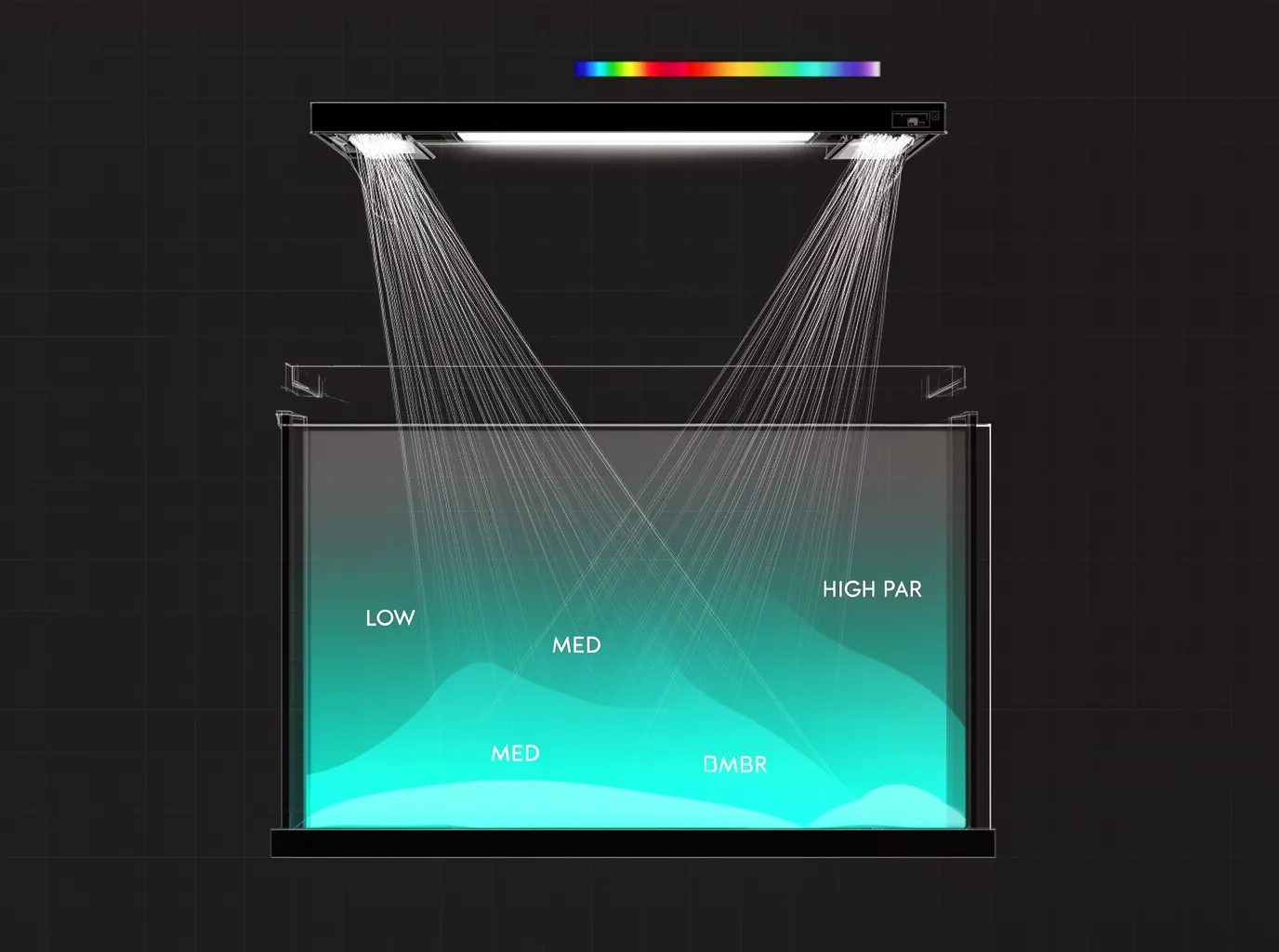
If you look closely at a tank under high PAR near the surface, you will often notice stronger growth in upper stems compared to lower leaves. That difference is energy distribution through depth.
This is usually the point when it becomes clear that PAR is not about brightness at the light source. It is about usable energy at plant level.
Why It Happens
In planted aquariums, light intensity decreases with depth. Water absorbs and scatters photons. Hardscape and plant mass create shading.
When this starts appearing, carpeting plants in the foreground may thin out while stem tops grow aggressively. The surface receives high PAR. The substrate receives less.
Biologically, higher PAR increases photosynthetic rate only if CO2 and nutrients remain stable. If carbon supply cannot match high surface PAR, excess energy creates metabolic stress.
This is what causes algae under intense light with unstable CO2.
This explains why raising PAR without stabilizing carbon often worsens imbalance.
How To Diagnose It
When plant growth feels uneven, start by observing distribution patterns across the tank rather than adjusting intensity immediately.
In most tanks, upper growth thriving while lower leaves deteriorate indicates depth based PAR drop off. Shadows from hardscape or dense stems amplify this effect.
Measure PAR at multiple levels if possible. Surface readings alone do not reflect substrate energy.
You will often notice that tanks running 150 to 200 micromoles at substrate behave differently from tanks running 40 to 60 at substrate under the same fixture.
This is where measurement clarifies assumptions.
If algae concentrates in high light zones near the surface, excess PAR relative to carbon stability may be the constraint.
How To Fix It (Beginner-Friendly)
Correcting PAR imbalance begins with matching intensity to system stability rather than chasing higher numbers.
Set a Realistic PAR Range
In most high tech planted tanks, 50 to 80 micromoles at substrate supports healthy growth when CO2 is stable. Advanced aquascapes may run 100 or more, but carbon must remain consistent.
This is why moderate PAR often produces more stable results than extreme intensity.
Balance PAR With CO2
If PAR exceeds carbon delivery capacity, reduce intensity slightly while stabilizing CO2 injection and distribution.
In practice, plants respond more predictably to stable moderate PAR than unstable high PAR.
Improve Distribution
Raise fixtures slightly or adjust mounting to widen spread. Hard shadows create localized high and low energy zones.
You will often notice improved uniformity when spread improves even if peak PAR decreases.
This explains why distribution sometimes matters more than raw intensity.
Prevention Strategy
In planted systems that remain stable long term, PAR remains aligned with carbon supply rather than pushing the upper limit.
Use consistent mounting height. Avoid sudden large intensity increases. Observe plant response over several days before adjusting further.
Almost always, algae outbreaks follow rapid intensity increases without carbon recalibration.
This is usually where restraint protects the system.
Reconnect to the core model: PAR must remain inside the tank’s energy processing envelope.
System Interactions
Light
Higher PAR increases energy input per second. Short photoperiod at high PAR can equal long photoperiod at moderate PAR.
This is why intensity and duration cannot be separated.
CO2
Carbon supply determines how much PAR plants can utilize. High PAR under unstable CO2 narrows stability margin quickly.
In most tanks, stable carbon allows slightly higher PAR safely.
Nutrients
Nutrient uptake scales with photosynthetic rate. High PAR increases demand for nitrogen and phosphorus.
Deficiency appears faster under intense light.
Substrate
Substrate depth and plant density affect how much PAR reaches lower leaves. Dense carpets may self shade.
Filtration
Flow distribution ensures dissolved CO2 reaches high PAR zones. Poor circulation under intense light magnifies imbalance.
Stability
Daily consistency in intensity prevents metabolic shock. Fluctuating light output creates stress patterns similar to unstable CO2.
Reconnect again: PAR amplifies whatever stability already exists.
Advanced: Mechanism & Biology
Photosynthesis rate increases as photon flux increases until saturation. Beyond saturation, additional light does not increase carbon fixation unless CO2 supply also increases.
When PAR exceeds carbon availability, excess excitation energy produces reactive oxygen species within chloroplasts. Plants activate protective mechanisms, reducing efficiency.
Algae often tolerate fluctuating carbon better than vascular plants.
This explains why moderate PAR with stable carbon often outperforms extreme PAR with unstable supply.
Advanced: System Stability Analysis
Think of PAR control in three layers.
Layer one is intensity at substrate. Layer two is distribution across depth and layout. Layer three is carbon and nutrient stability relative to that energy input.
If intensity is high but distribution uneven, localized stress appears. If intensity is moderate but carbon unstable, algae still emerges.
In most tanks, optimal performance occurs when PAR remains slightly below maximum carbon processing capacity.
This is usually where balance becomes visible in steady, compact growth.
More light is not always better. Balanced light is better.
Common Myths
Higher PAR always means faster growth. Growth depends on carbon and nutrient stability.
You need 100 plus micromoles for carpeting plants. Many carpets thrive at moderate PAR with stable CO2.
Surface PAR reading reflects whole tank intensity. Depth and shading change distribution significantly.
Algae is caused by too much light alone. Imbalance between light and carbon drives it.
FAQ
What PAR should I aim for in a planted tank? Most stable systems run 40 to 80 micromoles at substrate depending on plant type and CO2 stability.
Is high PAR necessary for red plants? Higher PAR can enhance pigmentation but only with stable carbon and nutrients.
How do I measure PAR accurately? Use a calibrated PAR meter at multiple depths and positions.
Can low tech tanks run high PAR? Without injected CO2, moderate PAR is safer.
Should I increase PAR gradually? Yes. Adjust in small increments and observe plant response over several days.
Related Guides
How Long To Run Lights
CO2 Problems and Fixes
How Much CO2 Do I Need
High Light vs Low Light Systems
Understanding Photoperiod Balance
Clean URL suggestion: /freshwater/lighting/par-for-planted-tanks