
SPS Coral Care: The Complete Guide to Keeping Small
Quick Summary
SPS corals are the most demanding category of reef coral, but also the most rewarding when conditions are right. Keeping them healthy requires stable alkalinity (7.5 to 9.0 dKH with minimal daily swing), high light (200 to 450 PAR), strong variable flow, consistent calcium and magnesium levels, and disciplined husbandry. The single most important factor is stability. SPS corals tolerate a range of acceptable parameter values, but they do not tolerate fluctuation within that range.
If your reef tank has been running for at least 6 months, your alkalinity stays within 0.5 dKH day-to-day, and your other parameters hold steady between water changes, you are likely ready for entry-level SPS. Start with Montipora or Pocillopora, prove your system can sustain them, and work up to Acropora and more demanding species from there.
What Makes SPS Different
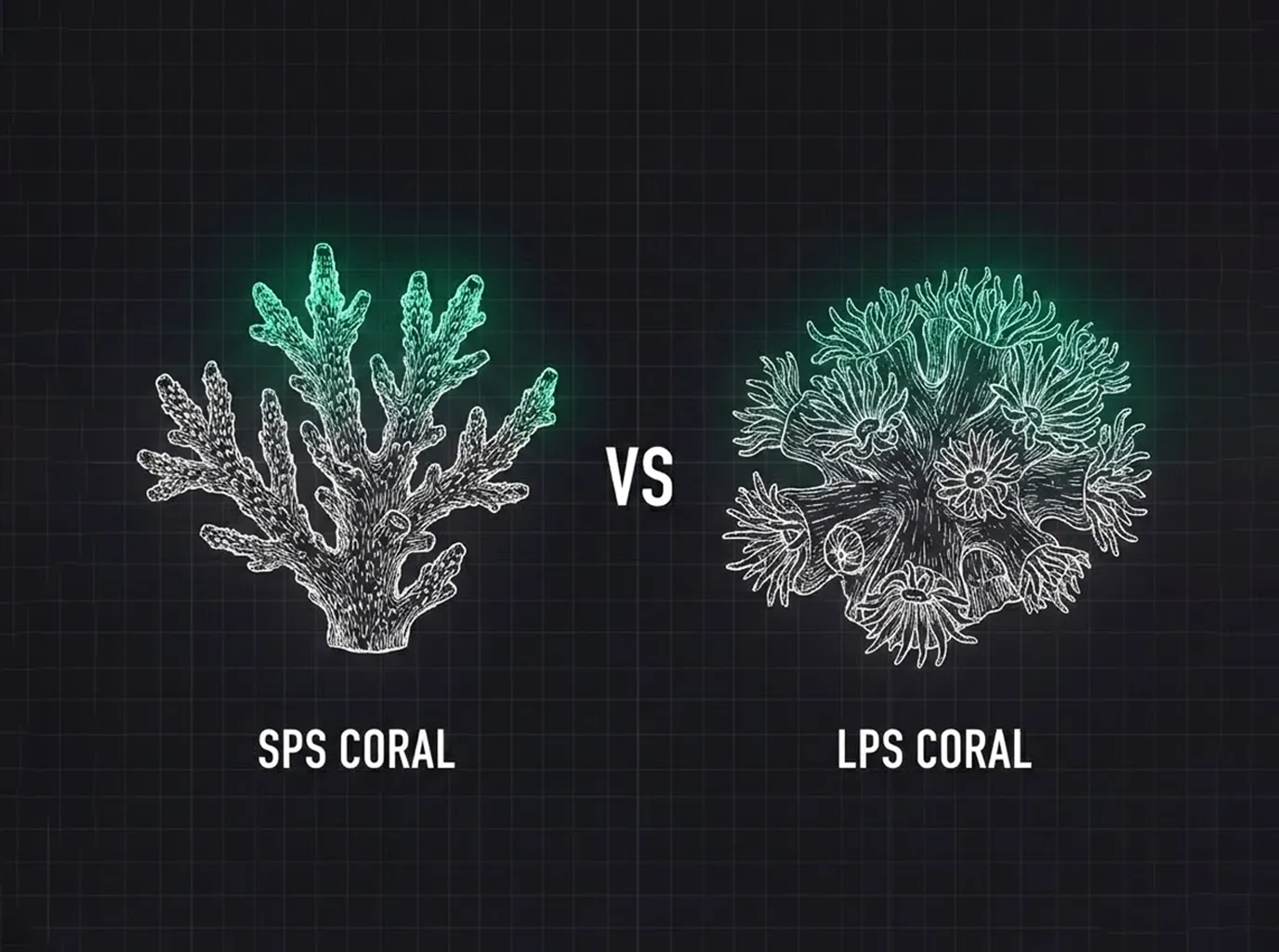
If you have kept LPS corals or soft corals successfully, you already understand the basics of reef husbandry. SPS corals take those same fundamentals and narrow the acceptable margins considerably.
SPS corals have thin tissue covering a porous calcium carbonate skeleton. This thin tissue means minimal energy reserves. When something goes wrong in the tank, SPS respond within hours to days, not weeks. An alkalinity swing that an LPS coral absorbs without visible stress can cause an Acropora to begin losing tissue from the base within 24 hours.
This sensitivity is not a design flaw. It is the biological reality of an organism that dedicates most of its energy to rapid skeletal growth rather than tissue mass. SPS corals grow fast when conditions are optimal and decline fast when conditions shift. Your job as the reef keeper is to make the environment so consistent that the coral never has to choose between growth and survival.
Water Parameters for SPS
Water chemistry is the foundation of SPS care. Every other factor (light, flow, feeding) matters, but none of them can compensate for unstable or out-of-range water chemistry.
Alkalinity: The Most Critical Parameter
Alkalinity is consumed by SPS corals as they build their calcium carbonate skeletons. In an SPS-dominant system, alkalinity drops measurably every day, and the rate of consumption increases as coral mass grows.
Target range: 7.5 to 9.0 dKH. The exact number matters less than the consistency. A tank that holds steady at 7.8 dKH will grow SPS better than a tank that swings between 8.0 and 10.0 dKH.
Daily stability target: within 0.5 dKH. If your alkalinity swings more than 0.5 dKH between dosing cycles, your dosing method needs adjustment. This is usually the point when reef keepers move from manual dosing to automated dosing pumps or calcium reactors.
Testing frequency: daily when first establishing SPS, weekly once dosing is dialed in and consumption rates are predictable.
Calcium
Calcium is the other major building block of coral skeleton. SPS consume it alongside alkalinity in a roughly predictable ratio.
Target range: 400 to 450 ppm. Calcium is less volatile than alkalinity because it is present at much higher absolute concentrations in the water. A 10 ppm calcium swing is proportionally smaller than a 0.5 dKH alkalinity swing.
Most reef keepers find that maintaining alkalinity stability automatically keeps calcium reasonably stable, provided both are being dosed. If calcium drifts outside range while alkalinity stays stable, check your magnesium level, as magnesium imbalance disrupts the calcium-alkalinity relationship.
Magnesium
Magnesium stabilizes the calcium and alkalinity balance. Without adequate magnesium, calcium precipitates out of solution and alkalinity becomes difficult to maintain.
Target range: 1,300 to 1,400 ppm. Magnesium is consumed slowly in most reef tanks and often only needs supplementation every few weeks rather than daily. Test biweekly and dose as needed.
Nitrate
Target range: 1 to 10 ppm. Ultra-low nitrate (below 1 ppm) starves SPS zooxanthellae and produces pale, slow-growing corals. Elevated nitrate (above 15 ppm) causes tissue browning as zooxanthellae overpopulate, blocks coloration, and can promote tissue recession.
In practice, 3 to 8 ppm is the sweet spot where most SPS display their best coloration and growth rate. Tanks running ultra-low nutrient systems (ULNS) often struggle with pale, fragile SPS. A small, stable nitrate presence is healthier than chasing zero.
Phosphate
Target range: 0.01 to 0.08 ppm. Phosphate inhibits calcification when elevated and starves zooxanthellae when depleted. Like nitrate, a small stable presence is preferable to zero.
Phosphate testing requires an accurate colorimetric or photometric test (Hanna Checker is the hobby standard). Standard reef test kits often lack the resolution to distinguish 0.02 from 0.08 ppm, which matters for SPS care.
Temperature
Target: 76 to 79°F (24.5 to 26°C). Temperature stability matters as much as the target range. Daily swings exceeding 2°F stress SPS and can trigger bleaching. A quality heater controller and, in warm climates, a chiller or fan-based cooling system are essential for SPS tanks.
Salinity
Target: 1.025 to 1.026 specific gravity (35 ppt). Use a refractometer calibrated with calibration fluid, not a hydrometer. Hydrometers are too imprecise for SPS-level husbandry. Top off evaporation with fresh RO/DI water daily (or via auto top-off) to prevent salinity creep.
Lighting for SPS
SPS corals are photosynthesis-dependent organisms. The light you provide determines their energy budget, coloration, and growth potential.
PAR Requirements
Most SPS corals need PAR levels of 200 to 450 at their placement point. Acropora species generally require the upper end of this range (300 to 450 PAR). Montipora and Pocillopora are more flexible and can perform well at 150 to 350 PAR.
Measure PAR at the coral's actual position in the tank, not at the water surface. Light attenuates significantly through water depth and spreads laterally from the fixture. A light producing 500 PAR at the surface may deliver only 200 PAR at the bottom of a 50 cm tank.
Spectrum
Blue and violet wavelengths (400 to 480 nm) drive fluorescent protein production in SPS, creating the vivid blues, purples, greens, and pinks that make these corals visually stunning. A spectrum weighted toward blue with moderate white (the typical "20K look" that many reef keepers prefer) maximizes coloration while providing adequate photosynthetically active radiation.
Full white spectrums (6500K appearance) grow SPS effectively but often produce browner, less colorful colonies. The zooxanthellae thrive under broad-spectrum light and overpopulate, masking the coral's natural fluorescent pigments with their own brown coloration.
Photoperiod
Run lights for 8 to 10 hours daily. A ramp-up period of 30 to 60 minutes at the start and end of the photoperiod simulates sunrise and sunset and reduces the stress of sudden light intensity changes. Many modern reef LED fixtures have built-in scheduling for gradual ramp profiles.
Light Acclimation
New SPS corals must be acclimated to your tank's light intensity gradually. A coral grown under moderate light at a coral farm or frag swap will bleach if placed immediately under high-intensity lighting.
Start new SPS at the bottom or mid-level of your rockwork and move them upward over 2 to 4 weeks. Alternatively, reduce light intensity by 30 to 40 percent when adding new SPS and increase it gradually over 2 to 3 weeks. You will often notice new SPS browning slightly during acclimation as zooxanthellae populations adjust. This is normal and reverses as the coral settles in.
Flow for SPS
SPS corals evolved on wave-swept reef crests. They need strong, variable water movement to thrive in the aquarium.
How Much Flow
Total flow in an SPS tank should be 20 to 50 times the tank volume per hour from all sources combined (filter return, wavemakers, powerheads). For a 200-liter tank, that means 4,000 to 10,000 liters per hour of total water movement.
This sounds aggressive, but the flow should be distributed across the entire tank through multiple sources, not blasted from a single powerhead. The goal is turbulent, random-pattern flow that reaches every coral surface from varying angles.
Flow Pattern
Variable or pulsing flow is strongly preferred over constant laminar current. Wavemaker controllers that create randomized pulse patterns produce the best SPS polyp extension and growth. Constant unidirectional flow causes one-sided growth, tissue thinning on the high-flow side, and dead zones on the sheltered side.
Position powerheads or wavemakers so their output overlaps and creates chaotic intersection patterns. Two wavemakers on opposite ends of the tank, running offset pulse programs, create a natural turbulence that SPS respond to with full polyp extension and vigorous growth.
Signs of Inadequate Flow
If you notice tissue recession on one side of an SPS colony while the other side grows normally, the affected side is likely in a flow shadow. Sediment or detritus settling on SPS branches indicates insufficient flow in that zone. Mucus buildup on coral surfaces (visible as a hazy film) signals that flow is not strong enough to clear metabolic waste from the tissue.
Feeding SPS
SPS corals are primarily photosynthetic, but supplemental feeding produces measurably better growth and coloration.
Broadcast Feeding
SPS benefit from dissolved and fine particulate foods added to the water column. Amino acid supplements (Acropower, Reef Energy, or similar products) are the most widely used SPS food. Dose 1 to 3 times per week according to the product's instructions.
Phytoplankton and bacterioplankton supplements provide additional food sources that SPS capture through their mucus nets. These are particularly useful in low-nutrient systems where ambient particulate matter is scarce.
What SPS Cannot Eat
SPS polyps are too small to capture the meaty foods that LPS corals consume. Mysis shrimp, brine shrimp, and chunky coral foods are wasted on SPS and only contribute to nutrient loading. Keep SPS feeding to dissolved and sub-100-micron particulate foods.
Feeding and Nutrient Balance
Every food addition raises nutrient levels. In SPS tanks where nitrate and phosphate are carefully managed, overfeeding can push parameters out of range. Start with the minimum recommended dose of any coral food and increase only if corals respond positively without a detectable nutrient rise.
In practice, most SPS tanks benefit from consistent, light feeding rather than heavy, infrequent feeding. Small doses 2 to 3 times per week maintain a steady nutritional baseline without nutrient spikes.
Acclimation and Placement
How you introduce new SPS to your tank and where you place them determines their survival in the critical first 2 to 4 weeks.
Acclimation Process
Temperature acclimate by floating the bag or container in your sump or tank for 15 to 20 minutes. For parameter acclimation, drip acclimate over 30 to 60 minutes, adding tank water slowly until the coral's water volume has roughly doubled.
Dip new SPS in a coral pest treatment (CoralRx, Bayer, or similar) before placing in the tank. SPS are vulnerable to hitchhiker pests (Acropora eating flatworms, red bugs, nudibranchs) that can devastate colonies if introduced undetected.
Initial Placement
Place new SPS in a lower-light, moderate-flow zone for the first 1 to 2 weeks. This gives the coral time to recover from shipping stress and adjust to your tank's specific conditions without the additional stress of maximum light intensity.
After 1 to 2 weeks, begin moving the coral toward its permanent placement. Move in small increments (5 to 8 cm upward every 3 to 5 days) to allow gradual light acclimation.
Permanent Placement
SPS go at the top of the rockwork in most reef tanks, where light and flow are strongest. Space colonies to allow growth room. A 3 cm frag will become a 15 cm colony within a year under good conditions. Crowding SPS leads to intercolony warfare (chemical aggression) and shading as colonies grow into each other.
Encrusting species (Montipora capricornis, Montipora digitata) can be placed on vertical rock faces or overhangs. Branching species (Acropora, Seriatopora) perform best on horizontal surfaces or gently sloped rockwork where light hits them from above.
Common SPS Species and Their Needs
Each SPS genus has distinct characteristics. Matching your species selection to your system's capabilities prevents the frustration of keeping corals that your tank cannot support.
Montipora
The most forgiving SPS genus. Montipora species (capricornis, digitata, setosa, undata) tolerate slightly lower light (150 to 300 PAR), wider parameter ranges, and moderate flow. They grow fast as encrusting plates or branching colonies. In most tanks, Montipora is the first SPS to try and the last to show problems when conditions shift.
Pocillopora
Hardy, fast-growing branching SPS that adapts to a range of conditions. Pocillopora damicornis is nearly as forgiving as Montipora and is an excellent second SPS species. It handles moderate to high flow and light well and recovers quickly from minor stress events.
Stylophora
Branching SPS with slightly higher demands than Pocillopora. Stylophora prefers strong flow and high light (250 to 400 PAR). It grows into dense, bushy colonies and is a reliable mid-tier SPS species.
Seriatopora
Thin-branched, delicate SPS known as "Birdsnest" coral. Seriatopora grows quickly but is more sensitive to alkalinity swings than Montipora or Pocillopora. Its fine branches are easily damaged by physical contact. Keep it in high light and moderate to strong flow with space around it.
Acropora
The benchmark SPS genus. Acropora species number in the hundreds and range from relatively tolerant (A. millepora) to extremely demanding (A. tenuis, A. nasuta). All Acropora require high light (300 to 450 PAR), strong variable flow, and tight parameter control. Tissue recession from the base (STN, slow tissue necrosis) or tips (RTN, rapid tissue necrosis) is the characteristic failure mode when conditions are not met.
If your system consistently grows Montipora, Pocillopora, and Stylophora well for 3 to 6 months, it is likely stable enough for Acropora.
Common Problems
SPS corals communicate stress through a predictable set of visual cues. Recognizing these early gives you a window to identify and correct the cause before the coral is lost.
Tissue Recession (STN)
Slow tissue necrosis begins as a visible line of bare white skeleton at the base of branches, progressing upward over days to weeks. The tissue appears to pull away from the skeleton, exposing clean white calcium carbonate underneath.
Common causes: alkalinity instability, prolonged low alkalinity, chronic elevated nitrate or phosphate, insufficient flow around the colony base, or pest damage.
Response: test alkalinity immediately and correct any deviation. Inspect the affected area with a magnifying glass for flatworms, nudibranchs, or other pests. If recession is advancing rapidly, frag healthy tissue above the recession line to preserve the colony.
Rapid Tissue Necrosis (RTN)
RTN is catastrophic tissue loss that progresses across an entire colony within hours. Healthy tissue sloughs off in sheets, exposing bare skeleton. By the time RTN is visible, much of the colony is already lost.
Common causes: severe parameter shock (large alkalinity or temperature swing), bacterial infection following physical damage, or introduction of an infected coral.
Response: immediately frag any visibly healthy portions and move them to a separate container with stable tank water. RTN cannot be reversed once it starts on a colony. The only option is saving unaffected fragments.
Browning
SPS colonies that turn brown or dull have overabundant zooxanthellae populations masking the coral's natural pigments. This is typically caused by elevated nitrate and phosphate, excessive white-spectrum lighting, or insufficient light intensity that triggers the coral to pack more zooxanthellae for energy production.
Response: gradually lower nutrients through water changes and GFO (granular ferric oxide) if phosphate is elevated. Increase blue spectrum intensity or overall PAR. Browning reverses over weeks to months as zooxanthellae populations adjust.
Bleaching
Bleaching is the expulsion of zooxanthellae from coral tissue, leaving the tissue transparent and the white skeleton visible through it. Mild bleaching (partial, one side of a colony) can recover. Severe bleaching (entire colony) is often fatal.
Common causes: temperature spike above 82°F (28°C), sudden light intensity increase, severe parameter swing, or chemical contamination.
Response: reduce light intensity by 30 percent. Stabilize temperature and parameters. Do not feed aggressively during bleaching recovery, as the coral cannot process food without its zooxanthellae. Recovery, if it occurs, takes weeks to months.
Dosing and Supplementation
An SPS-dominant reef consumes alkalinity, calcium, and magnesium daily. Manual dosing works for small systems with light SPS loads, but most SPS keepers eventually automate.
Two-Part Dosing
The most common method. Separate alkalinity (sodium bicarbonate/carbonate) and calcium (calcium chloride) solutions are dosed in balanced amounts. Dose in small, frequent increments spread across the day rather than one large daily dose. Larger, less frequent doses create parameter spikes that SPS detect and react to.
Automated dosing pumps that deliver small amounts every hour or two provide the most stable results. Manual dosing twice daily (morning and evening) is the minimum frequency for acceptable stability.
Calcium Reactor
For systems with heavy SPS loads consuming large amounts of alkalinity and calcium, a calcium reactor dissolves calcium carbonate media using CO2-acidified tank water, returning balanced alkalinity and calcium to the system continuously. Calcium reactors provide the most stable delivery method but require more setup, tuning, and monitoring than two-part dosing.
Kalkwasser (Limewater)
Saturated calcium hydroxide solution dripped as top-off water. Kalkwasser supplements both calcium and alkalinity while precipitating phosphate. It works well as a supplemental method alongside two-part dosing but rarely provides enough on its own for heavy SPS systems.
Advanced: Stability as the Master Variable
Experienced SPS keepers eventually recognize that stability overrides every other variable. A tank holding alkalinity at 7.5 dKH with 0.2 dKH daily variation will outperform a tank swinging between 8.0 and 9.5 dKH, even though the second tank's average is within the ideal range.
This is because SPS corals calibrate their metabolic processes to the ambient conditions. Skeletal growth rate, zooxanthellae density, and tissue thickness all adjust to the current environment. When parameters shift, the coral must recalibrate. Frequent recalibration wastes energy, slows growth, and eventually compromises tissue health.
This explains why seemingly identical tanks produce different results. The tank with boring, unchanging parameters grows SPS consistently. The tank with "correct" parameters that swing between water changes experiences perpetual minor stress that compounds over months.
The practical implication is that dosing precision, auto top-off reliability, consistent feeding schedules, and repeatable water change routines matter more than chasing perfect numbers. Stability is not a single parameter. It is the entire system behaving predictably.
Advanced: Nutrient Balance and SPS Coloration
SPS coloration is a direct product of the balance between zooxanthellae density and host fluorescent pigments. This balance is controlled primarily by light and nutrients.
Elevated nitrate and phosphate promote zooxanthellae growth. Dense zooxanthellae populations appear brown and mask the coral's underlying fluorescent proteins. This is why nutrient-rich tanks produce brown SPS even under quality lighting.
Very low nutrients (near-zero nitrate and phosphate) reduce zooxanthellae density, which reveals fluorescent pigments and produces vivid coloration. However, taken too far, nutrient depletion starves the coral. The zooxanthellae provide energy through photosynthesis, and with too few of them, the coral cannot sustain tissue or grow skeleton.
The best SPS coloration occurs in a narrow nutrient band: just enough nitrate (3 to 8 ppm) and phosphate (0.02 to 0.06 ppm) to maintain zooxanthellae health without overpopulation. Achieving this band requires consistent testing and precise nutrient management, which is part of what makes SPS keeping an advanced skill.
Common Myths
"SPS need ultra-low nutrients to color up." Near-zero nutrients produce pale, fragile corals that lack energy reserves. The best coloration comes from low but measurable nitrate (3 to 8 ppm) and phosphate (0.02 to 0.06 ppm). Chasing zero nutrients is one of the most common mistakes in SPS keeping.
"You need a 2-year-old tank for SPS." Tank age is a proxy for stability, not a requirement itself. A 6-month-old tank with consistent parameters and mature biological filtration can support entry-level SPS. A 3-year-old tank with ongoing stability issues cannot. Judge readiness by parameter consistency, not calendar time.
"More light is always better for SPS." Excessive light (above 500 PAR for most species) causes photoinhibition, where zooxanthellae are damaged by light energy they cannot process. The coral responds with bleaching or chronic stress. Match PAR to the species' documented range rather than maximizing intensity.
"SPS are too hard for intermediate reef keepers." Entry-level SPS (Montipora, Pocillopora) are well within reach of reef keepers who have maintained stable LPS tanks for 6 months or more. Starting with forgiving species and building experience gradually is more productive than avoiding SPS entirely until some arbitrary experience threshold.
FAQ
What is the best first SPS coral?
Montipora capricornis (plating Montipora) or Montipora digitata (branching Montipora) are the most forgiving SPS species. They tolerate slightly lower light, wider parameter ranges, and moderate flow. If they grow well for 2 to 3 months, your system is ready for more demanding species.
How do I know if my tank is ready for SPS?
Test alkalinity daily for two weeks. If it stays within 0.5 dKH of your target without intervention, your dosing is stable enough. Check that calcium stays above 400 ppm, magnesium above 1,300 ppm, and nitrate and phosphate are detectable but low. If all of these hold consistently, start with an entry-level SPS.
Why is my SPS turning brown?
Browning indicates excess zooxanthellae density, typically caused by elevated nitrate or phosphate, insufficient blue-spectrum light, or overall PAR that is too low. Gradually increase light intensity, reduce nutrients through water changes and media, and the coral should regain coloration over 4 to 8 weeks.
How often should I test water in an SPS tank?
Test alkalinity daily until dosing is consistent, then weekly. Test calcium and magnesium weekly. Test nitrate and phosphate weekly. Test salinity daily or rely on a calibrated ATO system. Once your system is dialed in and consumption patterns are predictable, biweekly testing for stable parameters is acceptable.
Can I keep SPS with aggressive LPS like Torch coral?
Yes, but maintain significant distance (15 cm minimum) between aggressive LPS and SPS. Euphyllia sweeper tentacles can extend 10 cm or more at night and will damage SPS tissue on contact. Place SPS above and well away from any LPS with known chemical or physical aggression.
What causes SPS tips to turn white?
White tips on actively growing SPS are normal. The newest skeletal growth has not yet been colonized by zooxanthellae, so it appears white or pale. This is a sign of healthy, active growth. White tips that progress downward into tissue recession are a different situation entirely and indicate STN.