
SPS vs LPS Coral: Differences and Care
Quick Summary
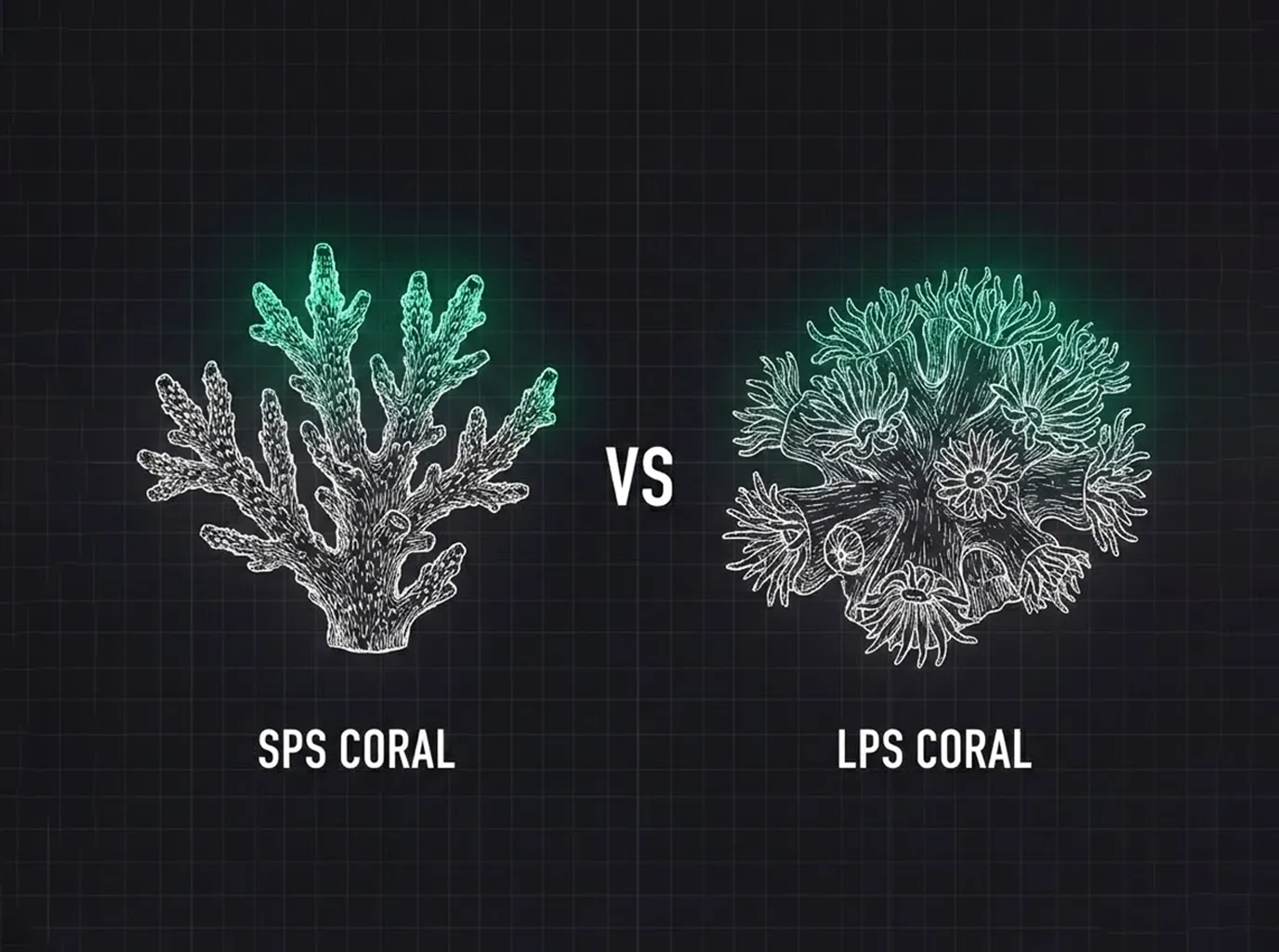
SPS (small polyp stony) and LPS (large polyp stony) are the two main categories of hard coral kept in reef aquariums. Both build calcium carbonate skeletons, but they differ in polyp size, growth form, care difficulty, and environmental demands. SPS corals have tiny polyps on branching or plating skeletons and require pristine water, high light, and strong flow. LPS corals have large, fleshy polyps on bulkier skeletons and tolerate a wider range of conditions.
For most reef keepers, LPS corals are the entry point into stony corals. They are more forgiving of parameter fluctuations and adapt to moderate lighting and flow. SPS corals are the benchmark of an advanced, stable reef system. Keeping them healthy signals that your water chemistry, lighting, and husbandry are operating at a high level. Neither category is better than the other. They serve different roles in different systems and at different stages of a reef keeper's experience.
What Are SPS Corals?
If you have ever seen a reef tank filled with colorful branching Acropora, vivid plating Montipora, or encrusting Pocillopora, you were looking at SPS corals. The name refers to the small size of their individual polyps, which are typically 1 to 3 mm in diameter, often barely visible without close inspection.
SPS corals build lightweight, porous calcium carbonate skeletons that grow into branching, plating, tabling, or encrusting forms. Their growth is relatively fast compared to many LPS species, which is part of their appeal for aquascaping. A healthy Acropora colony can add several centimeters of branch length per month under optimal conditions.
The small polyp size means SPS corals have limited ability to capture food particles from the water. They rely heavily on their symbiotic zooxanthellae (photosynthetic algae living within their tissue) for energy. This is why SPS corals demand high light intensity. Without strong PAR levels, the zooxanthellae cannot photosynthesize enough to sustain the coral's metabolic and skeletal growth needs.
Common SPS genera in the hobby include Acropora, Montipora, Stylophora, Pocillopora, Seriatopora, and Porites. Acropora is considered the most demanding and is often the benchmark species for evaluating reef system stability.
What Are LPS Corals?
LPS corals are the fleshy, dramatic corals that draw attention in any reef tank. Their polyps are large (often 1 cm or more in diameter), and many species inflate their tissue dramatically during the day, creating a soft, pillowy appearance that belies the hard skeleton underneath.
The larger polyps give LPS corals a significant advantage in feeding. They can capture zooplankton, phytoplankton, and particulate food directly from the water column. This supplemental feeding means LPS corals are less dependent on light-driven photosynthesis than SPS species. In practice, many LPS corals thrive under moderate lighting that would starve an Acropora.
LPS skeletons tend to be denser and more massive than SPS skeletons. Growth forms include brain-like domes (Favia, Favites), long tentacle clusters (Euphyllia), plate-like discs (Fungia), and tubular structures (Caulastrea). Growth rates are generally slower than SPS, but the large tissue mass and vivid coloration make LPS corals visually impactful even at small colony sizes.
Common LPS genera include Euphyllia (Torch, Hammer, Frogspawn), Blastomussa, Acanthastrea (Acan Lords), Lobophyllia, Trachyphyllia (Open Brain), Duncanopsammia (Duncan), Caulastrea (Candy Cane), and Goniopora.
Structural Differences
The distinction between SPS and LPS goes beyond polyp size. The skeletal architecture and tissue distribution create fundamentally different organisms with different vulnerabilities.
Skeleton
SPS corals build thin-walled, highly branched skeletons with high surface-area-to-mass ratios. This structure maximizes light exposure across the colony and allows rapid skeletal extension. However, the thin branches are fragile. Strong impacts, rockwork shifts, or aggressive tank inhabitants can snap branches easily.
LPS corals build thicker, denser skeletons with lower surface-area-to-mass ratios. Brain corals, for instance, grow as solid, rounded mounds. This makes them more physically robust but also means they grow more slowly because more calcium carbonate is deposited per unit of surface expansion.
Tissue
SPS coral tissue is a thin layer covering the skeleton. There is very little flesh between the surface and the underlying calcium carbonate. This thin tissue means SPS corals have minimal energy reserves. When stressed, they deplete their reserves quickly, which is why SPS respond to problems faster and more dramatically than LPS.
LPS coral tissue is thick, fleshy, and often extends well beyond the skeleton. Many LPS species (Euphyllia, Trachyphyllia) have tissue that inflates to several times the skeleton's footprint during the day. This tissue mass represents stored energy, giving LPS corals a buffer against short-term stress events that would damage SPS.
This is why LPS corals tolerate parameter swings that would cause SPS to bleach or die. The tissue reserves buy time for the coral to adapt, while SPS corals have almost no margin for error.
Lighting Requirements
Light is the primary energy source for both SPS and LPS, but the intensity and spectrum they need differ substantially.
SPS: High Light
Most SPS corals require PAR levels of 200 to 450 at their placement point. Some Acropora species perform best above 300 PAR. This is why SPS corals are typically placed at the top of the rockwork, closest to the light source.
The high light demand stems from the SPS growth model. With small polyps and minimal heterotrophic feeding, virtually all energy for tissue maintenance and skeletal growth comes from zooxanthellae photosynthesis. Insufficient light produces slow growth, color loss, and eventually tissue recession from the tips or base of branches.
SPS corals also respond to light spectrum. Blue and violet wavelengths (400 to 480 nm) drive fluorescent protein production, which creates the vivid coloration reef keepers prize. A strong blue spectrum with moderate white intensity is the typical lighting strategy for SPS-dominant systems.
LPS: Moderate Light
LPS corals generally thrive at PAR levels of 75 to 200. Some species (Blastomussa, Caulastrea) perform well at even lower levels. Placing LPS under SPS-intensity lighting can actually cause photoinhibition, where excess light damages the zooxanthellae and causes bleaching.
The lower light requirement comes from the dual feeding strategy of LPS. Because they supplement photosynthesis with direct food capture, LPS corals are less reliant on maximal light intensity. In most reef tanks, LPS occupy the mid to lower zones of the rockwork where light naturally attenuates.
This difference in light demand is one of the main reasons mixed SPS and LPS tanks require careful placement planning. SPS goes high, LPS goes low to mid, and the light gradient across the tank's vertical axis accommodates both.
Flow Requirements
Water movement serves different purposes for SPS and LPS corals, and getting flow wrong is one of the most common causes of coral stress in reef tanks.
SPS: Strong, Variable Flow
SPS corals in the wild grow on exposed reef crests and upper slopes where wave action is constant and strong. In the aquarium, they need vigorous flow (typically 20 to 50 times tank turnover from powerheads and wavemakers, in addition to filter flow) to simulate these conditions.
Strong flow around SPS serves several functions. It delivers dissolved nutrients and food particles to the tiny polyps. It removes waste products and mucus from the coral surface. And it prevents sediment from settling on the fine skeletal branches, which can smother tissue and promote bacterial infection.
Variable or pulsing flow (achieved with wavemaker controllers) is preferable to constant unidirectional current. Random patterns prevent dead zones on the coral colony and more closely mimic natural reef conditions. You will often notice SPS polyps extending more fully in variable flow compared to steady laminar current.
LPS: Moderate, Gentle Flow
LPS corals generally prefer lower flow that allows their large polyps and tentacles to extend fully without being battered by current. Flow that is too strong causes LPS tissue to retract permanently, reduces feeding opportunities (tentacles cannot capture food in chaotic water), and can physically damage inflated tissue that gets pushed against the skeleton or adjacent rockwork.
Moderate flow (enough to see gentle tissue movement but not enough to flatten or pin polyps against the skeleton) is the target. In practice, most LPS do well in the calmer zones of the tank: behind rockwork, in lower positions where flow has dissipated, or in areas sheltered from direct wavemaker output.
Goniopora is a notable exception among LPS. Its long polyps extend best in moderate to moderately strong flow and can retract permanently if water movement is too weak. Each species has its own preferences, but the general rule of gentler flow for LPS holds across most genera.
Water Chemistry Tolerance
This is where the practical difference between keeping SPS and LPS becomes most apparent. Both need stable reef water parameters, but the margin for error differs dramatically.
SPS: Narrow Tolerance
SPS corals require consistent, stable water chemistry within tight ranges. The parameters that matter most:
- Alkalinity: 7.5 to 9.0 dKH. Stability matters more than the exact number. Daily swings of more than 0.5 dKH can cause stress, tissue loss, or bleaching.
- Calcium: 400 to 450 ppm. Necessary for skeleton building. Demand increases as SPS colonies grow.
- Magnesium: 1,300 to 1,400 ppm. Stabilizes alkalinity and calcium balance.
- Nitrate: 1 to 10 ppm. Ultra-low nitrate (below 1 ppm) starves SPS, while elevated nitrate (above 15 ppm) causes browning and tissue recession.
- Phosphate: 0.01 to 0.08 ppm. Excess phosphate inhibits skeletal growth and promotes algae on coral surfaces.
The narrow tolerance is why SPS tanks require consistent testing, automated dosing or calcium reactors, and disciplined husbandry. A parameter swing that an LPS barely notices can cause SPS tissue to recede within days.
LPS: Wider Tolerance
LPS corals tolerate broader parameter ranges and recover more gracefully from fluctuations.
- Alkalinity: 7.0 to 11.0 dKH. Most LPS species handle a wider range and tolerate moderate swings better than SPS.
- Calcium: 380 to 450 ppm. Less critical than for fast-growing SPS because LPS build skeleton more slowly.
- Magnesium: 1,250 to 1,400 ppm.
- Nitrate: 2 to 20 ppm. Many LPS actually benefit from slightly elevated nitrate, which feeds their zooxanthellae and supports more vibrant tissue.
- Phosphate: 0.02 to 0.12 ppm. More tolerant of elevated phosphate than SPS, though excessive levels still cause issues.
This wider tolerance does not mean LPS are indestructible. Sudden, large parameter shifts still stress them. But the buffer they provide makes them far more appropriate for reef keepers who are still learning to maintain consistent chemistry or whose systems are not yet fully matured.
Feeding
How you feed SPS and LPS reflects their different biological strategies.
SPS Feeding
SPS corals feed primarily through photosynthesis. Their small polyps can capture fine particulate foods (amino acids, phytoplankton, bacterioplankton) but not the larger meaty foods that LPS consume.
Many SPS keepers broadcast-feed amino acid supplements, phytoplankton, or coral-specific foods 1 to 3 times per week. These fine particles are captured by the coral's mucus net or absorbed directly through the tissue. The growth and coloration response to consistent amino acid dosing is well-documented in SPS, particularly Acropora.
Direct target feeding of individual SPS polyps is impractical due to their size. Feeding strategy for SPS is water-column based, not polyp-targeted.
LPS Feeding
LPS corals are active, efficient predators at the polyp level. Species like Euphyllia, Trachyphyllia, and Acanthastrea capture and consume meaty foods (mysis shrimp, reef roids, finely chopped seafood) placed directly on or near their polyps. You will often notice feeding tentacles extending at night or when food is detected in the water.
Target feeding LPS 1 to 3 times per week produces noticeably faster growth, improved coloration, and increased tissue mass. Many experienced reef keepers consider regular LPS feeding essential rather than optional, especially for species like Goniopora that rely heavily on heterotrophic nutrition.
LPS also benefit from the broadcast feeding approaches used for SPS (phytoplankton, amino acids), but their ability to consume larger food items gives them a nutritional advantage that SPS cannot match.
Growth Rate and Fragging
Growth characteristics and propagation potential differ between SPS and LPS, which matters for long-term reef planning and coral trading.
SPS Growth
SPS corals grow relatively fast under optimal conditions. Acropora can extend branches 5 to 10 cm per year. Montipora can encrust and plate several centimeters annually. This growth rate means SPS-dominant tanks change visually from month to month, filling in open space and creating complex three-dimensional structures.
Fragging SPS is straightforward. Branches are snapped or cut with bone cutters, glued to frag plugs, and placed back in the tank. SPS heal quickly from clean cuts and begin growing from the frag within weeks. This ease of fragging makes SPS the most commonly traded coral type in the hobby.
LPS Growth
LPS corals grow more slowly. New polyps develop gradually, and colony expansion may be measured in millimeters per month rather than centimeters. This slower pace means LPS tanks are more stable visually over time but take longer to achieve a "filled in" appearance.
Fragging LPS is more involved. Species with distinct polyp heads (Acanthastrea, Blastomussa, Caulastrea) can be separated with a saw or Dremel tool along the skeleton between polyps. Branching LPS like Euphyllia can be cut between branch points. The cuts are more traumatic than SPS snaps, and healing takes longer (2 to 4 weeks for tissue to fully recover over the cut surface).
Difficulty Level
In most reef keeping communities, the consensus difficulty ranking from easiest to hardest is: soft corals, then LPS, then SPS. This ranking is broadly accurate but oversimplifies the range within each category.
Easy LPS (Beginner-Friendly)
Several LPS species are genuinely hardy and appropriate for newer reef keepers with stable, cycled systems. Duncan corals, Candy Cane (Caulastrea), Blastomussa, and Hammer coral (Euphyllia ancora) tolerate moderate conditions and recover well from minor mistakes.
Demanding LPS
Some LPS species are surprisingly difficult. Goniopora has a historically poor survival rate in captivity despite being widely sold. Alveopora and certain Acanthastrea species require specific flow, feeding, and placement to thrive. Do not assume all LPS are easy.
Entry-Level SPS
Montipora (both encrusting and plating varieties) and Pocillopora are considered the most forgiving SPS. They tolerate slightly wider parameter ranges than Acropora and adapt to moderate-high (rather than extreme-high) light. Many reef keepers use these species as indicators: if Montipora grows well, the system may be ready for more demanding SPS.
Advanced SPS
Acropora, Seriatopora, and many Stylophora species demand the tightest parameter control, highest light, strongest flow, and most consistent husbandry. They are the last corals most reef keepers add and the first to show signs when something in the system shifts.
Can You Keep SPS and LPS Together?
Most reef tanks contain a mix of SPS and LPS, and this works well with proper planning. The key is respecting the different requirements of each category through strategic placement.
Place SPS at the top of the rockwork where light and flow are strongest. Place LPS in the middle and lower zones where light attenuates and flow is gentler. Leave adequate space between LPS species with sweeper tentacles (Euphyllia, Galaxea) and any neighboring corals, as these tentacles can sting and damage adjacent colonies.
The water chemistry in a mixed tank should target the overlapping comfort zone of both categories. Alkalinity of 8 to 9 dKH, calcium at 420 to 440 ppm, and magnesium at 1,350 ppm serves both SPS and LPS well. Nitrate in the 3 to 10 ppm range and phosphate at 0.03 to 0.08 ppm satisfies both without starving SPS or overloading LPS.
In practice, the most successful mixed reef tanks maintain conditions that lean slightly toward SPS requirements. If the system is stable enough for SPS, LPS will thrive. The reverse is not always true.
Common Myths
"SPS are always harder than LPS." On average, yes. But some LPS species (Goniopora, Alveopora) have higher mortality rates in captivity than entry-level SPS species (Montipora, Pocillopora). Difficulty depends on the specific species, not just the category.
"LPS do not need stable water chemistry." LPS are more tolerant of fluctuations, but they still need stable conditions to thrive long-term. A tank with wildly swinging alkalinity will stress LPS just as it stresses SPS, only the symptoms take longer to appear.
"SPS corals do not need feeding." SPS benefit significantly from broadcast feeding of amino acids and fine particulate foods. Unfed SPS tanks often show slower growth and duller coloration compared to consistently fed systems. Photosynthesis alone sustains survival but not optimal performance.
"You need a mature tank for any SPS." While tank maturity (12 or more months) helps with parameter stability, some entry-level SPS (Montipora, Pocillopora) can be added to stable systems as young as 6 months old. The requirement is stability, not age. A stable 6-month tank outperforms an unstable 2-year tank for SPS success.
FAQ
Which should I start with, SPS or LPS?
Start with LPS. Their wider tolerance for parameter fluctuations gives you room to learn and refine your husbandry. Once your LPS are growing well and your water chemistry stays consistent for several months, begin introducing entry-level SPS like Montipora.
Can SPS and LPS share the same light?
Yes. Most modern reef LED fixtures produce enough intensity for SPS at the top of the rockwork while naturally attenuating to appropriate levels for LPS lower down. The vertical gradient in a well-lit tank accommodates both categories without separate lighting zones.
How long before I can add SPS to a new tank?
Most experienced reef keepers wait 6 to 12 months after initial cycling before adding SPS. This allows the biological system to mature, parameters to stabilize, and the reef keeper to establish consistent dosing and maintenance routines. Adding SPS too early, before the system proves it can maintain stable chemistry, often results in rapid tissue loss.
Do LPS sting SPS?
Some LPS species (particularly Euphyllia and Galaxea) have sweeper tentacles that extend well beyond their visible tissue mass and deliver potent stings. These tentacles can damage or kill nearby SPS colonies. Always leave a buffer zone (10 to 15 cm minimum) between aggressive LPS and any neighboring corals.
Is alkalinity or calcium more important for SPS growth?
Alkalinity is consumed faster and fluctuates more readily than calcium in most SPS systems. Maintaining stable alkalinity (within 0.5 dKH day-to-day) is the single most important parameter for consistent SPS health and growth. Calcium is important but changes more slowly and is easier to keep within range.
Can I keep a reef tank with only LPS and soft corals?
Absolutely. Many beautiful and successful reef tanks contain no SPS at all. LPS and soft corals provide vivid color, dramatic movement, and visual complexity without the demanding parameter precision SPS require. This is a perfectly valid approach that suits reef keepers who prefer lower maintenance intensity.