
LPS Coral Care: The Complete Guide to Keeping Large
Quick Summary
LPS corals are the fleshy, dramatic stony corals that bring movement and bold color to reef tanks. They build calcium carbonate skeletons like SPS, but their large polyps, thick tissue, and ability to capture food directly make them significantly more forgiving. Most LPS thrive under moderate lighting (75 to 200 PAR), gentle to moderate flow, and stable water parameters within a wider acceptable range than SPS demand.
LPS are the natural bridge between soft corals and SPS. If you can keep soft corals alive and your water chemistry stays reasonably consistent, you are ready for LPS. They reward good husbandry with vivid coloration, dramatic tissue inflation, and visible feeding responses that make them some of the most engaging corals in the hobby.
What Makes LPS Unique
If you have ever watched a Torch coral's tentacles sway in the current or seen a Trachyphyllia inflate to three times the size of its skeleton, you understand the visual appeal of LPS. These corals look alive in a way that few other reef organisms match.
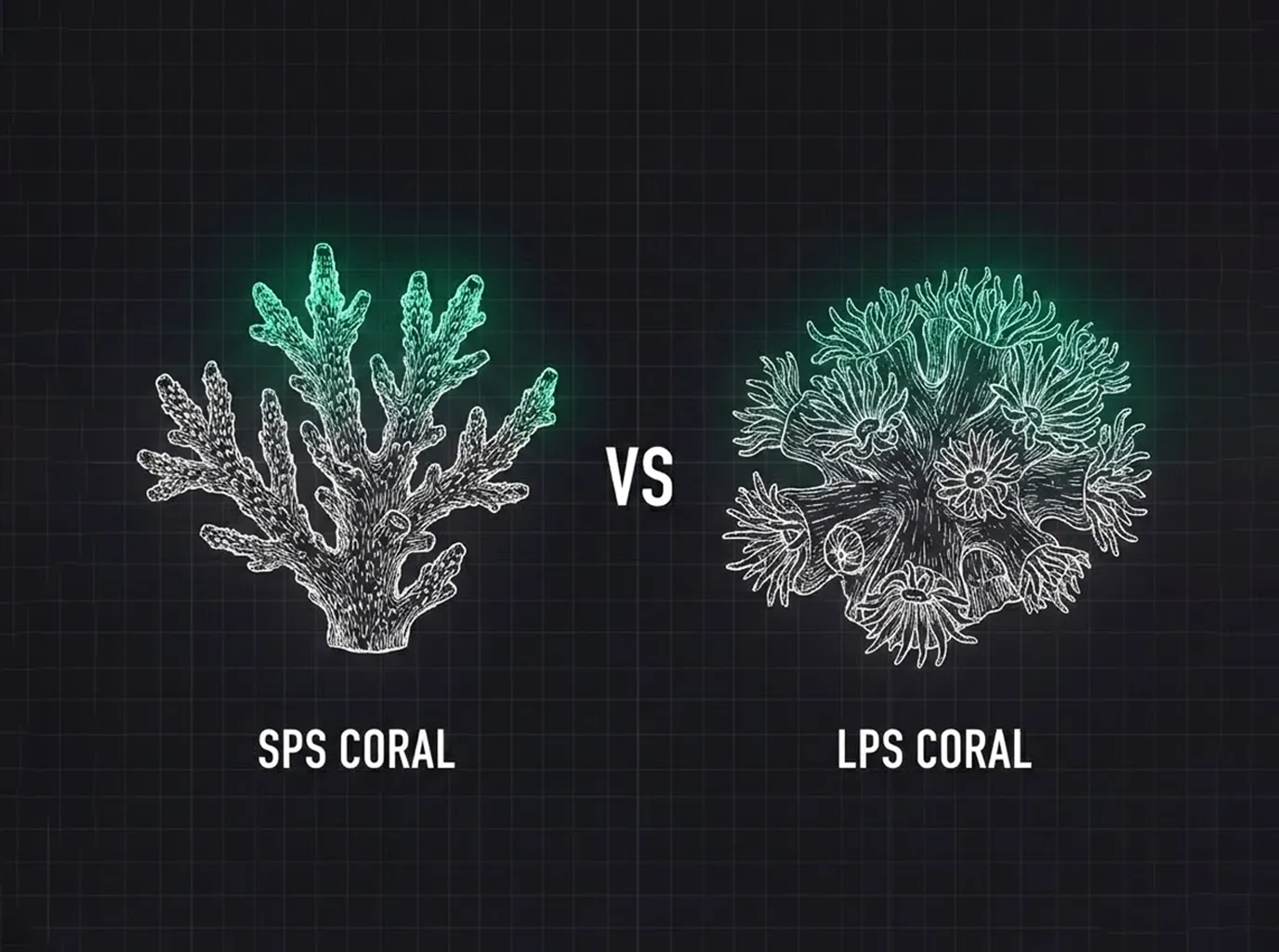
The defining feature of LPS is their large, fleshy polyps. Where SPS corals have polyps measured in millimeters, LPS polyps range from 1 cm to over 10 cm across. This polyp size gives LPS two major biological advantages. First, the tissue mass acts as an energy reserve during stress. Second, the large polyps are effective predators that capture food particles directly from the water column.
These advantages translate to practical care differences. LPS tolerate parameter fluctuations that would damage SPS, recover from short-term stress events more gracefully, and supplement their photosynthetic energy with direct feeding. In most reef tanks, LPS are the workhorses of the coral display: reliable, colorful, and forgiving enough for reef keepers still refining their husbandry skills.
Water Parameters for LPS
LPS require stable reef water parameters, but their acceptable ranges are wider than what SPS demand. This does not mean LPS are indifferent to water quality. It means they give you more room to learn and adjust without immediate consequences.
Alkalinity
Target range: 7.0 to 11.0 dKH. Most LPS perform best between 8.0 and 10.0 dKH. LPS consume alkalinity for skeleton building, but at a slower rate than fast-growing SPS, so daily alkalinity drops are smaller and easier to manage.
Stability still matters. Alkalinity swings exceeding 1.5 dKH over 24 hours can cause tissue retraction in sensitive species like Euphyllia. For an LPS-focused tank, maintaining alkalinity within 1.0 dKH of your target day-to-day is a reasonable goal. This is less demanding than the 0.5 dKH standard for SPS but still requires consistent dosing.
Calcium
Target range: 380 to 450 ppm. LPS build skeleton more slowly than most SPS, so calcium consumption is moderate. In tanks with only LPS and soft corals, calcium levels remain stable longer between doses compared to SPS-heavy systems.
Magnesium
Target range: 1,250 to 1,400 ppm. Magnesium maintains the calcium-alkalinity balance. Test biweekly and supplement as needed. Magnesium depletion is less rapid in LPS tanks but can still drift if not monitored.
Nitrate
Target range: 2 to 20 ppm. This is one of the biggest practical differences between LPS and SPS care. Many LPS species actually benefit from slightly elevated nitrate (5 to 15 ppm), which feeds their zooxanthellae and supports thicker, more colorful tissue. Ultra-low nitrate environments that some SPS keepers chase can leave LPS looking pale and underfed.
In practice, an LPS tank with a moderate fish load producing 5 to 15 ppm nitrate between water changes is in an excellent nutrient range. You do not need to aggressively export nitrate in an LPS-dominant system.
Phosphate
Target range: 0.02 to 0.12 ppm. LPS tolerate higher phosphate than SPS without the skeletal growth inhibition that elevated phosphate causes in fast-calcifying species. Keeping phosphate below 0.15 ppm prevents algae issues on coral tissue, but the precise control required for SPS (below 0.08 ppm) is not necessary for most LPS.
Temperature
Target: 76 to 80°F (24.5 to 26.5°C). LPS handle temperature fluctuations slightly better than SPS, but swings exceeding 3°F in 24 hours still cause stress. A reliable heater and, in warmer climates, adequate cooling remain essential.
Salinity
Target: 1.024 to 1.026 specific gravity (34 to 35 ppt). Consistent salinity through reliable auto top-off is important. Evaporation without replenishment concentrates salt and raises salinity, which stresses all corals.
Lighting for LPS
LPS corals have lower light requirements than SPS, and excessive light is one of the most common causes of LPS problems in mixed reef tanks.
PAR Requirements
Most LPS thrive at PAR levels of 75 to 200 at their placement point. Some species prefer even lower:
- High-light tolerant (150 to 200 PAR): Euphyllia (Torch, Hammer, Frogspawn), Caulastrea, Duncanopsammia
- Moderate light (100 to 150 PAR): Acanthastrea, Lobophyllia, Favites, Favia
- Low light (50 to 100 PAR): Blastomussa, Trachyphyllia, Scolymia, Cynarina
Placing low-light LPS under high PAR (above 200) causes photoinhibition. The zooxanthellae receive more light energy than they can process, generating reactive oxygen that damages the coral tissue. You will often notice affected LPS pulling their tissue tight against the skeleton, losing color, or bleaching from one side.
Spectrum
LPS respond well to the same blue-weighted spectrum used for SPS-dominant tanks (the 14K to 20K appearance). Blue and violet wavelengths promote fluorescent protein expression in many LPS species, producing the vivid greens, oranges, reds, and purples that make them visually striking.
Full daylight spectrum (6500K appearance) grows LPS adequately but tends to produce browner coloration. If your primary goal is LPS color, weight the spectrum toward blue.
Photoperiod
Run lights for 8 to 10 hours daily. LPS benefit from a gradual ramp-up and ramp-down (30 to 60 minutes each) to avoid the stress of sudden intensity changes. Many LPS species extend their polyps more fully during lower-light periods, including the ramp phases and even actinic-only periods, which is when feeding is most effective.
Light Acclimation
New LPS should be placed in lower-light areas initially and moved to their permanent position over 1 to 2 weeks. This is less critical than with SPS (LPS tolerate abrupt light changes better), but gradual acclimation still produces smoother transitions with less tissue retraction.
Flow for LPS
Getting flow right is essential for LPS health, and the most common mistake is too much, not too little.
How Much Flow
LPS prefer gentle to moderate flow. Enough water movement to see the polyps and tentacles gently swaying is the visual target. The tissue should move with the current, not be pinned against the skeleton or battered by turbulence.
In quantitative terms, total tank flow of 10 to 25 times the tank volume per hour from all sources is appropriate for LPS-dominant systems. This is noticeably less than the 20 to 50 times recommended for SPS tanks.
Why Excessive Flow Harms LPS
LPS tissue is soft, fleshy, and often inflated well beyond the skeleton. Strong, direct current pushes this tissue against the sharp skeleton, causing physical abrasion and tissue damage. Over time, the coral responds by refusing to inflate (a protective behavior that reduces its light-gathering and feeding surface area) or by permanently retracting into the skeleton.
Excessive flow also prevents LPS from feeding. Tentacles that cannot extend and hold their position in the current cannot capture food particles. If your LPS tentacles are consistently flattened or blown to one side, the flow at that location is too strong.
Ideal Flow Pattern
Indirect, diffuse flow works best for most LPS. Position corals in areas where flow has bounced off rockwork, glass, or other structures rather than in the direct path of a powerhead or wavemaker output. Gentle, alternating flow patterns (low-frequency pulsing from wavemakers) keep water circulating around the coral without hammering it.
Species-Specific Exceptions
Goniopora is one LPS genus that benefits from moderate to moderately strong flow. Its long polyps extend best with consistent water movement and may fail to open in very still water. Duncan corals (Duncanopsammia) also tolerate and appreciate somewhat stronger flow than most LPS. Observe each species individually and adjust placement based on polyp behavior.
Feeding LPS
Feeding is where LPS care diverges most dramatically from SPS. LPS are active predators, and target feeding produces visibly better health, growth, and coloration.
Why Feeding Matters
LPS corals supplement photosynthesis with heterotrophic feeding (direct food capture). Some species, particularly Trachyphyllia and Goniopora, rely on feeding for a significant portion of their energy budget. Even species with robust zooxanthellae populations (Euphyllia, Caulastrea) show measurably faster growth and better coloration when regularly fed.
In most reef tanks, unfed LPS survive but do not thrive. Fed LPS develop thicker tissue, more vivid coloration, faster growth, and greater resilience to stress events. The difference between a target-fed and unfed Acanthastrea colony over 6 months is striking.
What to Feed
LPS polyps can capture and consume a variety of foods. The best options are:
- Frozen mysis shrimp: The standard LPS food. Thaw, rinse in RO water, and target-feed individual polyps with a pipette or turkey baster. Most LPS accept mysis readily.
- Reef roids or coral-specific powdered foods: Fine particulate foods that stimulate a feeding response. Useful for species with smaller polyps (Blastomussa, smaller Acanthastrea) that struggle with larger food items.
- Finely chopped raw shrimp or fish: Larger LPS (Trachyphyllia, Cynarina, Lobophyllia) can consume pieces of raw seafood 3 to 5 mm across. Cut pieces small enough for the polyp to fully enclose.
- Phytoplankton and amino acids: Broadcast-fed supplements that benefit all corals. Less targeted than direct feeding but provide background nutrition.
How to Target Feed
Turn off flow (powerheads and wavemakers) during feeding. This prevents food from being blown away before corals can capture it. Using a pipette or turkey baster, place food directly on or adjacent to extended polyps. Most LPS will respond within seconds to minutes by curling tentacles around the food and drawing it toward the mouth.
Feed 2 to 3 times per week. More frequent feeding accelerates growth but also increases nutrient loading. Match feeding frequency to your tank's ability to process the added nutrients without algae issues.
Resume flow after 15 to 20 minutes. This gives corals time to capture and begin ingesting food before circulation disperses remaining particles to the filter.
Signs of Underfeeding
LPS that are not receiving enough nutrition show gradual tissue thinning, reduced inflation, duller coloration, and slower recovery from any stress event. If your LPS were previously thriving and gradually decline despite stable parameters and lighting, insufficient feeding is a likely cause. You will often notice this first in species that are most dependent on heterotrophic feeding, such as Goniopora and Trachyphyllia.
Placement and Aggression
LPS placement requires considering not just light and flow requirements but also the chemical and physical warfare that many LPS species wage on their neighbors.
Sweeper Tentacles
Several LPS genera produce sweeper tentacles: elongated, sting-loaded tentacles that extend well beyond the coral's normal tissue footprint, usually at night. These tentacles deliver potent nematocyst stings that damage or kill tissue on any coral they contact.
The most aggressive sweeper tentacle species:
- Euphyllia (Torch, Hammer, Frogspawn): Sweepers can extend 10 to 15 cm or more beyond the tentacle tips. Euphyllia species are generally non-aggressive toward each other (Torch near Hammer is usually fine) but will damage most other coral types on contact.
- Galaxea: Produces exceptionally long sweeper tentacles (up to 20 cm) and is aggressive toward almost all neighboring corals including other Galaxea.
- Goniopora: Can extend long polyps that sting nearby corals, though this is less targeted than true sweeper tentacles.
Spacing Rules
Leave a minimum buffer of 10 to 15 cm between aggressive LPS and any neighboring coral. For Galaxea, increase this to 20 cm or more. These distances account for sweeper tentacle reach at night when they are fully extended.
If you are unsure about a species' aggression level, observe the coral at night with a red flashlight. Sweeper tentacles are most active and extended 2 to 3 hours after lights-out. One nighttime observation session tells you exactly how far the coral's reach extends.
Placement Zones
In most reef tanks, LPS occupy the mid to lower zones of the rockwork. This naturally separates them from SPS (placed high for light) and provides the moderate light and gentler flow LPS prefer. Within the LPS zone:
- Place aggressive species (Euphyllia, Galaxea) with open space around them or on isolated rock islands where sweeper tentacles cannot reach neighbors
- Place peaceful species (Blastomussa, Caulastrea, Duncan) in closer groups where they will not sting each other
- Place large, fleshy species (Trachyphyllia, Cynarina) on the sand bed or flat rock surfaces where their tissue can inflate freely without contacting other corals
Refer to the full coral placement guide for detailed strategies by species and tank layout.
Common LPS Species and Their Care
Each LPS genus has specific characteristics that affect how you keep it. Matching species to your system's conditions prevents frustration.
Euphyllia (Torch, Hammer, Frogspawn)
The most popular LPS genus and for good reason. Euphyllia species produce long, flowing tentacles that sway dramatically in current. They tolerate a wide range of conditions (PAR 100 to 200, moderate flow, alkalinity 7.5 to 10.0 dKH) and respond well to target feeding.
Euphyllia anchor is the classic Hammer coral with anchor-shaped tentacle tips. Euphyllia divisa (Frogspawn) has branching tentacle tips. Euphyllia glabrescens (Torch) has long, flowing tentacles with distinct ball tips. All three share similar care requirements and can be placed near each other without aggression issues.
Watch for Euphyllia-specific diseases: brown jelly disease (rapid tissue dissolution with a brown mucus film) and Euphyllia eating flatworms. Quarantine and dip all new Euphyllia before adding to your display.
Acanthastrea (Acan Lords)
Acanthastrea are encrusting to mounding corals with large, colorful polyps. They come in an extraordinary range of color morphs (rainbow, Superman, Ultra varieties) and are among the most visually striking LPS available.
Care is straightforward: moderate to low light (75 to 150 PAR), gentle flow, and regular target feeding. Acanthastrea respond dramatically to feeding, with visible tissue expansion and color intensification over weeks to months of consistent nutrition.
Place them in the lower to mid rockwork zone. They have short sweeper tentacles (2 to 5 cm) and can be placed relatively close to peaceful neighbors.
Blastomussa
One of the easiest LPS genera. Blastomussa merleti and Blastomussa wellsi feature soft, round polyps that extend well beyond the skeleton. They prefer low light (50 to 100 PAR), gentle flow, and can thrive in areas of the tank that are too dim for most other corals.
Blastomussa grow slowly but are extremely hardy. They are an excellent choice for shaded areas beneath rockwork overhangs or in the lower front of the tank.
Trachyphyllia (Open Brain)
Trachyphyllia are large, fleshy corals that sit directly on the sand bed. Their tissue inflates dramatically during the day, often tripling the apparent size of the skeleton. They are beautiful but require specific care: low to moderate light (75 to 125 PAR), very gentle flow, and regular feeding.
Place Trachyphyllia on the sand bed, never on rockwork where the inflated tissue can abrade against rock edges. Feed them 2 to 3 times per week with mysis or finely chopped seafood placed directly on the mouth.
Caulastrea (Candy Cane)
One of the best corals for beginners. Caulastrea grow as branching colonies with rounded polyps at the tip of each branch. They tolerate a wide range of light (75 to 200 PAR) and flow conditions, accept target feeding readily, and grow at a moderate pace.
Candy Cane corals are peaceful, with minimal sweeper tentacle activity. They can be placed in groups or near other peaceful species without aggression concerns.
Duncanopsammia (Duncan)
Duncan corals produce clusters of long-stemmed polyps that extend dramatically during the day and retract at night. They are hardy, fast-growing by LPS standards, and respond enthusiastically to target feeding.
Duncans prefer moderate light (100 to 175 PAR) and moderate flow. They tolerate slightly stronger current than most LPS due to their flexible polyp stems. One of the easiest and most rewarding LPS for newer reef keepers.
Goniopora
Goniopora is beautiful but historically difficult. Long, flowery polyps extend from a round skeleton, creating a sunflower-like appearance. Failure rates in captivity have been high, largely due to inadequate feeding and flow.
Modern care understanding has improved Goniopora success rates significantly. The keys are: moderate flow (strong enough to keep polyps extended), consistent target feeding (3 times per week minimum), moderate light (100 to 175 PAR), and stable parameters. Goniopora relies on heterotrophic feeding more than most LPS, and underfed specimens decline slowly over months.
Common Problems
LPS communicate stress through predictable visual cues. Early recognition gives you time to correct the cause.
Tissue Retraction (Not Opening)
When LPS polyps remain retracted against the skeleton for extended periods, the coral is stressed. Short-term retraction (hours) is normal during acclimation or after disturbance. Persistent retraction lasting days indicates a problem.
Common causes: excessive flow (tissue being battered), excessive light (photoinhibition), water chemistry shift (alkalinity swing, elevated phosphate), or nearby coral aggression (sting damage from sweeper tentacles). Check each factor systematically. For more detail, see the full coral not opening guide.
Brown Jelly Disease
A bacterial infection that appears as a brown, mucus-like substance spreading across coral tissue. Brown jelly progresses rapidly and can destroy a colony within 24 to 48 hours. It most commonly affects Euphyllia species.
Response: immediately remove the affected coral from the display. Blow off the brown jelly with a turkey baster in a separate container of tank water. Dip the coral in an iodine-based coral dip for 5 to 10 minutes. If the infection has not reached all tissue, the surviving portions can recover. Return only when no further tissue loss is visible for 48 hours.
Bleaching
LPS bleaching is less sudden than SPS bleaching but follows the same mechanism: zooxanthellae expulsion due to stress. Causes include temperature spikes, excessive light, or severe parameter swings.
LPS have a better chance of recovering from bleaching than SPS because their thick tissue holds more energy reserves. Reduce light by 30 percent, stabilize parameters, and avoid feeding the bleached coral until zooxanthellae begin repopulating (visible as a gradual return of color over weeks).
Tissue Recession
Tissue pulling away from the skeleton, exposing white calcium carbonate. In LPS, this is usually caused by chronic low alkalinity, persistent aggression from a neighboring coral, or bacterial infection following physical damage.
Test alkalinity and correct any shortfall. Inspect for sweeper tentacle damage (check at night). If recession is localized and the cause is corrected, most LPS recover over weeks as tissue regrows over the exposed skeleton.
Advanced: LPS in Mixed Reef Systems
Most reef tanks are mixed systems containing soft corals, LPS, and SPS together. Managing LPS within this context requires understanding their position in the tank hierarchy.
LPS sit in the middle of the reef tank aggression ladder. Soft corals generally cannot sting LPS. LPS can sting and damage most soft corals and many SPS species. SPS generally lack the aggressive weaponry to damage LPS but can be victims of LPS sweeper tentacles.
In practice, the mixed reef strategy is vertical segregation. SPS at the top (high light, high flow), LPS in the middle (moderate light, moderate flow), and soft corals at the bottom or in shaded areas. Horizontal spacing between aggressive LPS and all neighbors prevents warfare.
The water chemistry target for a mixed reef should lean toward SPS requirements (alkalinity 8.0 to 9.0 dKH, nitrate 3 to 10 ppm, phosphate 0.03 to 0.08 ppm). These parameters fall within LPS comfort zones while also supporting SPS. LPS will thrive in these conditions even though they could tolerate wider ranges.
Advanced: LPS Fragging
LPS propagation is more involved than SPS fragging but achievable for most common species.
Branching LPS (Euphyllia, Caulastrea, Duncan): Separate individual branches using a bone cutter or Dremel tool at the skeletal junction between polyp heads. Each branch with one or more intact polyps becomes a viable frag. Let the cut heal in moderate flow for 1 to 2 weeks before placing permanently.
Encrusting and mounding LPS (Acanthastrea, Favia, Favites): Use a band saw, tile saw, or Dremel to cut the skeleton between polyp centers. Each piece should retain at least 2 to 3 complete polyps. The cuts are more traumatic than branching species and healing takes 2 to 4 weeks.
Solitary LPS (Trachyphyllia, Scolymia, Cynarina): These species are single-polyp organisms and cannot be fragged conventionally. Some specimens occasionally bud new polyps that can be separated once they develop their own skeleton, but this is infrequent and unpredictable.
After fragging, place frags in moderate flow with slightly reduced light for 1 to 2 weeks. Avoid target feeding the cut area until tissue has fully closed over the exposed skeleton. Premature feeding on open wounds invites bacterial infection.
Common Myths
"LPS are beginner corals that do not need attention." LPS are more forgiving than SPS but still need stable water chemistry, appropriate lighting, proper placement, and regular feeding. Neglected LPS decline slowly but inevitably. The wider tolerance band gives you more time to notice and correct problems, not permission to ignore them.
"LPS do not need feeding if you have fish." Fish waste contributes some nutrition, but it is not a substitute for direct target feeding. LPS that receive mysis or coral foods 2 to 3 times per week consistently outperform unfed specimens in growth, coloration, and stress resilience. Species like Goniopora and Trachyphyllia may slowly waste away without direct feeding.
"All LPS are peaceful." Many LPS species (Euphyllia, Galaxea, Goniopora) are equipped with sweeper tentacles that deliver damaging stings. Placement without adequate spacing leads to tissue damage on neighboring corals. Always research a species' aggression profile before placing it near other corals.
"LPS do not need dosing." LPS consume alkalinity and calcium for skeleton building. In tanks with significant LPS colonies, alkalinity depletion is measurable and requires supplementation through two-part dosing, kalkwasser, or water changes. The consumption rate is lower than SPS-heavy systems but not zero.
FAQ
What is the easiest LPS coral to start with?
Duncan coral (Duncanopsammia) and Candy Cane coral (Caulastrea) are the most forgiving. They tolerate a wide range of conditions, grow visibly, respond well to feeding, and are peaceful. Blastomussa is another excellent option for low-light areas.
How much light do LPS need?
Most LPS thrive at 75 to 200 PAR. Place them in the mid to lower rockwork zone where light naturally attenuates from the fixture above. Species like Blastomussa and Trachyphyllia prefer even lower (50 to 100 PAR). Too much light is more common than too little with LPS.
Can I keep only LPS in my reef tank?
Absolutely. LPS-only reef tanks are beautiful, lower-maintenance than SPS systems, and allow you to focus on the dramatic coloration and movement that LPS provide. Without SPS, you can relax parameter precision slightly and run moderate lighting that costs less in electricity and equipment.
Why are my Euphyllia tentacles not extending?
The most common causes are excessive flow (tentacles being battered), excessive light (photoinhibition), sting damage from a neighboring coral, or a water chemistry shift. Move the coral to a calmer, slightly shadowed position and observe for 3 to 5 days. If tentacles resume normal extension, adjust the permanent placement.
How far apart should LPS be from each other?
Peaceful species (Blastomussa, Caulastrea, Duncan) can be placed within 5 cm of each other. Aggressive species (Euphyllia, Galaxea) need 10 to 15 cm minimum from any neighbor. Observe tentacle extension at night to verify your spacing is adequate.
Do LPS grow fast?
LPS grow slower than most SPS. Expect new polyp heads every 1 to 3 months on branching species (Duncan, Caulastrea, Euphyllia) under good conditions with regular feeding. Encrusting species grow even more slowly. Patience is part of LPS keeping, but the growth tips guide covers how to maximize growth rate.