
Carpet Plants Guide: How to Grow Lush Aquarium
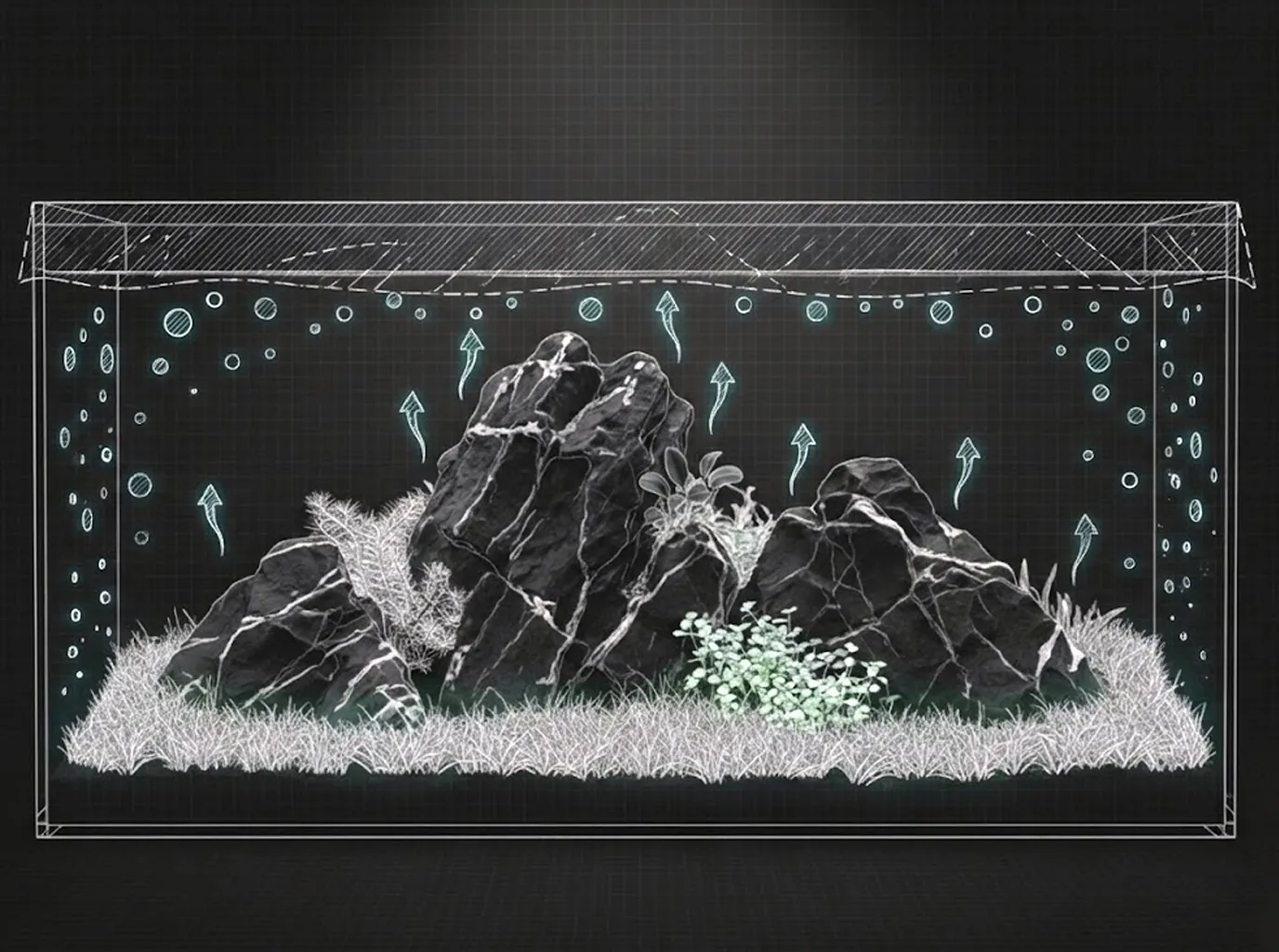
Carpet plants transform empty foreground space into living green meadows. The dense, low-growing coverage creates depth, frames hardscape, and anchors the visual foundation of planted aquascapes. But achieving a healthy carpet requires more than simply planting small plants in the front of the tank. Most carpet species demand high light, stable CO₂, and specific planting techniques that differ significantly from stem or rosette plants.
In most tanks, carpet plants either grow beautifully or struggle visibly. There is little middle ground. When conditions are right, they spread horizontally through runners or stolons, filling gaps and creating uniform coverage within 6-8 weeks. When conditions are inadequate, they float up repeatedly, melt away, or remain sparse and patchy despite months of waiting. This is why understanding species requirements and planting methods before choosing a carpet plant saves considerable frustration.
Quick Summary
Carpet plants are low-growing foreground species that spread horizontally to create dense ground coverage in aquascapes. Popular species include Dwarf Baby Tears (Hemianthus callitrichoides), Monte Carlo (Micranthemum tweediei), Dwarf Hairgrass (Eleocharis parvula), and Staurogyne repens. Most carpet plants require moderate to high light (40-80+ PAR at substrate level), CO₂ injection, and nutrient-rich substrate for successful establishment. Planting technique matters significantly: small portions spread across the area fill in faster than large clumps, and proper anchoring prevents floating. The Dry Start Method can accelerate carpet establishment by growing plants emersed before flooding. Common problems include floating due to insufficient depth, melting from light or nutrient deficiency, and algae growth during the establishment phase. Patience is essential, as most carpets take 4-8 weeks to establish and 8-12 weeks to achieve full coverage.
What Are Carpet Plants?
Carpet plants are aquatic or semi-aquatic species that grow low to the substrate and spread laterally rather than upward. Unlike stem plants that grow toward the light or rosette plants that remain in one location, carpet plants propagate through horizontal runners (stolons) or creeping stems that root at nodes. This growth pattern allows them to cover substrate area progressively.
The visual effect resembles terrestrial lawns or meadows, creating a sense of scale and naturalness in aquascapes. Carpet plants are fundamental to nature-style aquascaping (Iwagumi, Dutch, Nature Aquarium styles) because they establish the foreground layer and provide visual weight that balances taller background plants and hardscape elements.
Most carpet plants have small leaves (1-5mm) and compact growth habits. This small scale creates the illusion of larger landscapes in small tanks. A 60cm tank with a dense carpet can evoke the feeling of a vast field or meadow when proportioned correctly with scaled hardscape.
Popular Carpet Plant Species
Dwarf Baby Tears (Hemianthus callitrichoides 'Cuba')
Dwarf Baby Tears, commonly abbreviated as HC Cuba, produces tiny round leaves (1-2mm diameter) that create the finest-textured carpet available. The growth is dense and bright green under optimal conditions. HC Cuba requires very high light (60-100+ PAR), CO₂ injection, and nutrient-rich substrate. It is considered the most demanding carpet plant but produces unmatched visual results in Iwagumi and Nature Aquarium layouts.
Planting requires separating the purchased portion into individual stems or small 2-3 stem clusters, then planting them 1-2cm apart across the desired area. This labor-intensive process is necessary because HC Cuba spreads slowly and large clumps often rot from the inside due to light deprivation at the base.
Monte Carlo (Micranthemum tweediei)
Monte Carlo has become the most popular carpet plant for intermediate aquascapers. The leaves are slightly larger than HC Cuba (2-3mm), with rounder shape and lighter green color. It grows faster, tolerates slightly lower light (40-80 PAR), and spreads more aggressively through runners. While CO₂ is strongly recommended, Monte Carlo can survive in high-light setups without CO₂, though growth will be significantly slower and less dense.
Planting is easier than HC Cuba. Separate into small clumps (5-10 stems) and plant 2-3cm apart. Monte Carlo establishes faster and fills gaps more reliably, making it more forgiving for first-time carpet attempts.
Dwarf Hairgrass (Eleocharis parvula)
Dwarf Hairgrass grows in vertical grass-like blades (3-10cm tall depending on light intensity) that spread through underground runners. It creates a meadow or prairie aesthetic rather than a tight ground-hugging carpet. Hairgrass tolerates moderate light (30-60 PAR) and can grow without CO₂, though growth is slow and coverage takes 3-6 months without injection.
Plant small clumps (8-12 blades) 2-3cm apart in a grid pattern. The underground runners will connect adjacent clumps over time. Trim regularly once established to maintain 4-6cm height and encourage horizontal spread. Uncut hairgrass can reach 15cm+ and lose the carpet aesthetic.
Staurogyne repens
Staurogyne repens produces small serrated leaves on compact stems that grow 5-10cm tall. It spreads through creeping stems that root at nodes, creating a bushy carpet rather than a flat mat. The growth is slower and more vertical than true carpet plants, but it tolerates lower light (30-50 PAR) and moderate conditions better than HC Cuba or Monte Carlo.
Plant individual stems or small clusters 3-4cm apart. Staurogyne works well as a midground transition between true carpets and taller plants. It requires less maintenance than grass-like carpets and can tolerate some shading from hardscape.
Hydrocotella tripartita (Japan, Australia, Mini versions)
Hydrocotella species produce clover-like leaves on creeping stems. The growth pattern is lateral, with stems rooting at each node. Under high light (60-100+ PAR) and CO₂, they grow densely and stay low (2-5cm). In lower light, they stretch upward (10-15cm) and lose the carpet form.
Plant small sections (3-5cm stem length) 2-3cm apart. The plants spread quickly in good conditions and can fill areas within 4-6 weeks. Hydrocotella 'Japan' is the most compact variety, staying under 3cm in height with proper trimming.
Glossostigma elatinoides
Glossostigma produces small oval leaves (3-5mm) that grow in pairs along creeping stems. It creates a dense, flat carpet under very high light (80-120+ PAR) and CO₂. In insufficient light, it grows vertically and loses its ground-hugging habit. Glossostigma is one of the fastest-spreading carpet plants when conditions are met.
Plant small clusters 1-2cm apart. The stems root aggressively and can cover substrate rapidly (6-8 weeks to full coverage in ideal conditions). This species is less popular than Monte Carlo or HC Cuba due to its tendency to lift and float if light drops below optimal levels.
Light Requirements for Carpet Plants
Light intensity at substrate level determines carpet plant success more than any other factor. Most carpet species need 40-80 PAR minimum at the planting depth. Species like HC Cuba and Glossostigma require 60-100+ PAR for compact growth and full coverage.
The challenge is that substrate-level PAR is significantly lower than mid-tank or surface measurements. In a 45cm tall tank, substrate PAR may be 40-50% of surface PAR depending on fixture spread and penetration. Always measure or estimate PAR at the actual planting location, not at mid-depth or surface.
Insufficient light causes vertical growth (etiolation), where carpet plants stretch upward seeking more light instead of spreading horizontally. This ruins the carpet aesthetic and creates sparse, leggy growth. If your carpet plants are growing taller than expected or developing long internodal spacing, light is insufficient.
Photoperiod should be consistent, typically 7-9 hours daily. Longer periods increase algae risk during the vulnerable establishment phase when carpet coverage is incomplete and substrate is exposed. Shorter periods slow growth and delay full coverage.
CO₂ Requirements
Most carpet plants benefit significantly from CO₂ injection. Species like HC Cuba, Monte Carlo, and Glossostigma require 25-35 ppm CO₂ for healthy growth. Without CO₂, these plants grow extremely slowly, remain sparse, or fail to establish entirely.
Dwarf Hairgrass and Staurogyne repens can grow without CO₂ in moderate to high light, but establishment takes 3-6 months instead of 6-10 weeks. If growing carpet plants without CO₂, choose these more forgiving species and maintain patience.
CO₂ distribution at substrate level is critical. Carpet plants are positioned in the lowest area of the tank, where circulation is often weakest. Ensure your filter outflow or circulation pump creates flow that reaches the substrate surface. Dead zones at the bottom will result in patchy carpet growth, with robust growth in high-flow areas and poor growth in stagnant zones.
Consistency matters more than peak levels. Fluctuating CO₂ (30 ppm during the day, dropping to 10 ppm at night) causes more problems than stable 25 ppm throughout the photoperiod. Use a solenoid valve to control injection and minimize overnight accumulation.
Substrate and Nutrient Requirements
Carpet plants have high nutrient demands due to their rapid growth and dense coverage. Nutrient-rich substrate (aquasoil or enriched planted tank substrate) provides the best results. Sand or inert gravel can work with root tabs placed every 10-15cm, but initial establishment is slower.
Substrate depth should be 3-4 inches (7-10cm) in the foreground planting area. Shallow substrate (1-2 inches) does not provide sufficient rooting depth, and plants frequently float loose during the establishment phase. This is usually where new aquascapers encounter repeated floating issues.
Root development is essential for carpet stability. Until roots penetrate 2-3cm into substrate and anchor the plant, mechanical disturbance (fish, shrimp, water changes) can dislodge portions. This is why proper planting depth and substrate choice matter significantly during the first 3-4 weeks.
Water column fertilization supplements substrate nutrients. Dose complete NPK macros and micronutrients regularly. Carpet plants consume nutrients rapidly during establishment, and deficiencies cause yellowing, stunted growth, or melting. Target 10-20 ppm nitrate, 1-2 ppm phosphate, and sufficient iron (0.1-0.2 ppm) in the water column.
Planting Techniques for Success
The single most important factor in carpet plant success is proper planting method. Large clumps or dense plantings do not spread effectively. Small separated portions establish faster and fill in more uniformly.
For fine-leaved species (HC Cuba, Monte Carlo), use tweezers to separate the purchased mat into individual stems or 2-3 stem clusters. Plant each cluster 1-2cm apart in a grid pattern across the entire area you want carpeted. Push the stems 5-10mm deep into substrate, ensuring the leaves remain above the surface.
In most tanks, you will initially see more substrate than plant. This is correct. Resist the urge to plant densely. Dense clumps shade themselves, causing the interior stems to rot while outer stems spread. Sparse planting allows each portion to receive light and spread through runners without competition.
For grass-like species (Dwarf Hairgrass), separate into small clumps (8-15 blades per clump). Plant 2-3cm apart. The underground runners will connect adjacent clumps within 4-6 weeks under good conditions.
For larger-leaved species (Staurogyne, Hydrocotella), plant individual stems or small clusters 3-4cm apart. These spread through visible above-ground runners, so you can observe the spreading progress.
After planting, avoid disturbing the substrate for 2-3 weeks. The plants need time to develop roots and anchor. Resist the temptation to replant floating portions immediately. Wait until roots develop (visible as white root hairs extending from nodes), then replant more securely.
The Dry Start Method (DSM)
The Dry Start Method grows carpet plants emersed (above water) during the establishment phase, then floods the tank once the carpet is established. This technique accelerates growth and eliminates floating problems during the vulnerable establishment period.
To use DSM, plant the carpet as usual in damp substrate. Add water only to the substrate surface level, leaving plants exposed to air. Cover the tank with plastic wrap or glass to maintain high humidity (90-100%). Provide 8-10 hours of light daily. Mist the plants if they appear dry, but do not flood.
In most tanks using DSM, carpet plants spread much faster than submerged growth. HC Cuba or Monte Carlo can achieve 70-80% coverage in 4-6 weeks, compared to 8-12 weeks when planted underwater. Once coverage reaches 70-90%, slowly flood the tank over several days, allowing plants to adapt to submerged conditions.
DSM works best for HC Cuba, Monte Carlo, Glossostigma, and Hydrocotella. It does not work well for Dwarf Hairgrass or purely aquatic species. The primary drawback is the delay before adding livestock and the risk of mold growth in overly humid conditions. Ensure good air circulation and monitor for fungal growth on exposed substrate.
Common Carpet Plant Problems
Floating
Floating is the most frustrating carpet plant problem during establishment. It happens when plants are not anchored deeply enough, substrate depth is insufficient, or root development is poor. Shrimp and bottom-dwelling fish can also dislodge newly planted portions before roots establish.
To minimize floating, plant stems deeper (5-10mm into substrate), use 3-4 inches of substrate depth, and separate clumps into smaller portions that root more easily. Wait 2-3 weeks before adding livestock that might disturb the substrate. Replant floating portions with tweezers, pushing them slightly deeper than the original planting depth.
If flooding continues despite proper technique, the issue is usually light or nutrient deficiency preventing root growth. Check PAR at substrate level and ensure fertilization is adequate.
Melting
Melting occurs when carpet plants lose leaves, turn brown or translucent, and decompose. This is caused by insufficient light, CO₂ deficiency, nutrient deficiency, or drastic environmental changes. Newly planted carpets sometimes melt partially as they transition from emersed (nursery-grown) to submersed growth.
If melting happens within 1-2 weeks of planting, it is likely transition shock. Continue maintaining parameters and wait. New submersed growth should emerge within 2-3 weeks. If melting occurs after initial establishment, check light intensity (should be 40+ PAR at substrate), CO₂ levels (25-35 ppm), and nutrient dosing (10-20 ppm nitrate, 0.1+ ppm iron).
Vertical Growth
When carpet plants grow upward instead of spreading horizontally, light is insufficient. This is called etiolation. The plant stretches toward the light source, producing long stems with wide spacing between leaves instead of compact, dense growth.
Increase light intensity or reduce the distance between fixture and substrate. Trim excessively tall growth to encourage lateral spread and compact new growth under the improved lighting.
Algae During Establishment
Exposed substrate during the establishment phase is vulnerable to algae colonization. Hair algae, green spot algae, and diatoms frequently appear on bare spots between carpet plants during the first 4-6 weeks.
Reduce photoperiod to 6-7 hours during establishment to slow algae while allowing plant growth. Increase surface agitation to maximize CO₂ availability, giving plants a competitive advantage. Add floating plants temporarily to absorb excess nutrients and shade the substrate slightly. Once carpet coverage reaches 70-80%, algae problems typically resolve as the plants outcompete algae for nutrients and light.
Manual removal is effective. Use a toothbrush to gently remove hair algae from exposed substrate areas during water changes. Spot-treat stubborn green spot algae with diluted hydrogen peroxide (1ml of 3% H₂O₂ per 10L tank water, applied directly with a syringe after turning off filtration for 5 minutes).
Patchy Coverage
Uneven carpet coverage with dense growth in some areas and bare spots in others indicates inconsistent conditions. Light distribution, CO₂ circulation, or substrate nutrient depletion are the usual causes.
Check for substrate-level light variations. Areas directly under the fixture receive higher PAR than edges or corners. If patchy growth correlates with light zones, add supplemental lighting or reposition the fixture for better spread.
Ensure water circulation reaches all substrate areas. Place the filter outflow to create flow patterns that sweep across the entire foreground. Stagnant zones will always grow more poorly.
If patchy growth appears after months of good coverage, substrate nutrients may be depleted. Add root tabs to sparse areas or consider substrate replacement if using inert gravel without ongoing root fertilization.
System Interactions
Light
Light intensity at substrate level is the primary limiting factor for carpet plants. Most species require 40-80 PAR minimum, with demanding species like HC Cuba needing 60-100+ PAR. PAR decreases significantly with depth, so measure or estimate light at the actual planting location.
Light distribution affects coverage uniformity. Edge-to-edge spread ensures even growth across the entire carpet area. Fixtures with poor spread create bright central zones with strong growth and dim edges with poor growth. This is where upgrading to multiple smaller fixtures or fixtures with better optics improves results.
Spectrum is less critical than intensity for carpet plants. Standard full-spectrum (6500-8000K) LEDs work well. Carpet plants are chlorophyll-dense and do not require specialized red/blue spectrum ratios like red-leaved species.
CO₂
CO₂ availability at substrate level determines growth rate and establishment success. Carpet plants have small leaves and high surface-area-to-volume ratios, making them efficient at CO₂ uptake when levels are adequate (25-35 ppm).
Distribution is critical. Substrate-level CO₂ concentration depends on circulation pushing CO₂-enriched water down to the foreground. Without adequate flow, CO₂-rich water remains in the upper water column, leaving carpet plants with suboptimal levels despite correct overall tank concentration.
Consistency prevents growth disruption. Fluctuating CO₂ causes carpets to alternate between active growth and stagnation, resulting in uneven coverage and weak root systems. Maintain stable injection throughout the photoperiod using a solenoid timer.
Nutrients
Carpet plants have high nutrient demand due to rapid growth rates and dense biomass. Nitrogen (10-20 ppm nitrate) and phosphorus (1-2 ppm phosphate) must remain available in both substrate and water column.
Iron and micronutrients are essential for chlorophyll production and enzyme function. Carpet plants display iron deficiency as yellowing new growth (chlorosis). Dose iron 2-3 times weekly to maintain 0.1-0.2 ppm in the water column.
Substrate nutrients deplete over time, especially in sand or inert gravel. Root tabs provide localized nutrition. Place them every 10-15cm across the carpet area, replenishing every 3-4 months or when growth slows despite adequate lighting and CO₂.
Substrate
Substrate type determines how easily carpet plants root and access nutrients. Nutrient-rich aquasoil provides the best results, allowing rapid root development and sustained growth. Inert substrates (sand, gravel) work with supplemental root tabs but require more maintenance.
Substrate depth must be 3-4 inches (7-10cm) in foreground areas. Shallow substrate prevents proper root anchoring and increases floating problems. Adequate depth also provides a larger nutrient reservoir, supporting long-term carpet health.
Particle size affects rooting ease. Fine substrates (1-2mm aquasoil or sand) allow delicate roots to penetrate easily. Coarse gravel (5-10mm) creates air gaps that hinder root contact with nutrients and increase floating issues.
Filtration
Water circulation patterns affect carpet plant success by determining CO₂ distribution and nutrient availability at substrate level. Filter outflow should create gentle flow across the foreground, sweeping CO₂-rich water down to the carpet without creating excessive turbulence that uproots plants.
Biological filtration stability prevents ammonia or nitrite spikes that damage delicate carpet plant roots. Mature filtration (4+ weeks aged) is preferable before planting demanding carpet species.
Mechanical filtration removes particulates that settle on carpet leaves and block light. Fine pre-filter sponges or filter floss prevent detritus accumulation in dense carpets, which can smother plants and promote algae growth.
Stability
Carpet plants are sensitive to parameter fluctuations during establishment. Temperature variations, inconsistent photoperiods, irregular dosing, or fluctuating CO₂ all slow growth and increase failure rates.
Once established (8-12 weeks), carpets become more resilient and tolerate minor variations. But during the initial 6-8 weeks, maintain strict consistency in all parameters. This is why carpet plants are considered intermediate-level projects. They require sustained attention during the vulnerable establishment phase.
Advanced: Carpet Growth Patterns and Optimization
Carpet plants spread through two primary mechanisms: stoloniferous growth (horizontal runners above substrate) or rhizomatous growth (underground runners). Understanding the pattern allows optimization of planting strategy.
Stoloniferous species (HC Cuba, Monte Carlo, Glossostigma, Hydrocotella) produce visible runners above substrate that extend outward and root at nodes. These spread faster because each runner tip can become a new growth point. Optimizing growth requires ensuring every runner tip receives adequate light. This is why sparse initial planting outperforms dense planting. Each portion has space to spread runners in multiple directions without shading neighbors.
Rhizomatous species (Dwarf Hairgrass) spread through underground runners invisible from above. Growth appears as new shoots emerging between existing clumps. Spreading is slower because runners must navigate substrate before producing shoots. Optimization requires ensuring substrate is not compacted, which impedes underground runner progression.
Trimming strategy differs by species. Stoloniferous carpets benefit from surface trimming once 80-90% coverage is achieved. This removes old growth, allows light penetration to lower layers, and stimulates new runner production. Trim 30-40% of the carpet height every 4-6 weeks to maintain density.
Rhizomatous hairgrass requires vertical trimming. Cut blades to 4-6cm height every 3-4 weeks once established. This maintains the carpet aesthetic and redirects energy into horizontal runner production rather than vertical blade growth.
Advanced: Managing Long-Term Carpet Health
Over time (6-12 months), carpet plants can develop problems from accumulated detritus, substrate compaction, or nutrient depletion. Dense carpets trap organic matter at the substrate surface, creating anoxic zones that harm root health.
Regular vacuuming during water changes prevents detritus accumulation. Use a small-diameter siphon tube (4-6mm) to gently vacuum between carpet plants without uprooting them. This removes trapped waste and maintains aerobic substrate conditions.
Substrate compaction happens as carpet plants develop dense root mats. Compacted substrate restricts water flow and creates anoxic pockets. If growth slows after 9-12 months despite adequate light and fertilization, consider replanting the carpet. Thin out 30-40% of the densest areas, loosen the substrate with tweezers, and replant the removed portions after refreshing substrate nutrients.
For aquasoil substrates, nutrient depletion becomes noticeable after 12-18 months. Growth slows, colors fade, or yellow patches appear despite water column dosing. Add root tabs to refresh substrate fertility or plan for eventual substrate replacement (typically every 2-3 years in heavily planted carpets).
Some aquascapers maintain long-term carpets (3-5+ years) by periodically removing 20-30% of the carpet, refreshing that section with new substrate and replanting. Rotate through different sections every 6 months. This maintains ongoing vitality without completely tearing down the aquascape.
Common Myths About Carpet Plants
Myth: Carpet plants require expensive high-end lighting While carpet plants need adequate PAR (40-80+), this can be achieved with mid-range LED fixtures positioned correctly. The key is intensity at substrate level, not expensive fixtures. A properly positioned budget LED often outperforms a poorly positioned high-end fixture.
Myth: You cannot grow carpets without CO₂ Some species (Dwarf Hairgrass, Staurogyne repens) can grow without CO₂ in moderate to high light. Growth is slower (3-6 months for full coverage), but it is possible. Monte Carlo can survive without CO₂ under very high light, though growth is slow and sparse.
Myth: Dense initial planting fills in faster The opposite is true. Sparse planting (small portions spaced 1-3cm apart) fills in faster and more uniformly than dense clumps. Dense planting causes interior shading, rotting, and poor spread.
Myth: Carpet plants do not need substrate nutrients While some carpet plants primarily feed from the water column, substrate nutrients significantly improve root development and growth rates. Nutrient-rich substrate or root tabs in inert substrate provide better results than water column fertilization alone.
Myth: Once established, carpets need no maintenance Established carpets require regular trimming, detritus removal, and nutrient replenishment. Neglected carpets thin out, accumulate algae, or die back over time. Ongoing maintenance keeps carpets healthy and visually attractive.
FAQ
What is the easiest carpet plant for beginners? Monte Carlo (Micranthemum tweediei) offers the best balance of ease and visual appeal. It tolerates slightly lower light than HC Cuba, spreads faster, and forgives minor parameter fluctuations. Dwarf Hairgrass is another beginner option, particularly in setups without CO₂, though establishment takes longer.
How long does it take for a carpet to fill in? With optimal conditions (high light, CO₂, nutrients), most carpets achieve 70-80% coverage in 6-10 weeks. Full coverage takes 8-12 weeks. Without CO₂ or in lower light, the timeline extends to 3-6 months. The Dry Start Method can reduce establishment time to 4-6 weeks before flooding.
Can I grow carpet plants in low-tech tanks? Dwarf Hairgrass and Staurogyne repens can grow in low-tech setups with moderate to high light (40-60+ PAR). Growth will be slower, and coverage may take 4-6 months. Species like HC Cuba and Monte Carlo struggle significantly without CO₂ and usually fail or remain extremely sparse in low-tech conditions.
Why do my carpet plants keep floating? Floating happens when roots have not developed sufficiently to anchor the plant, substrate depth is inadequate (less than 3 inches), or planting depth is too shallow. Plant stems 5-10mm deep into substrate, use at least 3-4 inches of substrate depth, and wait 2-3 weeks before adding livestock that might disturb the substrate.
How do I prevent algae during carpet establishment? Reduce photoperiod to 6-7 hours during the first 4-6 weeks, add temporary floating plants to absorb excess nutrients and provide shading, ensure CO₂ is stable (25-30 ppm), and manually remove any algae during water changes. Once carpet coverage reaches 70-80%, algae typically resolves naturally.
Do I need to trim carpet plants? Yes, regular trimming maintains carpet health and density. Trim surface growth once coverage is established (8-10 weeks) to remove old leaves and stimulate new runner production. Frequency depends on species: fast-growing carpets (Monte Carlo, HC Cuba) need trimming every 4-6 weeks, slower species (Staurogyne, Hairgrass) every 6-8 weeks.
Can I use carpet plants with sand substrate? Yes, but use root tabs placed every 10-15cm to provide nutrients. Sand drains nutrients quickly, so root tab replenishment every 3-4 months is necessary. Nutrient-rich substrates (aquasoil) provide easier long-term maintenance for carpet plants.
What light level do I need for HC Cuba? HC Cuba requires 60-100+ PAR at substrate level. Measure with a PAR meter or use online calculators based on your fixture specifications and tank depth. Insufficient light (below 50 PAR) causes vertical growth and prevents proper carpet formation.
Related Guides
- Best Plants for Low Light – Alternative plant options if carpet species feel too demanding
- Planted Aquarium Guide – Foundation for setting up high-tech tanks suitable for carpet plants
- CO₂ in Planted Tanks – Essential guide for CO₂ systems required by most carpet species
- Aquarium Substrate Guide – Learn about substrate options and depth requirements
- Plant Nutrient Deficiencies – Diagnose and fix nutrient problems affecting carpet growth