
Canister Filter vs HOB: Which Is Better for Your
Quick Summary
Canister filters sit beneath the tank and cycle water through a sealed, pressurized chamber packed with filter media. Hang-on-back (HOB) filters clip to the rim and pull water up through a smaller media chamber before pouring it back in. Both filter types keep water clean, but they handle flow, media volume, surface agitation, and CO2 retention differently.
For most planted tanks, canister filters are the stronger choice because they hold more media, create less surface agitation, and support inline CO2 and heater accessories. HOB filters are simpler, cheaper, and perfectly effective for smaller or low-tech tanks where CO2 retention is not a concern. The right filter depends on your tank size, whether you inject CO2, and how much you value clean equipment lines around the tank.
How Canister Filters Work
If you look behind or beneath a planted tank setup at a competition or in an experienced aquarist's fishroom, you will almost always see a canister filter. The design is straightforward but effective.
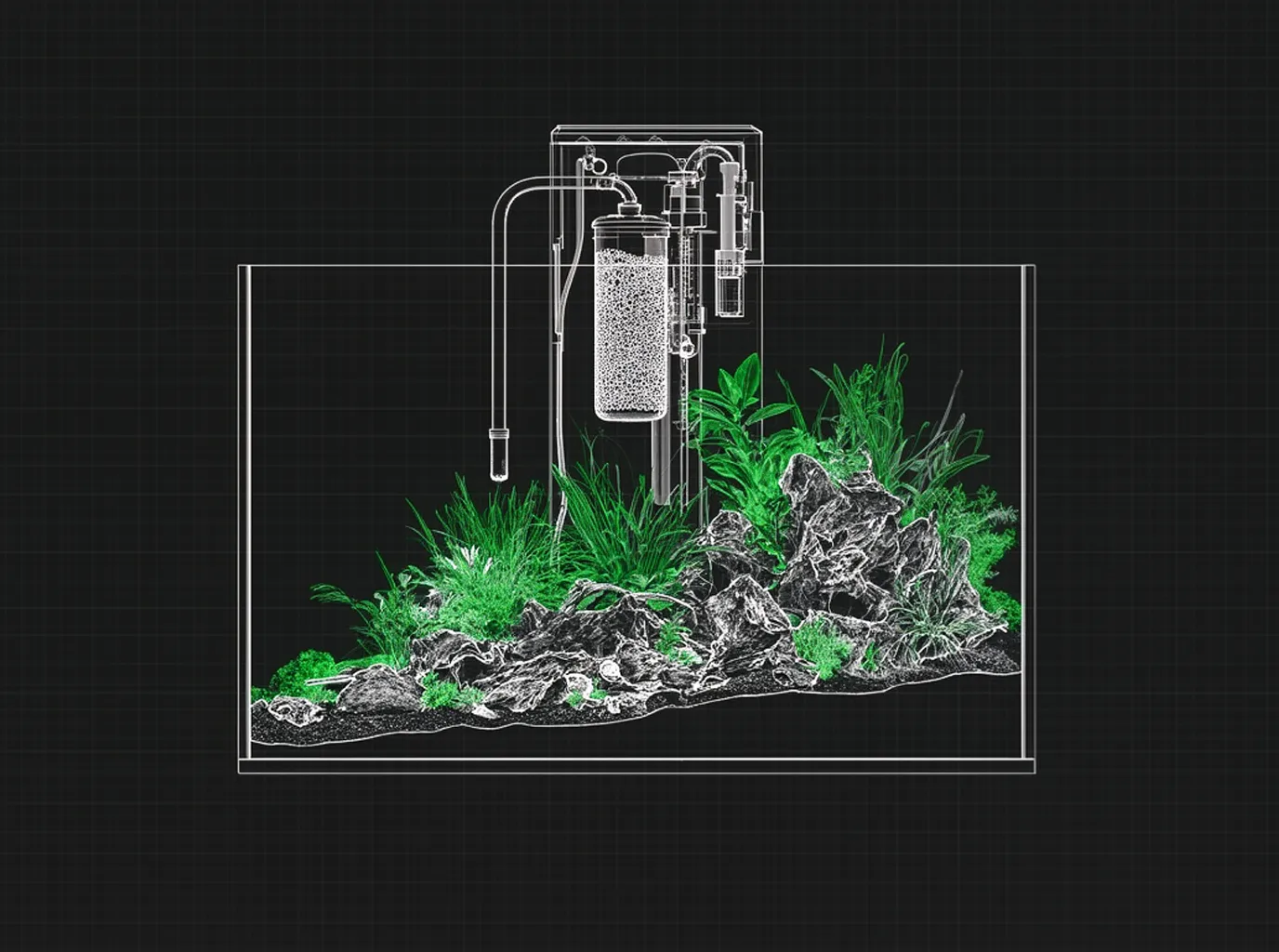
Water is drawn from the tank through an intake tube, travels down a hose to the canister body (usually stored inside the cabinet beneath the tank), passes through stacked media trays, and returns to the tank through an output hose and spray bar or lily pipe. The entire system is sealed and pressurized, meaning water is forced through the media rather than simply passing over it.
This pressurized flow is the key advantage. It ensures water contacts all the media in the canister, not just the surface layer. Mechanical filtration catches particulates in the first tray, and biological media in the lower trays processes ammonia and nitrite with consistent water contact. The sealed design also means no water-to-air interface inside the filter, which eliminates gas exchange within the unit itself.
Common canister brands include Oase, Eheim, Fluval, and SunSun. Sizes range from compact models for nano tanks (under 100 liters) to large units rated for 400 liters or more.
How HOB Filters Work
HOB filters are the most common filter type for aquariums under 200 liters. They hang on the back rim of the tank with the intake tube submerged and the filter body sitting outside.
Water is pulled up through the intake by an impeller, passed through a small media chamber (typically containing a cartridge, sponge, or loose media), and returned to the tank by flowing over a spillway back into the aquarium. The return flow creates a small waterfall effect as water drops from the spillway back to the surface.
This waterfall return is both the defining feature and the main tradeoff of HOB filters. It creates significant surface agitation, which is excellent for gas exchange (oxygenation) but problematic for CO2 retention in injected tanks. Almost always, an HOB filter will off-gas more dissolved CO2 than a canister with a submerged return.
Popular HOB brands include AquaClear, Seachem Tidal, Fluval, and Marineland. The AquaClear series in particular is well-regarded because it uses customizable loose media rather than proprietary cartridges.
Filtration Capacity
The volume of media a filter can hold directly determines its biological filtration capacity. More media surface area means more space for beneficial bacteria, which means more ammonia and nitrite processing.
Canister Advantage
Canister filters hold significantly more media than HOB filters rated for the same tank size. A canister rated for a 200-liter tank typically holds 3 to 6 liters of media across multiple trays. An HOB rated for the same tank might hold 0.5 to 1.5 liters in its single chamber.
This extra media volume provides a larger biological filtration buffer. In practice, canister-filtered tanks recover faster from bioload spikes (adding new fish, overfeeding) because the bacterial colony is proportionally larger relative to the ammonia input. You will often notice that canister-filtered tanks maintain more stable water parameters during the disruptions that cause mini-cycles in HOB-filtered tanks.
The multiple tray design also allows media specialization. A typical canister setup runs coarse sponge in the first tray (mechanical), ceramic rings or bio balls in the middle trays (biological), and fine filter floss or polishing pads in the last tray (water clarity). This layered approach is difficult to replicate in the compact single chamber of an HOB.
HOB Limitations
HOB filters work well for tanks with moderate bioloads, but their smaller media volume means less biological reserve. In heavily stocked planted tanks or tanks running CO2 (where bacterial activity increases alongside plant growth), an HOB can become the bottleneck.
Some HOB models (AquaClear, Seachem Tidal) allow custom media loading, which helps maximize the available space. Replacing the stock cartridge with a sponge and ceramic rings significantly improves biological filtration compared to the default setup. If you are running an HOB, this swap is one of the best upgrades you can make.
Flow and Distribution
How water moves through your tank affects nutrient distribution, CO2 delivery, and waste removal. Both filter types produce very different flow patterns.
Canister Flow
Canister filters return water through a submerged outlet, typically a spray bar, lily pipe, or jet nozzle positioned below the waterline. This creates a circulation pattern within the tank without breaking the surface.
Spray bars distribute flow across a wide area, creating gentle, even circulation. Lily pipes concentrate flow into a smooth, directional stream that can be aimed to create a specific current pattern. Both options keep surface disturbance minimal, which is critical for CO2 retention in injected tanks.
The ability to position the intake and output independently gives you control over circulation. In most planted tanks, the intake is placed at one end and the output at the opposite end, creating a unidirectional flow that carries nutrients and CO2 across the entire tank.
HOB Flow
HOB filters return water from the spillway at the back of the tank, creating a top-down flow pattern. The current is strongest near the surface and weakens toward the bottom. This means the lower portions of the tank, where most plants are rooted, often receive less circulation.
In tanks under 60 liters, this is rarely an issue because the distances are small. In larger tanks, the uneven flow distribution can create dead zones at the front bottom corners where detritus accumulates and CO2 disperses poorly. If you are running an HOB on a larger tank, adding a small circulation pump or powerhead at the opposite end helps balance the flow.
The flow rate you need for a planted tank is typically 4 to 6 times the tank volume per hour. Both filter types can achieve this, but canister filters distribute that flow more evenly throughout the water column.
CO2 Retention
For tanks running pressurized CO2, the filter's impact on gas exchange is one of the most important considerations. This is where the difference between canister and HOB becomes decisive for many planted tank setups.
Why Surface Agitation Matters
CO2 dissolves into water and stays dissolved only if the water surface is relatively calm. Surface agitation increases the rate at which dissolved gases exchange with the atmosphere. Since atmospheric CO2 concentration is far lower than what we inject into a planted tank, surface agitation causes net CO2 loss (off-gassing).
Canister: Minimal Off-Gassing
Canister filters with submerged returns (lily pipes, spray bars positioned below the surface) create minimal surface agitation. This allows injected CO2 to remain dissolved and reach the target concentration (typically 30 ppm, shown by a green drop checker) without excessive injection rates.
Many canister setups also support inline CO2 diffusers, which inject CO2 directly into the filter return line. The pressurized flow within the hose dissolves CO2 more efficiently than in-tank diffusers, and the dissolved CO2 enters the aquarium already mixed into the water stream. This is the most efficient CO2 delivery method available for home aquariums.
HOB: Significant Off-Gassing
The waterfall return of an HOB filter is essentially a degassing mechanism. Water falling from the spillway to the surface breaks the surface tension and exposes a large water surface area to the air. In practice, HOB filters can reduce effective CO2 levels by 30 to 50 percent compared to the same injection rate with a canister filter.
If you run CO2 with an HOB, you will need to inject significantly more CO2 to reach the same dissolved concentration. This wastes CO2, increases running costs, and makes it harder to maintain stable CO2 levels throughout the photoperiod.
Some aquarists modify HOB filters by raising the water level until the spillway is submerged, eliminating the waterfall effect. This works but reduces surface oxygenation, which can stress fish in tanks with higher bioloads.
For non-CO2 planted tanks (low-tech setups), the surface agitation from an HOB is actually beneficial. It drives oxygen exchange and helps maintain healthy dissolved oxygen levels for fish. In tanks without CO2 injection, the off-gassing concern disappears entirely, and an HOB's natural aeration becomes an advantage.
Noise and Aesthetics
How a filter looks and sounds matters for tanks displayed in living spaces. In most setups, the filter runs 24 hours a day, making noise a constant factor.
Canister: Out of Sight
Canister filters are stored inside the tank cabinet or stand, making them invisible during normal viewing. The only visible components are the intake and output tubes inside the tank. With glass lily pipes or stainless steel fittings, these can be made nearly unnoticeable.
Noise-wise, quality canister filters (Oase, Eheim Classic) are nearly silent. The sealed, water-filled design dampens vibration. Cheaper models (some SunSun units) may develop impeller rattle over time, but even these are quieter than most HOB filters.
HOB: Visible and Audible
HOB filters sit behind the tank with the motor housing visible above the rim. On open-top tanks, the filter body is in plain sight. For aquascapers who prioritize a clean visual presentation, this can be a dealbreaker.
The waterfall return creates a constant trickling or splashing sound. Some people find this pleasant (like a small fountain), but in quiet rooms or bedrooms, it can be disruptive. The noise increases as water evaporates and the drop distance between spillway and surface grows.
Maintenance
Both filter types need regular cleaning to maintain flow and biological filtration. The approach differs significantly, and ease of maintenance matters for long-term consistency.
Canister Maintenance
Canister filters need cleaning every 2 to 4 months depending on bioload and tank size. The process involves disconnecting hoses, carrying the canister to a sink, opening the housing, and rinsing media in dechlorinated or tank water.
This is more involved than HOB cleaning, and some aquarists postpone it because the process feels cumbersome. Postponing canister maintenance reduces flow rate as mechanical media clogs, which reduces filtration efficiency and circulation. In planted tanks, reduced flow means reduced CO2 and nutrient distribution.
The key to cleaning a filter safely is never rinsing biological media in untreated tap water. Chlorine kills beneficial bacteria instantly. Rinse sponges and bio media in a bucket of tank water removed during a water change.
Quick-disconnect fittings (standard on most modern canisters) make the disconnection process much easier. If your canister lacks quick disconnects, aftermarket valves are worth the investment.
HOB Maintenance
HOB filters are significantly easier to maintain. Lift the lid, pull out the media, rinse or replace, and put it back. The entire process takes 2 to 3 minutes without disconnecting anything.
This ease of maintenance is one of the strongest arguments for HOB filters. Aquarists who maintain HOBs tend to clean them more frequently, which keeps flow rates consistent. A well-maintained HOB often outperforms a neglected canister in real-world conditions.
If your HOB uses proprietary cartridges, consider switching to reusable sponge and loose media. Cartridge replacement throws away the bacterial colony each time, which can trigger mini-cycles. Custom media that you rinse rather than replace maintains biological continuity.
Cost Comparison
The price difference between canister and HOB filters is substantial, both upfront and over time.
Upfront Cost
A quality HOB filter (AquaClear 50, Seachem Tidal 55) costs $30 to $60 USD. A comparable canister filter (Oase BioMaster 250, Eheim Classic 250, Fluval 207) costs $80 to $180 USD. Budget canisters (SunSun, Polar Aurora) run $40 to $70 but sacrifice build quality and longevity.
Ongoing Cost
HOB filters with proprietary cartridges generate recurring media costs ($5 to $15 every 4 to 6 weeks). Switching to reusable media eliminates this. Canister filters use durable media (ceramic rings, sponges) that lasts years, making their ongoing cost minimal.
Electricity consumption is comparable between similarly rated models. Both types use small, low-wattage pumps.
Long-Term Value
Over a 3-year period, a canister filter with durable media typically costs less per year than an HOB with cartridge replacements. The canister's higher upfront cost amortizes across its longer lifespan (5 to 10 years for quality models). HOB motors tend to have shorter lifespans (2 to 5 years), though this varies by brand and maintenance.
When to Choose a Canister Filter
Canister filters are the better choice when the setup demands higher filtration capacity, CO2 compatibility, or clean aesthetics.
Choose a canister when:
- Your tank is 100 liters or larger
- You inject CO2 and need minimal surface agitation
- You want to run inline CO2 diffusers or inline heaters
- You prioritize a clean, equipment-free look inside the tank
- Your bioload is moderate to high (community tank with root-heavy planting)
- You want maximum biological filtration capacity for long-term stability
In most high-tech planted tanks, a canister filter is considered standard equipment rather than an upgrade. The CO2 retention advantage alone justifies the price difference for anyone running pressurized injection.
When to Choose an HOB Filter
HOB filters are practical, effective, and the right choice for many planted tank setups, especially when simplicity and cost matter more than maximum performance.
Choose an HOB when:
- Your tank is under 100 liters
- You are running a low-tech setup without CO2 injection
- You want easy, quick maintenance access
- Budget is a primary consideration
- You keep the tank in a location where the back is not prominently visible
- Your plant selection is primarily hardy species (Anubias, Java Fern, Cryptocoryne) that do not require optimized flow patterns
An HOB filter on a well-maintained low-tech tank with undemanding plants will perform excellently. The simplicity encourages more frequent maintenance, which often matters more than raw filtration capacity for long-term tank health.
Can You Use Both?
Some aquarists run a canister and an HOB on the same tank. This is more common on larger tanks (200 liters and above) where a single filter may not provide adequate flow coverage.
The canister handles primary biological filtration and provides submerged, directional flow. The HOB acts as a secondary mechanical filter and provides supplemental surface oxygenation. This combination covers both needs but adds complexity and cost that most tanks do not require.
If you find that a single canister is not providing enough flow, increasing the canister size or adding a circulation pump is usually more practical than adding an HOB alongside it.
Advanced: Biological Filtration Efficiency
The pressurized flow of a canister filter forces water through the media rather than allowing it to find the path of least resistance. This means a higher percentage of the media surface area is actively colonized by bacteria and consistently exposed to ammonia-carrying water.
In an HOB filter, water tends to channel through the loosest media paths. Areas of tightly packed media or dead corners receive less flow and contribute less to biological processing. This is why HOB filters, despite having some customizable media space, often underperform canisters with equivalent total media volume.
Canister filters also maintain more stable conditions for bacterial colonies. The sealed, dark environment inside the canister has consistent temperature, flow, and oxygen levels. HOB filters expose media to light, temperature fluctuations (near the tank rim and lamp), and variable water levels as evaporation changes the flow dynamics.
This stability difference explains why canister-filtered tanks tend to handle disruptions (medication, power outages, feeding mistakes) with less parameter instability. The bacterial colony in a canister is larger and more protected, giving it greater resilience.
Common Myths
"HOB filters cannot grow plants." HOB filters absolutely support healthy planted tanks. Thousands of thriving low-tech setups run HOB filters with excellent results. The limitation is specifically around CO2 retention, not general plant health. Without CO2 injection, an HOB is entirely adequate.
"Canister filters are too complicated for beginners." Modern canister filters are straightforward to set up and maintain. The initial setup takes 20 to 30 minutes, and maintenance every 2 to 3 months takes about the same. The learning curve is minimal compared to the long-term benefits.
"You need to clean your filter every week." Both canister and HOB filters function best with infrequent cleaning (every 4 to 12 weeks depending on bioload). Over-cleaning disrupts bacterial colonies. The goal is to maintain flow, not sterilize the media. Rinse gently in tank water and leave the biological media largely undisturbed.
"Bigger filters are always better." A filter rated for double your tank volume sounds like extra safety, but excessive flow can stress fish, uproot plants, and create turbulence that disrupts CO2 distribution. Match the filter to your tank size and adjust the flow with the built-in valve or spray bar configuration.
FAQ
Which filter type is quieter?
Canister filters are significantly quieter in most cases. The sealed design and cabinet placement muffle vibration and motor noise. HOB filters produce audible water flow noise from the spillway, which varies with water level. For bedroom or office tanks, canisters are the better choice.
Can I use an HOB filter with CO2 injection?
You can, but you will lose a significant amount of injected CO2 through surface agitation. Expect to use 30 to 50 percent more CO2 to achieve the same dissolved concentration compared to a canister with a submerged return. For high-tech setups where CO2 optimization matters, a canister is the more efficient option.
How often should I clean each filter type?
Both types should be cleaned every 4 to 12 weeks depending on bioload. HOB filters may need more frequent mechanical media rinsing because their smaller chambers clog faster. Canister filters can go longer between cleanings but should not be neglected past 3 to 4 months.
Do I need a prefilter sponge on a canister intake?
A prefilter sponge on the canister intake catches large debris before it enters the hose, reducing how often you need to open the canister for cleaning. It also protects small fish and shrimp from being drawn in. The tradeoff is that the sponge itself needs rinsing every 1 to 2 weeks as it collects debris and restricts flow.
Is a sponge filter a viable alternative to both?
Sponge filters work well for breeding tanks, shrimp tanks, and small low-tech setups. They provide biological filtration and gentle flow but lack mechanical filtration capacity and create surface agitation. For planted tanks larger than 40 liters or any tank with CO2, a canister or HOB is the better choice.
What size canister filter do I need?
Choose a canister rated for 1.5 to 2 times your tank volume. For a 100-liter tank, a filter rated for 150 to 200 liters provides adequate flow and media capacity with room for flow reduction as media accumulates debris between cleanings. Check that the resulting flow rate falls within the 4 to 6 times turnover range for planted tanks.