
Aquascaping Styles: Nature, Iwagumi, Dutch
Quick Summary
Aquascaping is the art of designing the layout of a planted aquarium. It goes beyond randomly placing plants and rocks. Each aquascaping style follows specific principles of composition, plant selection, and hardscape placement that create distinct visual effects.
Here is what to know before choosing a style:
- Every style has rules, but none are rigid. Understanding the principles gives you a foundation. Breaking them deliberately is how personal style develops.
- Your tank dimensions, lighting, and skill level narrow the options. An Iwagumi layout demands high light and CO2. A jungle scape works in almost any setup.
- Hardscape comes first. In every style, the rock and wood structure defines the layout before a single plant goes in.
- Maintenance demands vary dramatically. A Dutch scape requires weekly trimming. A jungle scape rewards neglect. Choose a style that matches your commitment level.
Why Aquascaping Style Matters
Most planted tanks start the same way. The aquarist buys plants that look interesting, places them where there is space, and hopes the result looks good. Within a few months, the fast growers have overtaken the slow growers, the foreground is shaded by the background, and the tank looks chaotic rather than designed.
In practice, understanding aquascaping styles solves this problem before it starts. Each style provides a blueprint for plant placement, height progression, focal points, and negative space that creates a coherent visual result as the plants grow in.
You do not need to follow any style rigidly. But knowing why certain layouts work helps you avoid the common mistakes that turn a planted tank from a display into a maintenance headache.
The Core Composition Principles
Before diving into specific styles, there are composition principles that apply across all aquascaping approaches. These come from visual art and photography, and they work because of how the human eye processes visual information.
The Rule of Thirds
Divide your tank visually into a 3x3 grid. The strongest focal points sit at the intersections of these grid lines, not in the centre. A centred focal point feels static and predictable. An off-centre focal point creates visual tension and draws the eye naturally.
In most successful aquascapes, the primary focal point (the largest rock, the tallest wood piece, or the most dramatic plant) sits at the left or right third intersection, not dead centre. This applies regardless of style.
Height Progression
The eye naturally reads a planted tank from front to back. Foreground plants should be short (carpet plants, small Cryptocoryne). Midground plants are medium height (stem plant groupings, Anubias on wood). Background plants are tall (Vallisneria, tall stem plants, large Echinodorus).
Violating this progression blocks sight lines and makes the tank look flat. Even in styles that do not emphasise depth, maintaining a general front-to-back height increase creates visual clarity.
Negative Space
Empty space is as important as planted space. Negative space (open sandbed, unplanted substrate, gaps between plant groups) gives the eye room to rest and makes the planted areas more impactful.
Most beginners plant too densely from the start, filling every available spot. The result feels cluttered and overwhelming. Experienced aquascapers deliberately leave 30 to 50 percent of the substrate visible (depending on style), allowing the layout to breathe.
The Golden Ratio
The golden ratio (approximately 1:1.618) appears throughout successful aquascapes in the proportions between hardscape elements, the position of focal points, and the balance between planted and open areas. You do not need to measure it precisely. Understanding that asymmetric proportions feel more natural than symmetric ones is the practical takeaway.
A layout where the main hardscape occupies roughly 60 percent of the tank width with 40 percent open space feels more natural than a 50/50 split. Similarly, a layout with the tallest point at the one-third mark looks more dynamic than one with the peak centred.
Nature Style Aquascaping
Nature style, developed by Takashi Amano and popularised through Aqua Design Amano (ADA), is the most influential aquascaping approach in the hobby. It aims to recreate the feeling of a natural landscape within the aquarium, not by copying nature literally, but by capturing its essence through composition.
Core Principles
Nature style aquascapes are built on a few key ideas:
- The layout represents a scene from nature (a forest floor, a riverbank, a mountain range) abstracted into aquarium scale.
- Hardscape defines the structure. Rocks and driftwood create the skeleton of the layout. Plants are added to complement and soften the hardscape, not to replace it.
- Simplicity and restraint. Nature style uses a limited number of plant species (typically 3 to 7) planted in distinct groupings rather than mixed randomly.
- Negative space is essential. Open areas of substrate or sand represent water, clearings, or paths in the natural scene.
Hardscape
In a Nature style tank, the hardscape is the first thing you build and the most important element. Rocks and wood are placed before any water or plants enter the tank.
Common hardscape approaches:
- Concave layout. Hardscape and plants rise on both sides with a valley or open area in the centre. Creates depth and draws the eye into the middle distance.
- Convex layout. Hardscape and plants build to a central mound or island with open space on both sides. The focal point is a single mass in the centre or off-centre.
- Triangular layout. Hardscape and plants slope from one high corner diagonally to a low opposite corner. Creates a strong sense of direction and movement.
Use one type of rock and one type of wood per layout. Mixing rock types or wood types looks chaotic and unnatural. A single material used in various sizes creates visual cohesion.
Plant Selection
Nature style plant selection emphasises texture and form over colour variety:
- Foreground: Carpet plants (Hemianthus callitrichoides, Micranthemum Monte Carlo, Eleocharis) create a green floor.
- Midground: Mosses on wood and rock (Christmas moss, weeping moss), small Bucephalandra, Anubias petite.
- Background: Stem plants in monotypic groups (Rotala rotundifolia, Ludwigia, Hygrophila). Each species planted in its own distinct area, not mixed.
- Epiphytes: Ferns and Anubias attached to hardscape add vertical texture without planting in substrate.
The key is restraint. A Nature scape with 15 plant species looks like a plant collection. One with 5 species, each placed deliberately, looks like a landscape.
Maintenance
Nature style tanks require moderate to high maintenance. Stem plants need regular trimming (every 1 to 2 weeks) to maintain shape. Carpet plants need trimming to prevent lifting. Mosses need periodic pruning to keep them from overtaking hardscape details.
CO2 injection is standard for Nature style because carpet plants and the growth rates needed to fill in the layout demand it. Most Nature style tanks run high light with 30 ppm CO2.
Iwagumi Style
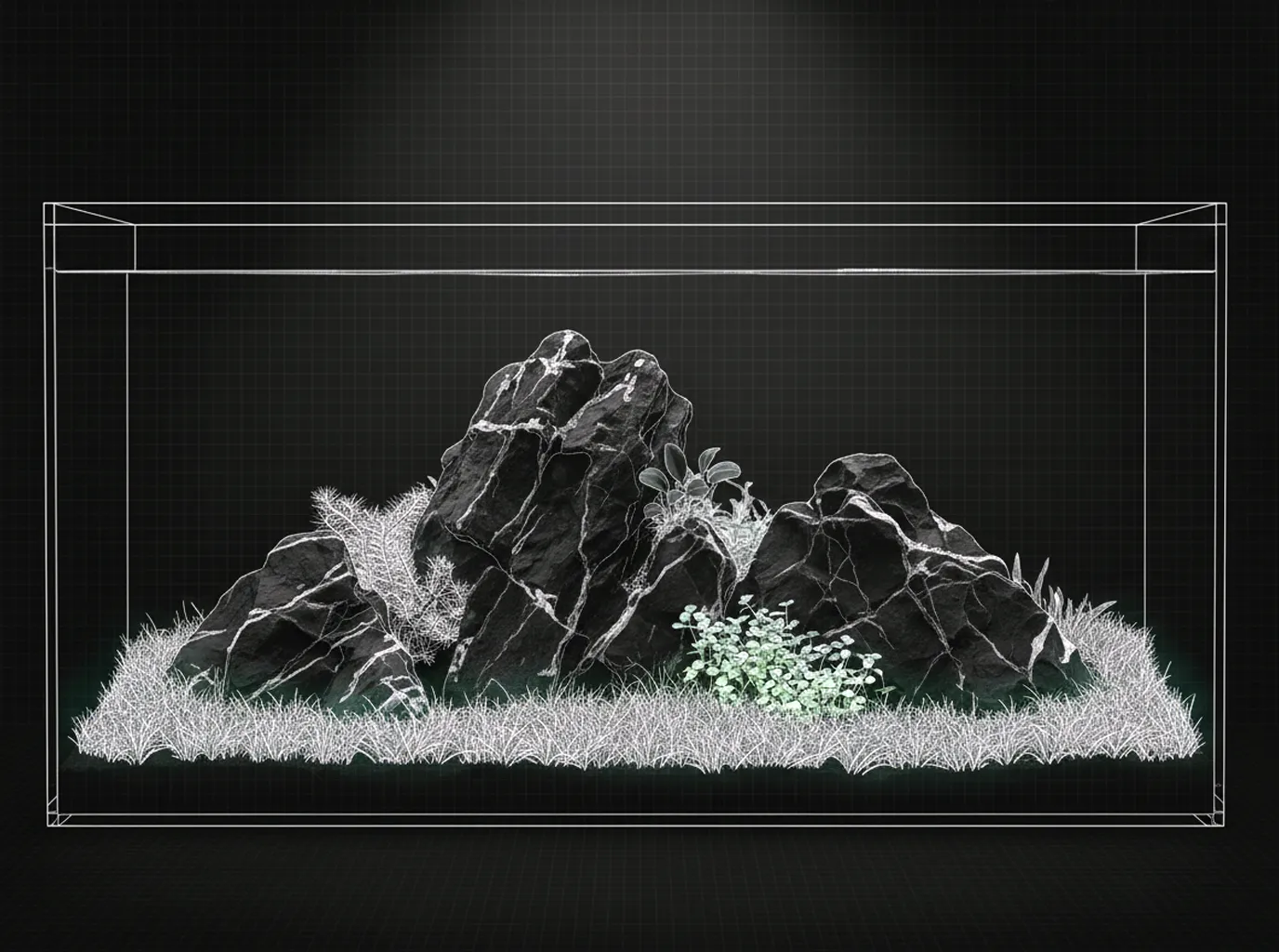
Iwagumi is a subset of Nature style that uses only stones and low-growing plants. Developed by Takashi Amano, it draws from Japanese rock garden aesthetics, where the arrangement of stones carries the entire composition.
Core Principles
Iwagumi is defined by minimalism and strict compositional rules:
- Stones are the focus. The layout is built entirely around stone placement. Plants serve as a supporting element (typically a single carpet species).
- Odd numbers of stones. Traditional Iwagumi uses an odd number of main stones (3, 5, or 7). Even numbers create visual symmetry that feels static.
- Named stone roles. Each stone has a purpose:
- Oyaishi (main stone). The largest and most dramatic stone. Placed at the primary focal point (typically the left or right third). Tilted slightly for dynamism.
- Fukuishi (secondary stone). The second largest. Placed to complement and balance the Oyaishi.
- Soeishi (supporting stone). Smaller stones that reinforce the visual weight of the main stones.
- Suteishi (sacrificial stone). Small stones placed to create natural transitions. They may become partially hidden by plants as the carpet fills in.
Plant Selection
Iwagumi uses very few plant species, often just one or two:
- Primary carpet: Hemianthus callitrichoides (HC Cuba), Eleocharis acicularis (dwarf hairgrass), or Micranthemum Monte Carlo.
- Accent (optional): A small contrasting plant at the base of the main stone, such as Glossostigma or Marsilea.
The simplicity is the point. The carpet creates a uniform green foreground that makes the stones the undeniable focal point.
Why Iwagumi Is Difficult
Iwagumi looks simple but is one of the hardest styles to execute and maintain:
- Carpet plants demand high light and CO2. Without both, the carpet grows unevenly or fails entirely.
- Algae is immediately visible. There is nowhere to hide. Any algae on the stones or carpet is front and centre.
- Cycling challenges. Aquasoil leaching ammonia in a tank with only carpet plants (low plant mass initially) makes the early weeks prone to algae blooms. Dense planting from the start or a dry start method helps.
- Limited biological filtration from plants. A carpet provides far less nutrient absorption than a tank full of stem plants. Parameter management and water changes must compensate.
In practice, Iwagumi is recommended for aquarists who have already mastered the fundamentals of CO2 injection, lighting, and nutrient management. It is not a beginner layout despite its simple appearance.
Dutch Style Aquascaping
Dutch style is the oldest formal aquascaping approach, originating in the Netherlands in the 1930s. It predates Nature style by decades and takes a fundamentally different approach: the focus is entirely on plants, not hardscape.
Core Principles
Dutch style treats the aquarium as a garden:
- No visible hardscape. Rocks and wood are not part of the visible composition. They may be used structurally beneath the substrate to create terracing, but they are hidden by plants.
- Dense, lush planting. Every area of the substrate is planted. There is no intentional negative space.
- Colour contrast and texture variety. Dutch scapes use many plant species (10 to 20+) specifically chosen for contrasting colours, leaf shapes, and textures.
- Organised rows and groups. Plants are arranged in distinct groups, often running diagonally from front to back, creating a layered tapestry effect.
- Street layout (Leiden street). A technique where a path of low plants runs diagonally from the front corner toward the back of the tank, creating a strong perspective line that enhances depth.
Plant Selection
Dutch style demands the widest plant variety of any aquascaping approach. Plant groups are chosen to contrast with their neighbours:
- Pair fine-textured plants (Rotala, Didiplis) next to broad-leaved plants (Hygrophila, Echinodorus)
- Alternate red and green species to create colour rhythm
- Use tall background plants (Limnophila aquatica, Hygrophila corymbosa) behind shorter midground groupings
- Foreground plants are typically low Cryptocoryne species or Lobelia cardinalis rather than carpets
Each plant group is trimmed into a defined shape, often domed or tapered, creating individual bushes within the larger composition. The effect is a garden viewed from above, compressed into a front-facing viewing plane.
Maintenance
Dutch style is the highest-maintenance aquascaping approach. Weekly trimming is essential to maintain the shape and proportions of each plant group. Fast-growing stem plants must be topped and replanted regularly. Slow growers must be protected from being shaded by neighbours.
This style requires high light, CO2 injection, and comprehensive nutrient dosing. The plant density and variety demand consistent, abundant resources.
In most tanks, a Dutch scape that is not trimmed for three weeks begins losing its compositional clarity. This is a style for aquarists who enjoy the weekly hands-on maintenance as part of the hobby.
Jungle Style
Jungle style is the least formal aquascaping approach and the most forgiving. It aims to create the impression of an overgrown, wild aquatic environment where plants grow freely and fill every space.
Core Principles
- Controlled chaos. The layout should look wild and natural, as if it grew without intervention. In practice, this requires some initial planning to ensure variety and prevent monoculture takeover.
- Minimal visible hardscape. Wood and rock may form the initial structure, but they become hidden as plants overgrow them.
- Diverse plant selection. Mixing species freely. Fast growers, slow growers, floating plants, epiphytes, stem plants, and rosette plants all coexist.
- Height variation is organic, not structured. Unlike Dutch or Nature style, there is no strict foreground-midground-background separation. Tall plants can appear in the midground. Short plants can be seen at the back if the viewer's eye finds a gap.
Why Jungle Style Works for Beginners
Jungle style is the most forgiving approach because:
- It does not require CO2. Many jungle-appropriate plants (Java fern, Anubias, Cryptocoryne, Vallisneria, hornwort) grow well in low-tech setups.
- Trimming is minimal. The goal is overgrowth. Occasional pruning to prevent one species from dominating is all that is needed.
- Imperfections are the aesthetic. A broken stem that regrows at an angle, a plant that propagates into a neighbour's space, or a patch of moss that spreads across a rock all contribute to the wild appearance.
- It hides equipment. Heaters, filter intakes, and thermometers disappear behind dense growth.
In practice, jungle style is the best starting point for aquarists who want a lush, planted tank without the precision demands of other styles.
Biotope Aquascaping
Biotope aquascaping recreates a specific natural habitat as accurately as possible. The goal is not abstract beauty but ecological accuracy: the fish, plants, substrate, water chemistry, and hardscape all match what would be found in a particular geographic location.
Core Principles
- Geographic accuracy. Every element matches a specific habitat (a blackwater stream in the Amazon, a rocky Lake Malawi shoreline, a Southeast Asian river pool).
- Species authenticity. Only plants and fish that coexist in the wild habitat are used.
- Water chemistry matching. pH, hardness, temperature, and tannin levels are adjusted to match the natural environment.
- Hardscape matching. Substrate, rock, and wood types reflect the natural environment. A Rio Negro biotope uses fine white sand and tangled driftwood with leaf litter, not volcanic rock and manicured carpet plants.
Practical Considerations
Biotope aquascaping requires research. You need to know what species coexist in the target habitat, what the water chemistry looks like, and what the physical environment includes. This makes it more of a research project than a design exercise.
The visual result can be stunning but unconventional. A blackwater biotope with tannin-stained brown water, leaf litter, and subdued lighting does not look like a typical planted tank. It looks like a window into a real environment, which is the point.
Biotope layouts are not typically competition aquascapes, but they are among the most ecologically meaningful and educational setups in the hobby.
Choosing Your Style
The right aquascaping style depends on your setup, your experience, and how much maintenance you want to commit to.
Here is a practical guide for choosing:
- New to planted tanks, low-tech setup: Jungle style. Forgiving, no CO2 required, minimal trimming.
- Comfortable with CO2 and lighting, moderate maintenance: Nature style. The broadest creative canvas with manageable upkeep.
- Experienced, enjoys precision work, high-tech setup: Dutch style or Iwagumi. Both demand consistent maintenance and advanced plant care.
- Interested in ecology over aesthetics: Biotope. Research-intensive but uniquely rewarding.
You will often notice that experienced aquascapers blend elements from multiple styles. A Nature-influenced layout with jungle density in the background. An Iwagumi core with Nature-style stem plant accents at the edges. The styles are starting points, not cages.
Getting Started: Practical Steps
Regardless of which style you choose, the process of building an aquascape follows the same sequence:
- Plan on paper. Sketch your layout before buying anything. Decide on focal point position, hardscape placement, and plant zones.
- Choose hardscape first. Buy rocks and wood that inspire you. Arrange them outside the tank until the composition feels right. Take photos from the viewing angle.
- Set the substrate. Create any slopes, terraces, or depth gradients before adding water. Use substrate retainers if needed to prevent levelling.
- Place hardscape in the tank. Transfer your dry arrangement into the tank. Adjust as needed. This is easier to do with no water in the tank.
- Plant. Work from background to foreground. Plant densely from the start (at least 70 to 80 percent of your final plant mass) to outcompete algae during the establishment phase.
- Fill and cycle. Add water slowly to avoid disturbing the layout. Begin the nitrogen cycle.
- Trim and refine. As plants grow in, trim to maintain the proportions and sight lines of your design. The first major trim usually happens 3 to 4 weeks after planting.
The most important advice for any style: start with the hardscape, not the plants. A strong hardscape composition can carry an aquascape even with simple plants. A weak hardscape cannot be saved by exotic species.
Common Myths
"You need expensive equipment for aquascaping." Good aquascaping is about composition, not equipment. A well-designed layout in a basic tank with adequate lighting outperforms a poorly designed one in a premium setup. Invest in quality hardscape materials before upgrading equipment.
"Aquascaping styles are strict rules you must follow." Styles are frameworks, not laws. Understanding the principles behind each style gives you tools. Combining elements from different styles or breaking rules deliberately is how personal expression develops.
"You need rare plants for a great aquascape." Some of the most successful competition aquascapes use common, inexpensive species. Rotala, Eleocharis, Java moss, and Cryptocoryne appear in award-winning layouts regularly. Plant placement and composition matter more than species rarity.
"More plant species means a better aquascape." Most Nature and Iwagumi styles use fewer than 7 species. Visual coherence comes from restraint, not variety. Too many species create visual noise. A well-placed group of 3 species can be more impactful than a scattered collection of 15.
"Aquascaping is only about appearance." A well-designed aquascape also functions better biologically. Proper height progression ensures all plants receive light. Adequate spacing prevents shading and nutrient competition. Good flow design reduces dead spots. Form and function overlap significantly.
FAQ
What is the easiest aquascaping style for beginners? Jungle style. It requires the least precision, works without CO2, and the overgrown aesthetic is forgiving of mistakes. Nature style with simple hardscape and hardy plants is the next step up.
Do I need CO2 for aquascaping? Not for jungle or basic Nature style with low-demand plants. Iwagumi and Dutch style require CO2 because their plant selections demand high growth rates. CO2 gives you more species options regardless of style.
How long does it take for an aquascape to grow in? Most aquascapes reach their intended look in 2 to 4 months with CO2 and high light. Low-tech setups take 4 to 8 months. Iwagumi carpet plants typically fill in within 6 to 10 weeks under optimal conditions.
Can I change my aquascape style later? Yes, but it usually means a full rescape (removing plants, rearranging hardscape, replanting). Partial style changes are possible (adding more structure to a jungle scape, removing hardscape visibility for a Dutch transition) but rarely seamless.
What size tank is best for aquascaping? Tanks between 10 and 75 gallons are the most common for aquascaping. Smaller tanks suit Iwagumi and nano Nature style. Larger tanks suit Dutch and complex Nature layouts. The 60 cm (approximately 17 gallons) rimless tank is the standard competition size and an excellent format for learning.
How do I create depth in a small tank? Slope the substrate from back (high, 4 to 5 inches) to front (low, 1 to 2 inches). Use smaller-leaved plants in the background and larger-leaved plants in the foreground (forced perspective). Place the hardscape slightly off-centre with diagonal sight lines running toward the back corner.
Should I use the dry start method for carpet plants? The dry start method (planting carpet plants in moist substrate without flooding the tank for 4 to 8 weeks) produces denser initial carpets and avoids the algae challenges of growing carpets submerged. It works well for HC Cuba, Monte Carlo, and Glossostigma. It adds time upfront but reduces problems later.